All Categories

Subcategories

  • RASTREANDO TENDENCIAS

    LatinNews 24 January 2014 Hits: 1126

    ARGENTINA | Pérdidas de Aerolíneas Argentinas en el 2013. El 16 de enero Mariano Recalde, el presidente de la aerolínea nacional Aerolíneas Argentinas, reveló que la firma reporto pérdidas por US$247m en el 2013. Desde que Aerolíneas y su subsidiaria, Austral, quedaron bajo control del gobierno en el 2008, ambas registraron pérdidas masivas año tras año a pesar del alto nivel de subsidios que reciben del Estado. De hecho, mantener las dos firmas funcionando le ha costado al Estado unos US$9mm desde el 2008.

    Pero a pesar de cerrar el año de nuevo en rojo, las pérdidas de Aerolíneas en realidad fueron un 44,1% menores que las registradas por la firma en el 2012. En verdad, presentando los resultados del 2013, Recalde dio una evaluación positiva de la situación de la afirma diciendo que: “Hemos alcanzado los objetivos establecidos en el presupuesto de la compañía, y en el plan de negocios, con un incremento de casi el 20% en el número de pasajeros y una tendencia hacia menos y menos asistencia del Estado”.

    Los resultados también muestran que las ventas generales para Aerolíneas y Austral, sumaron US$1,92mm, subiendo un 21,7% sobre la cifra de US$1,58mm registrada en el 2012. El número de vuelos, las horas de vuelo, y el número de pasajeros, también fueron mayores que las del año pasado, con incrementos del 16,3%, 14%, y 19,1%, respectivamente. Según Recalde, la expectativa es que esta tendencia hacia arriba continuará en el 2014. Como resultado él dijo que el gobierno espera expandir ambas flotas de transporte para que puedan servir a 10m de pasajeros cada una este año.

    Recalde también dijo que existen planes para incrementar el número de destinos que la compañía sirve, anunciando que desde marzo, Aerolíneas comenzará a volar desde Buenos Aires hasta la ciudad de Paraná, en la provincia de Entre Ríos, lo que significara que por primera vez en 25 años Aerolíneas volverá a volará a todas las 23 provincias de Argentina.

    También hay planes para abrir una nueva ruta a la ciudad brasilera de Curitiba, con la cual Aerolíneas intentará mejorar sus lazos con todo Brasil, a tiempo para la Copa Mundial de la Fifa de este año (aunque la construcción del estadio de Curitiba está retrasado para la fecha programada, y se comenta que la ciudad podría ser despojada de su condición de anfitriona de partidos); y para consolidar sus vuelos a la ciudad de Nueva York.

    Sin embargo, a pesar de las cifras positivas del año pasado, los resultados financieros destacan cuán dependiente es Aerolíneas de los subsidios del Estado. De acuerdo con datos del ministerio de economía, Aerolíneas y Austral gastaron todo su subsidio asignado para combustible para noviembre, requiriendo un desembolso adicional de US$39,8m a fin de que puedan seguir operando en diciembre. Todo esto sugiere que la factura del Estado para Aerolíneas continuará subiendo.

    • Acuerdo comercial Mercosur-UE

    El 21 de enero el canciller de Uruguay, Luis Almagro, dejó abierta la posibilidad de que uno o más países miembros del Mercado Común del Sur (Mercosur) podrían quedar excluidos de las negociaciones comerciales con la Unión Europea (UE) en un esfuerzo por facilitar las largamente estancadas conversaciones. Las negociaciones comerciales Mercosur-UE están siendo arrastradas desde el año 2000 con las dos partes aún incapaces de alcanzar un acuerdo final. Pero Almagro dijo que en un intento de expeditar el proceso, Mercosur ahora está manejando la idea de concluir “un acuerdo de tres países, o la firma de un acuerdo de un solo país” con aquellos inicialmente dejados fuera siendo incluidos más adelante. Según Almagro, esto será discutido en la próxima cumbre de jefes de estado del Mercosur, programada para realizarse a mediados de febrero.

  • TRACKING TRENDS

    LatinNews 05 February 2015 Hits: 1162

    ARGENTINA | Fernández in China

    Despite the furore surrounding the death of the prosecutor Alberto Nisman, an ankle injury, and a propensity to keep long-haul flights to an absolute minimum, President Cristina Fernández said “nothing would stand in the way” of her State visit to China this week.
    Successive Latin American heads of state have undertaken the pilgrimage to China since the start of the year, looking for large loans and big investment. Details of the exact accords struck have often been thin on the ground, but they all left claiming their visits were a resounding success. Fernández met China’s President Xi Jinping, with whom she ratified 20 bilateral deals signed in July and started work on 15 new agreements, including Chinese investment in Argentina’s oil and gas sector, and financing for new dams and a fourth nuclear power plant.
    Given Argentina’s perennially problematic economic situation and the urgent need for the scale of external assistance that only China seems willing or able to provide right now, Fernández made a remarkably ham-fisted attempt at humour during one of her frequent forays onto social media. Her tweet crudely mimicking Chinese accented Spanish garnered far more attention during the trip than any accords she signed, and suggests that the Nisman affair has, at best, clouded her judgement.

    Alluding to the 1,000 members of an audience she addressed at a conference, Fernández tweeted, roughly translating, “Did they only come for lice [rice] and petloleum [petroleum]?” She compounded this racially offensive tweet with a tweeted apology that was scarcely any more diplomatic: “Sorry, the levels of ridiculousness and absurdity are so high they can only be digested with humour.”

    Attempts were made to downplay the significance of the tweet. The executive director at the Argentine China chamber of commerce told Bloomberg that he did not “believe the Chinese are reading our President’s tweets all day”, as if they had not been picked up by pretty much all of the international media as a way to spice up reporting of yet another presidential foreign tour.

    China is unlikely to base its foreign trade and investment policy on a tweet. China has shown considerable flexibility with Venezuela failing to pay on time, for instance, which is a much more significant issue. But this sort of faux pas, insulting Argentina’s second biggest trading partner after Brazil, does raise serious questions about Fernández’s leadership. Opposition presidential candidates will seek to exploit this in the run-up to general elections on 25 October, by arguing that Kirchnerismo is a busted flush that urgently needs replacing in an attempt to undermine the bid of whichever candidate Fernández, who cannot stand for re-election, backs to succeed her.

  • COLOMBIA: Comienza nuevo cese al fuego de las Farc

    LatinNews 24 July 2015 Hits: 1045

    El 20 de julio las Fuerzas Armadas Revolucionarias de Colombia (Farc), el principal grupo guerrillero de Colombia, comenzó un nuevo cese al fuego unilateral. Este es el sexto cese al fuego unilateral de las Farc desde el lanzamiento de las actuales conversaciones de paz que mantiene con el gobierno de Colombia en Cuba desde fines del 2012. El mismo sería por cuatro meses, después de pasados los cuales, si se hicieron suficientes progresos en Cuba, el Presidente de Colombia, Juan Manuel Santos declararía un cese del fuego bilateral, o fracasará, junto con el proceso de paz. Si la dura retórica reciente de Santos no es suficiente para convencer a las Farc del peligro que enfrenta el proceso de paz, la caída en picada del apoyo del público a las conversaciones es muy clara, como para que todos la vean.

    Al anunciar el nuevo cese al fuego unilateral, las Farc dijeron que solamente duraría un mes, pero se espera que lo extenderán, particularmente porque Santos respondió anunciando una reducción en la intensidad de las operaciones militares para ‘reducir la escalada’ del conflicto armado interno. Siempre existe el riesgo de  que otro serio incidente en el conflicto armado pueda impactar de nuevo en las conversaciones, como ocurrió en meses recientes, no menos porque las Farc han dejado en claro que todas sus unidades guerrilleras tendrán la capacidad de ejercer una “legítima autodefensa” si ellas caen bajo ataque de los militares. Pero ambas partes ahora son plenamente conscientes de cuan precarias se han vuelto las perspectivas para la paz. La confianza pública en el proceso está en su punto más bajo, descendiendo agudamente desde que las guerrillas de las Farc mataron a 11 soldados (las Farc afirmaron que fue por ‘autodefensa’) en abril, durante su último cese del fuego unilateral [IL-15-15].

  • VENEZUELA: Maduro pulls off propaganda coup in Caribbean waters

    LatinNews 28 May 2020 Hits: 3850

    Escorted by the Venezuelan navy and air force, five Iranian tankers began arriving at Venezuelan ports from 24 May onwards, carrying an estimated 1.5m barrels of petrol between them. The tankers ran the gauntlet of an increased US naval presence in Caribbean waters. As the US applies economic sanctions against both Iran and Venezuela, there were fears President Donald Trump might order naval action to intercept the incoming flotilla. In the end, the ships were allowed to pass.

    Both Iran and Venezuela celebrated the petrol delivery as a great victory. Iran’s President Hassan Rouhani said any US attempt to interfere with his country’s trade with Venezuela would be “illegal”. Earlier he had warned that if the US created “problems” for the Iranian ships, Iran would cause reciprocal difficulties for US ships - taken as a reference to the stand-off in August 2019 after the seizure of an Iranian tanker in Gibraltar by the British authorities, and Iran’s subsequent seizure of a British-flagged tanker in the Gulf: both ships were eventually released after negotiations. Venezuela’s de facto president Nicolás Maduro tweeted “Thanks Iran”, adding that in the face of US opposition “only the brotherhood of free peoples will save us”.

    While the deliveries are clearly a setback for US efforts to isolate Venezuela, they can hardly be taken as a sign of Venezuelan strength. Venezuela, a country with the world’s largest oil reserves, has entirely lost its domestic refining capacity due to a combination of mismanagement and a lack of maintenance, spare parts, and key chemicals at the Amuay and Cardón refineries in the north-western state of Falcón.

    The Venezuelan government first turned to Rosneft for help but in March the Russian state oil company, concerned about the impact of US sanctions on two of its international subsidiaries, decided to withdraw from Venezuela. Iran’s Mahan Air then began direct flights to Falcón state bringing in equipment and technicians to try and get the refineries up and running, apparently without success. It was at that point that the two countries opted for delivering petrol by tanker.

    At best these deliveries look like a short-term fix. Even taking into account lower levels of petrol consumption in Venezuela because of the Covid-19 lockdown, the five tankers represent only two weeks to a month’s worth of supplies. There are reports that Venezuela paid for the shipments in gold, an attractive proposition for Iran at a time when it has a glut of oil and fuels on its hands, due to the slump in global demand.

    It is hard, however, to see this kind of trade being sustainable in the long-term. The US may still find ways of tightening its sanctions – a Chinese company supplying refinery spare parts has been blacklisted by the US Treasury. Venezuela does not have an unlimited supply of gold, and as the global economy begins to recover Iran may need to switch back to serving its traditional customers.

    Houston-based Venezuelan oil expert Francisco Monaldi told the New York Times on 25 May that “The Iranians, as soon as they get their quarantine lifted, will not have the capacity to supply Venezuela with gasoline. I don’t think it is something that can be continued systematically.” Speaking on 24 May US State Department spokeswoman Morgan Ortagus criticised the deal saying that “Venezuelans need free and fair presidential elections leading to democracy and economic recovery, not Maduro’s expensive deals with another pariah state”.

    Iran

    “Venezuela and Iran both want peace,” Maduro said in a televised state address thanking the country for its “solidarity”. “We are two revolutionary peoples who will never kneel down before North American imperialism…we have the right to trade freely,” he added.

  • TRACKING TRENDS

    Patrick de Courcy 19 January 2023 Hits: 3793

    ECUADOR | Tax reform starts paying off. The director of Ecuador’s tax authority (SRI), Francisco Briones Rugel, announced on 18 January that the government’s tax take increased by 22.8% in 2022 compared with the previous year, totalling US$17.16bn.

    Briones attributed 16.3% of this increase to the economic reactivation following the waning of the coronavirus (Covid-19) pandemic, and 6.5% to the tax reform which President Guillermo Lasso signed into law in November 2021, which predominantly raised taxes on higher earners.


    VENEZUELA | Pdvsa freezes oil exports. Colonel Pedro Rafael Tellechea, the new president of Venezuela’s state-owned oil company Petróleos de Venezuela (Pdvsa), has suspended most of the company’s oil exports, according to an internal document cited by Reuters on 17 January. The suspension will reportedly remain in force while export contracts are reviewed. According to Reuters, the freeze has so far affected shipments to Asian refineries, while cargoes carried by US company Chevron and Cuba’s Cubametales have not been impacted.

    Tellechea was named as Pdvsa’s president on 6 January, replacing Asdrúbal Chávez – the cousin of former president Hugo Chávez (1999-2013) and a former oil minister and vice president of Pdvsa. Chávez had held the position since April 2020.

    Tellechea had headed state petrochemical company Petroquímica de Venezuela (Pequiven) prior to his appointment at Pdvsa – experience which President Nicolás Maduro said would enable him to “consolidate the momentum of the national oil industry”. Chávez, Maduro said, would be given “other responsibilities”. Maduro also replaced the entire Pdvsa executive board, without offering any reason for the shakeup.

    Tellechea has a massive job on his hands. Oil production in Venezuela, which has been on a downward trend for years, has fallen off in recent months, with the government claiming to have produced 717,000 barrels per day (bpd) in October, 693,000 bpd in November, and just 669,000 bpd in December.

    Much of the country’s oil infrastructure is in a state of disrepair and huge investment is required if Pdvsa is to stop the rot. Maduro, not for the first or last time, announced ambitious plans recently for ramping up crude production, on this occasion after the US government announced the easing of some sanctions, with oil giant Chevron authorised to resume its operations in Venezuela for export to the US [WR-22-48].

  • Risk pointers

    LatinNews 15 February 2012 Hits: 192

    *** Israel reconstituting alternative ‘alliance of the periphery’.  Before the fall of the Shah of Iran, Israel ‘s strategy to mitigate the consequences of being surrounded by enemy states was to forge an ‘alliance of the periphery’ at the core of which were the non-Arab regional states Iran and Turkey.  With both Iran and Turkey now hostile, Israel has been looking for other potential friends, including Cyprus, which Prime Minister Binyamin Netanyahu is visiting this week.  This is a remarkable turn-around, as Cyprus, like Greece, was long seen as one of the more unfriendly European states.  But now Israel is exploiting the antipathy between Turkey and Cyprus/Greece to forge close ties.  It is also doing this with Romania and Bulgaria.  With tension between Cyprus and Turkey mounting over Cyprus’s intention to develop off-shore natural gas deposits without first settling the dispute with Turkish-backed Northern Cyprus, Cyprus is gratefully embracing Israel’s support.

    *** Russia’s problem with Russian-made weapons.  On 11 January, Russia’s deputy prime minister, and former representative to Nato, Dmitriy Rogozin, said that Russia must stop buying foreign arms, only doing so as an exception.  Unfortunately for Rogozin, the Russian Defence Ministry is not convinced.  Chief of the General Staff General Nikolay Makarov made it clear in remarks on 14 February that Russia’s arms manufacturers were inferior.  Referring to domestically manufactured weapons, he said: “We have practically stopped buying all the products for the ground forces because we are not happy with a single model.”  One particular area of concern for Makarov is that Russia’s defence industry has traditionally focused on the firing capacity of armoured vehicles and their mobility and manoeuvrability while “forgetting about people’s lives”.  According to Makarov, “the degree of personnel protection is extremely low”.  He said: “Any small mine explosion will lead to the entire crew being killed.”

    *** Clutching at straws over Iran.   A former chief of Israel’s Mossad intelligence agency, Ephraim Halevy, has been arguing that there is another way – other than sanctions or war - of stopping Iran going nuclear, and that is to do a deal with Russia over Syria.  Writing in the 15 February Yedioth Ahronoth, he argued that such a deal (under which Assad would have to go but Russia would be given a special position in post-Assad Syria) would deprive Iran of its position in Syria and that “the Iranian threat would be removed”.  Something seems to be missing from this argument, because if the removal of Iranian influence from Syria were a certain way to neutralizing Iran’s nuclear plans then it would be difficult to see what all the fuss is about.  Perhaps what Halevy has in mind is that Russia might act to prevent Iran going nuclear if Moscow were given special rights in post-Assad Syria.  But again, it is hard to believe that Moscow has not already been given every possible incentive to bring its influence to bear on Tehran.  Increasingly, the opponents of military action seem to be clutching at straws.

  • Risk pointers

    LatinNews 23 January 2013 Hits: 459

    *** Hint of Taleban compromise.  A former Taleban envoy to Pakistan, Mullah Abdossalam Zaif, published an article last week hinting at a willingness to compromise.  The article listed “six basic and important fundamentals for peace”.  For Zaif, the six fundamentals are:

    - A peace strategy to replace the war strategy

    - The future government to be inclusive

    - The constitution to be revised

    - Afghan forces to become truly national

    - No foreign forces to stay

    - Sharia or Islamic law to be enforced.

    Zaif maintains that the main sides in the Afghan struggle do not have problems with these six fundamentals and any differences are over “minor issues”.  He bases this assertion on the experience of the recent inter-Afghan talks in Paris.  However, Zaif said that the present administration of President Karzai remains an impediment.  He said: “In my opinion there is hope for peace in the future, but the element about which I am unsure is the Kabul administration, whose leadership is looking to fish in troubled waters.”

    The comments are interesting in that they do not reflect the usual uncompromising Taleban stance.  However, Zaif is realistic about the effect that the imminent foreign withdrawal is having on rival groups.  He said: “Those who fear the Taleban’s return have started re-arming themselves with new weapons in different parts of the country.  This process is in full swing, particularly in the northern and western provinces.”  Unless all groups settle for peace, Zaif warns, renewed civil war is likely.

    * Muslim Brotherhood warning to Jordan’s King Abdallah.  Speaking to Al-Sharq al-Awsat, the deputy-controller general of the Muslim Brotherhood in Jordan, Zaki Ben Rsheid, said: “We will give this warning...for the regime to carry out a comprehensive reform process as otherwise the popular movements...will sit down and decide their next steps which are bringing down the regime.”

    Ben Rsheid said that the 23 January parliamentary elections, which the MB has boycotted, were a “farce” and that “the state’s future is bleak as there are no programmes, visions, and plans for administering the state”.

    King Abdallah has said that for the first time he will consult MPs before appointing the prime minister, but there will be no opposition MPs in parliament to challenge his choice.

  • TRACKING TRENDS

    LatinNews 05 December 2013 Hits: 881

    CHILE | Shifting focus from Argentina to Brazil. On 2 December Chile’s foreign economic relations directorate (Direcon) reported that Brazil has now become the main recipient of Chilean investment, overtaking Argentina for the first time. Historically, Chilean businesses have had close links with their neighbours across the Andes, but according to Direcon since 2000 there has been a shift towards increased investment in Brazil rather than in Argentina. Data compiled by Direcon since 1990 shows that Chilean Foreign Direct Investment (FDI) in Brazil in the 1990-1999 period represented 16% of all Chilean FDI outflows, while in the 2000-2009 period this figure had increased to 31%. Moreover in the 2010-June 2013 period, Chilean FDI in Brazil represented over half (53%) of the total outflow. To put it into context, Direcon points out that since 1990 Chilean FDI in Brazil is an accumulated US$21.9bn, presenting 25.4% of all FDI going into Brazil. In comparison, Chilean FDI in Argentina during the period was US$16.8bn, or 19.5% of the total. Highlighting the fact that Chilean investment is not concentrated on a single sector but has been directed towards various sectors, led by industry (35.8% of the total) and services (32.4%), Direcon said that the investment was instrumental in promoting Brazil’s economic development. According to the study, Chilean investment in Brazil has generated 83,858 jobs, 67.6% direct and 32.4% indirect, during this period. Commenting on the study’s findings, the head of Direcon head, Alvaro Jana, noted: “Brazil is a very important trade partner for Chile in the region... it is market with great growth potential... and it is an attractive destination for Chilean capital”.

    URUGUAY| Low investor confidence. On 3 December Uruguay’s industrial chamber (CIU) released the latest instalment of its annual investor confidence survey, in which 44.2% of respondents said that they expected to invest significantly less in the country in 2014 compared to 2013. According to the CIU, this is the highest percentage of investors expressing a negative investment outlook in Uruguay since the CIU first began polling the sector back in 2004. Similarly, 29.1% of respondents said they expected to increase their investments next year, the lowest proportion ever. This will be cause for concern for the government led by President José Mujica. According to latest figures from the national statistics institute (INE), industrial production in the 12 months to November was down 0.1% year-on-year, the first drop industrial production since 2010.  The CIU noted that investors cited a series of internal factors weighing on their decisions including current market restrictions and uncertainty over local labour relations and other economic policy measures. Uruguay’s real GDP growth was just 3.9% last year, a significant slowdown from the 6.5% recorded in 2011; and it is expected to further slow to 3.5% this year on weaker domestic and external demand. Lower domestic demand was identified as an investment-limiting factor by 60% of the survey’s respondents. Meanwhile 59% identified uncertain labour relations as a limiting factor. The Mujica government has been unable to bring to a conclusion the tri-partite collective salary negotiations (between the government, business leaders and workers’ unions) to set next year’s salary levels. The talks failed to produce results before the 30 September deadline and are still underway. Concluding the negotiations is important to the ruling Frente Amplio leftist coalition as it tries to shore up investor confidence and convince the private sector that it can revert the low economic growth trend ahead of next year’s general elections. Incidentally, 47% of the CIU poll respondents said that political uncertainty ahead of the elections was another limiting factor.

    • Facebook in Guarani

    On 3 December Laura González-Estéfani, Facebook’s Latin American growth manager, announced the firm’s latest regional promotion drive, which will see its website translated into Guarani - the indigenous language spoken in Paraguay, Argentina and Bolivia. Making the announcement in Asunción, González-Estéfani said the firm had forged a strategic alliance with the regional mobile phone company, Tigo, to temporarily offer free internet access via Facebook to all Tigo subscribers in the region, including the use of the new Guarani language interface. González-Estéfani said that Facebook’s aim is to become the first internet point of access for the millions of Latin Americans that don’t have internet connections but do own mobile phones. According to Facebook over half of its 230m Latin American accounts are currently accessed via mobile phones.           

  • POINTERS

    LatinNews 31 October 2014 Hits: 1106

    BRAZIL | Clashes in Rio favelas. On 29 September Rio police launched a sweep of the Rocinha slum district, Operação Genesias, to carry out 50 arrest warrants against suspected drug traffickers still operating there. They ran into considerable resistance, including a volley of gunfire that struck a police helicopter. Over the following week police tracked down and arrested two men believed to have taken part in the attack on the helicopter.

    One of these proved to be one of the operation’s prime targets: Vinícius Pessoa Pedroni (‘o Guiça), reputedly the number-two leader of the traffickers in Rocinha and specifically the man in charge of organising armed resistance against the incursions by units of the military and civil police. According to one of the arresting officers, Guiça remarked that the ‘soldiers’ of the trafficking gang would now lose their bearings, since it was he who told them where to post themselves and what to do.

    On 8 October in the Baixa do Sapateiro district of the Complexo do Maré a soldier serving with the pacification force was injured by gunfire. The 2,400-strong pacification force, composed of army and marine personnel, have been occupying the Complexo do Maré since last April.

    In August President Dilma Rousseff extended until the end of October the ‘guarantee of law and order’ (GLO) provision which authorises the military to take part in internal security tasks. Local media ventured that the recent attack could lead to a further extension of this authorisation.

    PARAGUAY | Major cocaine lab located. On 23 October agents of the antidrugs agency, Senad, raided a cocaine lab in Hernandarias, in the centre of Alto Paraná department, just a few kilometres away from the ‘triple border’ hub of Ciudad del Este. According to Senad the lab had the necessary equipment to process cocaine base and produce HCl, with the capacity to turn out about one tonne a month. Only a kilo each of cocaine and cannabis were found on the site, but there was evidence that a substantial shipment had been made days before the raid.

    The agents said they had also found evidence as to the identity (undisclosed) of the leader of the network running the lab, which sent most of its cocaine to Brazil. Following the location of another lab near the border with a capacity to produce up to 100 kilos of HCl a week, Senad officials perceive a steady buildup of processing capacity in the country, increasingly close to the Brazilian border.

    URUGUAY | New drug transit route traced. Intelligence work by the antidrugs directorate (DGRTID) allowed the police to mount a scheme, codenamed Operación Diluvio, to intercept a load of 268 kilos of cocaine being flown in from Bolivia via Paraguay and round up the local trafficking ring.

    The cargo of 10 packages was dropped from the air in a field outside Tacuarembó, 400 kilometres north of Montevideo, where the police awaited the arrival of those charged with collecting it.

    They led the authorities to arrest eight people, among them a Brazilian based in Paraguay and an Italian based in Montevideo, and to discover that the ring was being supported by a man serving time in a Maldonado prison for drug trafficking. The outcome of the operation was announced on 19 October. Police source valued the haul at US$11m.

    Inquiries and the seizure of documents at one of the homes raided in Montevideo also led to the identification of two foreign associates based abroad. The judiciary is expected to issue international arrest warrants soon.

    • “Intelligence work by the antidrugs directorate (DGRTID) allowed the police to mount a scheme, codenamed Operación Diluvio, to intercept a load of 268 kilos of cocaine being flown in from Bolivia via Paraguay and round up the local trafficking ring.”
  • VENEZUELA: Guaidó seeks to consolidate support

    LatinNews 20 August 2020 Hits: 3617

    With the Venezuelan opposition having firmly committed itself to a boycott of December’s legislative elections - despite misgivings in some quarters about the viability of abstention as a strategy for challenging Nicolás Maduro’s government [WR-20-32] - opposition leader Juan Guaidó has been quick to return to the familiar exercise of gathering international backing for his position.

    Guaidó has always looked more comfortable building support in the international arena than within Venezuela itself, and this has been no exception. While the promised protests in rejection of Maduro’s electoral manoeuvrings [WR-20-27] are yet to materialise, signatories of a statement released on 14 August – the US, member states of the European Union (EU), and Lima Group of Western Hemisphere countries – insisted they would not recognise the results of the vote and called for “free and fair” elections to be called instead. On 18 August, the Organization of American States (OAS) further added that it would refuse to send an observation mission to Venezuela in December.

    The domestic opposition’s most prominent international ally is the US. Speaking on 16 August, National Security Advisor Robert O’Brien pledged that the country’s new ‘Strategic Framework for the Western Hemisphere’ would include “a maximum pressure strategy against Venezuela”. US officials have long promised to turn up the pressure on Maduro, and rarely delivered – but, with their own election approaching in November, there are signs that President Donald Trump is keen to make rapid progress in Venezuela to secure the support of influential diaspora voters in Florida.

    • Iranian fuel tankers

    One sign that the US might be preparing to up the ante came on 14 August, as its Department of Justice (DoJ) reported that US forces had confiscated the cargo of four tankers carrying fuel from Iran to Venezuela. The suggestion that the US might intercept Iranian fuel supplies - much-needed in Venezuela as oil production figures continue to tumble - caused a significant escalation of geopolitical tensions back in May [WR-20-21], and the decision to act on this occasion will not have been taken lightly.

    This is not to say that Guaidó has given up on effecting change at a domestic level; on 19 August he appealed for all sectors of the opposition to come together in a “unity pact”, in order to build “a concrete agenda of struggle and mobilisation”. Guaidó offered little insight into what the specifics of this strategy might look like, but it is clear that his ambitions remain lofty – his proposals included a return to protests through “an agenda of international action and mobilisation”, and he hinted at the possibility of organising some form of popular consultation to rival the legislative elections, calling for the country to “express its true will through a mechanism of massive citizen participation”.

  • GUATEMALA: Economy shows unexpected signs of life

    LatinNews 17 November 2020 Hits: 620

    After worrying forecasts earlier in the year due to the impact of the coronavirus (Covid-19) pandemic, several indicators provide grounds for optimism regarding the Guatemalan economy.

    In mid-October Guatemala’s central bank (Banguat) released a report which forecasts that the country’s GDP will contract by 1.5% in 2020, an improvement on the bank’s June forecast of a 2.5% contraction. Banguat attributed the improved forecasts to “fiscal and monetary stimulus measures”, as well as the government’s efforts to contain the virus “without affecting economic recovery too much”. These fiscal measures included providing support to different sectors through cash transfers, salary subsidies and financing to small and medium-sized firms (which totalled around 3.4% of GDP).

    In June Banguat’s monetary board cut its benchmark interest rate by an additional 25 basis points to 1.75%, having lowered its policy interest rate by 75 basis points to 2% in March. Guatemala is known for running small fiscal deficits, and Banguat forecasts this will come in at 5.3% of GDP in 2020, up from 2.2% in 2019. It also expects remittances (which totalled US$10.5bn in 2019) to rise 3.5% in 2020, compared with a 13.1% rise in 2019 (see sidebar). Remittances slumped in spring as the pandemic took hold in the US, the source of most remittances to Guatemala, but they have since picked up again. Total remittances for the first eight months of 2020 were US$7bn, up from US$6.85bn in the same period last year.

    Rates of formal employment have also shown signs of recovery. Guatemala’s deputy economy minister, Lisardo Bolaños, told reporters on 17 October that the number of workers registered with the social security institute (IGSS) in August was 1.26m, up from 1.24m in July and 1.23m in June but lower than the pre-pandemic figure of 1.35m observed in January. The recovery of formal employment is expected to continue given the reopening of the economy on 1 October.

    Banguat also forecast a 3% contraction in exports (worth a total US$11.16bn in 2019) and a 9% contraction in imports (US$19.88bn in 2019), reducing the country’s trade deficit. The resilience of Guatemala’s export market was also highlighted in a United Nations Economic Commission for Latin America and the Caribbean (Eclac) report published in August [EB-20-09]. Goods exports increased in value by 3.2% in the first five months of 2020 compared with the same period in 2019, making Guatemala one of four Central American countries which bucked a Latin America-wide decline in the value of goods exports year-on-year in the period. 

    While these numbers are fairly encouraging, the economy ministry identified a number of priorities to support an economic recovery in a report published September. The first is to ensure that people can get back to work, and businesses can generate new jobs, while following biosecurity protocols to avoid a second wave of Covid-19 infections; another is to make sure that businesses and entrepreneurs can access loans and financial instruments so they don’t go bankrupt. The ministry also says it will work on long-term changes such as promoting reforms designed to attract more strategic investments to the country, with a particular focus on nearshoring efforts among North American and Central American companies, as well as pushing for infrastructure projects such as a cargo airport at Puerto San José, Escuintla department. Other aims mentioned in the document are more nebulous, such as “improving the business environment”, “creating a legal framework that is favourable to investment”, and “stimulating demand for goods and services”.

    • Remittances

    According to a report by the US-based Pew Research Centre released on 31 August, remittances to Guatemala accounted for 14% of the country’s GDP last year.

  • REGION: Caribbean faces long-haul recovery

    LatinNews 27 April 2021 Hits: 1258

    In a Country Focus briefing released on 12 March, the International Monetary Fund (IMF) warned: “Much the same as some patients could suffer from lingering illnesses long after the coronavirus [Covid-19] infection has passed, the pandemic’s economic fallout might be felt in the [Caribbean] region long after the health emergency is controlled”. The reason, says the IMF, is the combination of the region’s reliance on tourism with the “small size and limited room to manoeuvre” of many of the countries.

    As the table below shows, the small tourism-dependent islands of the Caribbean fared particularly badly in 2020. If the exceptional case of oil-rich Guyana is excluded, only Trinidad & Tobago (-7.8%) and St Vincent & the Grenadines (-4.2%) avoided double-digit GDP contractions, and some economies will continue to contract in 2021, namely Dominica (-0.4%), Grenada (-1.5%), St Kitts & Nevis (-2.0%), and St Vincent & the Grenadines (-0.1%) – and the latter is now likely to fare considerably worse than forecast given the eruption of La Soufrière volcano.

    Real GDP annual percentage change

      2020 2021 2022 2026
      Actual      
    Antigua & Barbuda -17.3 -3 11.9 3
    Bahamas -16.3 2 8.5 1.5
    Barbados -17.6 4.1 7.7 1.8
    Belize -14.1 1.9 6.4 2
    Dominica -10.4 -0.4 5.8 1.5
    Grenada -13.5 -1.5 5.2 2.7
    Guyana 43.4 16.4 46.5 3
    Jamaica -10.2 1.5 5.7 2.2
    St Kitts & Nevis -18.7 -2 10 2.7
    St Lucia -18.9 3.1 10.7 1.4
    St Vincent & Grenadines -4.2 -0.1 4.9 2.7
    Suriname -13.5 0.7 1.5 1
    Trinidad & Tobago -7.8 2.1 4.1 1.5

    Source: World Economic Outlook 2021

    The main issue is going to be money for stimulating a recovery. The IMF estimates that the already over-indebted Caribbean will suffer a financing gap of “around US$4bn”, or 4.8% of 2020 regional GDP.

    But the IMF has no magic wand to wave. It recommends further economic support for the region “until the recovery is entrenched”; thereafter it is much the same old recipe of restoring debt sustainability through “well-calibrated and appropriately balanced revenue and expenditure measures to reduce the primary deficits while minimising the contractionary impact on growth”.

    The IMF does also mention, but without necessarily endorsing, that the Caribbean Community (Caricom) has launched a Caribbean Economic Recovery and Transformation Plan (Cert) “to develop a financing strategy to support post-pandemic investment needs”. The Cert plan has been modelled on the Barbados Economic Recovery and Transformation Plan (Bert). For the further development of Cert, Caricom has established a planning committee under the chairmanship of Barbados’ prime minister, Mia Mottley, and including five ministers of finance or economic affairs from the region and the governor of the Eastern Caribbean Central Bank.

    Speaking in mid-January, the Barbados ambassador to Caricom, David Comissiong, said that Caricom will “lobby at the international level” for an increase in the IMF members’ special drawing rights (SDRs) allocation and it will focus on “refinancing of the debt that Caribbean countries have incurred on account of Covid-19, at very low, fixed interest rates and with a seven- to 10-year moratorium on repayment”. Beyond that, according to Comissiong, the Cert will also “seek to amend downwards and extend the fiscal and debt reduction targets that the international financial institutions expect Caribbean countries to meet, which would give the governments more fiscal breathing space”.

    These calls for help over debt are becoming increasingly persistent. On 29 March, United Nations Secretary General António Guterres joined the prime ministers of Canada and Jamaica, Justin Trudeau and Andrew Holness, in calling for “far bolder steps” to prevent a debt crisis, including a moratorium on debt repayments, targeted debt relief, and reforms to the international debt architecture.

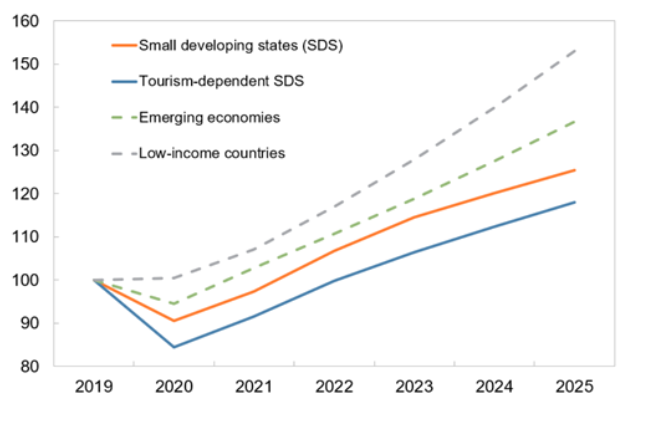
    However, there is a general feeling that the early-April Spring meetings of the IMF and World Bank did not deliver enough even though there was a proposal to increase SDRs by US$650bn. After the meetings, the managing director of the IMF, Kristalina Georgieva, talked about there being good news with “light at the end of the tunnel”, but she also warned: “Yet, while there is light, the crisis continues to cast a dark shadow. Economic fortunes are diverging dangerously. A small number of advanced and emerging market economies, led by the US and China, are powering ahead. Weaker and poorer countries are falling behind in this multi‑speed recovery”. The Caribbean is very definitely in this second category. As the graph below shows, tourism-dependent small developing states (SDS) have suffered more and will recover more slowly than SDS in general or than low-income countries and emerging economies.

    Countries more reliant on tourism had worse recessions (GDP in US Dollars, 2019 = 100)

    Source: IMF, World Economic Outlook database and IMF staff calculations

    But the Caribbean poses a special problem because many of the region’s countries are categorised as middle income or even high income, despite their clear vulnerabilities. In a question-and-answer session after the Spring meetings, Georgieva acknowledged this, saying that “middle‑income tourism dependent countries are in a very difficult position”, and she added that “we are, of course, concerned how we can rally more support so they can be on a more prudent path to recovery”. She did not, however, provide the answer.

  • VENEZUELA-COLOMBIA: Killing of Farc commander spells uncertainty

    LatinNews 20 May 2021 Hits: 4428

    The killing of ‘Jesús Santrich’ (Seuxis Paucias Hernández), a dissident commander of the disbanded Fuerzas Armadas Revolucionarias de Colombia (Farc), has shattered the notion that his Segunda Marquetalia unit was effectively untouchable in Venezuela. With reports indicating that Segunda Marquetalia is siding with the Venezuelan government amidst an offensive by a rival dissident Farc unit, ‘Martín Villa’, Santrich’s death could tip the playing field in favour of the insurgency.

    The details around Santrich’s killing are extremely murky, with no side claiming responsibility. What is clear is that the death of a man who threatened Colombia’s peace accord by returning to arms in September 2019 [WR-19-35] is unlikely to restore stability along Venezuela’s convulsive western border, and may intensify the military’s difficulties in restoring control [WR-21-17].

    An 18 May statement by Segunda Marquetalia confirming the commander’s death claimed that Santrich died in a cross-border assault by “commandos of the Colombian army,” who the group alleges removed a finger from Santrich’s body before being extracted by helicopter towards Colombia. The Colombian authorities have not officially commented, but Defence Minister Diego Molano Aponte tweeted that the government had received “unverified information” indicating that Santrich was killed in “suspected clashes”. Whilst not impossible, it is unlikely that Colombia was behind the attack. A cross-border assault would violate Venezuelan sovereignty and carry a risk of retaliation. With Colombia’s security forces preoccupied with mass civil unrest that has seen the military deployed to cities across the country, now would be a rash time to provoke Caracas [WR-21-18].

    Nor is there a clear motive for the Venezuelan security forces to have killed Santrich, given the alliance that is widely believed to exist between Segunda Marquetalia and the government led by Nicolás Maduro. Claims that the Venezuelan authorities have harboured Segunda Marquetalia have been made by Colombia, the Venezuelan opposition, and local human rights organisations, and in July 2019 Maduro said that Santrich was “welcome in Venezuela,” referring to him as a “leader of peace”. If Venezuelan soldiers were responsible for the killing, they are unlikely to have acted on the orders of the high command.

    The ongoing insurgency in Apure state by the Farc’s dissident 10th Front, in which Segunda Marquetalia has reportedly backed the Venezuelan government against its former allies, further diminishes the probability of Caracas’ involvement. According to the Venezuelan NGO Fundaredes, in the past week Segunda Marquetalia has clashed with fighters from the ‘Martín Villa’ bloc, which includes the 10th Front, leaving four militants dead. Whilst it is not clear whether that was the specific encounter that resulted in Santrich’s death, at this stage the most likely hypothesis is that he was killed in clashes between these groups.

    It is unclear what the consequences of Santrich’s death will be for the escalating conflict in Venezuela. Much depends on whether Segunda Marquetalia’s remaining leader, ‘Iván Márquez’ (Luciano Marín Arango), can maintain the group’s stronghold in Venezuela without Santrich. A diminished Segunda Marquetalia would benefit the 10th Front’s insurgency in Apure and could potentially see the violence spread further afield. Those concerns were raised by Fundaredes director Javier Tarazona, who said on 18 May that the fighting between dissident Farc units had sent the conflict in “a new direction”, with clashes taking place in both Amazonas and Zulia states in recent days.

    Elections

    On 13 May Venezuela’s new national electoral council (CNE) announced that regional and local elections will be held on 21 November, with the campaign season beginning on 28 October. The elections will be the first major test for the CNE, which was formally installed on 4 May with three Chavista rectors and two that are linked to the opposition [WR-21-18]. The European Union’s foreign office chief, Josep Borrell, described the elections as an opportunity to overcome Venezuela’s political crisis, calling them “a good moment to seek the participation of all political parties, including the opposition”, which boycotted December’s legislative elections alleging a high probability of vote rigging.

  • COSTA RICA: Poised for a second round

    Patrick de Courcy 14 January 2022 Hits: 3205

    Date: 6 February 2022. A presidential candidate must capture 40% + 1 of the valid vote to be elected or face a run-off election on 3 April 2022.

    Type: Presidential and legislative (57 seats in a unicameral legislature).

    Main presidential contenders: José María Figueres (Partido Liberación Nacional, PLN); Lineth Saborío (Partido Unidad Social Cristiana, PUSC); José María Villalta (Frente Amplio, FA); Fabricio Alvarado (Partido Nueva República, NR); Rodrigo Chavez (Progreso Social Democrático (PSD).

    The previous 2017/2018 electoral cycle produced some major upsets – not least the shock first-round victory of evangelical pastor Fabricio Alvarado, who Carlos Alvarado of the centre-left Partido Acción Ciudadana (PAC) went on to defeat in the April 2018 second round run-off. With a record 27 presidential candidates having thrown their hats in the ring for the current election, from which President Alvarado is constitutionally barred from standing, and polls again indicating voter uncertainty and disillusionment with the political class, the 2022 contest looks similarly unpredictable.

    As with previous recent electoral contests, pundits point to continued public disenchantment with the political establishment over public corruption, following recent scandals such as the ‘Diamante’ case involving municipal officials and the ‘Cochinilla’ public works scandal which made headlines in November 2021 and June 2021 respectively. The Cochinilla case in particular drew parallels with the Cementazo scandal (involving Sinocem Costa Rica, the Costa Rican subsidiary of a Chinese cement exporter, and top public officials), which roiled the country in 2017 under the previous PAC government led by Luis Guillermo Solís (2014-2018). As a result of this, corruption has once again become the main voter concern according to a November 2021 survey by the centre for research and policy studies (CIEP) of the Universidad de Costa Rica (UCR) which showed it was cited as such by 27.3% of respondents, ahead of unemployment (20.1%), which previously topped the list of voter concerns, and the cost of living (17.3%). Pollsters are quick to link this disillusionment with voter uncertainty. The latest Ciep survey on voter intentions, released on 15 December, showed that 40.5% were undecided. The survey also showed that no presidential candidate garnered 20% of voting intentions and just two candidates managed over 10% support.

    The frontrunner is the candidate for the main opposition right-of-centre PLN, former president José María Figueres (PLN, 1994-1998), who is polling at 17.2% down from 19.0% in October. In second place on 15.1% is Lineth Saborío, a former vice president (PLN, 2002-2006) who now belongs to the right-of-centre opposition PUSC, up from 8%. The 2014 presidential candidate José María Villalta, of the leftist opposition FA is on 5.1%, up from 4.0% while 2018 first round winner Fabricio Alvarado (NR) is also on 5.1%, up from 5.0%. The survey concludes that it is ‘highly unlikely’ that any candidate will secure 40% of the support necessary to avoid a presidential second-round run-off in April.

    Fiscal deficit

    Whoever wins the presidential election will face the continued challenge of addressing the country’s fiscal deficit – one of President Alvarado’s declared priorities. This reached 8.1% of GDP in 2020 – indicative of the impact of the coronavirus (Covid-19) pandemic - up from 6.94% of GDP in 2019. Yet the government has made strides in reducing the fiscal deficit – a key condition of the US$1.8bn financial arrangement with the International Monetary Fund (IMF) which the legislature approved in July 2021. On 8 December international credit ratings agency Moody’s forecast Costa Rica's fiscal deficit in 2021 would be 5.8% of GDP.

    Corruption

    The continued public anger with corruption comes despite Costa Rica’s strong performance in anti-corruption indicators, compared with its Central American neighbours. In the latest Corruption Perceptions Index (CPI), published on 28 January 2021 by anti-corruption NGO Transparency International (TI), Costa Rica ranked 42 out of 180 countries in 2020, up from 44 in 2019 and well ahead of El Salvador (104), its closest rival in the sub-region.

  • A dystopian hotel?

    Abbi Dicker 11 September 2025 Hits: 1199

    Many media outlets have focused on sensationalist claims that TdA leaders led a life of blatant luxury in Tocorón. There have been claims that the prison has its own private residential homes, a nursery, a swimming pool, a baseball and a football pitch, horses, food stands, eateries, a night club, and mobile phone sales points. The available evidence suggests that these claims are largely true. One revealing account was made by Venezuelan journalist Ronna Rísquez who managed to gain access to the prison, posing as a visiting family relative of one of the prisoners. On approaching the compound, she said she had to cross three external National Guard checkpoints. At the last of them, she had to leave her identity card, crossing the boundary into the area controlled by the Tren.

    Once walking through the grounds, she noticed heavily armed men driving around on motorcycles: these, she was told, were prison enforcers. They looked both well-fed and well-dressed. Others doing the motorcycle round were tasked with checking on the prison generators, required because of Venezuela’s frequent power cuts. They also saw the nursery, the swimming pool, and the infamous Tokio discotheque, where sports and entertainment celebrities had been seen. Dotted around was a restaurant, food stands, an upscale clothing shop, and bars offering whisky and rum. There was also a makeshift bank where prisoners paid a weekly US$15 fee to ‘the cause’ – the prison management. At a little distance, a line of houses was described as millionaire’s row, used by the top criminals and their families. Supplies of crack and cocaine were also available for sale, along with cripy, a home-grown and particularly potent version of marijuana. However, it seems that drug addiction is not rife through the prison. The Niño Guerrero is reportedly not a drug user.

    Further along the route were some half-ruined buildings inhabited by thin, ill-looking men. These were the ‘underclass’ of the prison social system, called in prison jargon varones or manchados. They were kept there in insalubrious conditions because they were unable to pay the weekly contribution to the ‘cause’, or because they had HIV, tuberculosis, or Covid 19, or had been caught thieving or breaking rules set out by the pranes. In this area of the prison there were dirty puddles and deposits of scattered rubbish. Former prisoners say that those who failed to pay the weekly US$15 were held here, given warnings, physically beaten, and in some cases shot and killed.

    Those suffering terminal diseases were also summarily executed. The prison had a rudimentary justice system - every Monday the pranes heard reports of conflicts and complaints and decided what punishments there should be. They could include shooting the transgressor in the foot (known as a patero) or shooting him dead. Former prisoners say these homicides were largely kept secret: certain people just disappeared from the prison and were not heard of again.

    Apart from horses kept in stables, Tocorón also had a makeshift zoo, inhabited by, among other specimens, a jaguar, a puma, a white eagle (Rey Zamuro), toucans, and monkeys. Leaving after her visit, Rísquez said the place struck her as surreal, dystopian version of Disneyworld, a theme park she had visited as a young girl. Once exiting back through the National Guard checkpoint, she was able to see the logbook, which showed at least 10 visitors had been staying in prison for more than a week.

    Former prisoners say that Tocorón had its own internal social system. Right at the bottom were the manchados or varones, followed by those known as ovejas (sheep) or bautizados (the baptised). El Niño Guerrero has been a follower of a form of evangelical Christian beliefs and considered this group as being “true Christians” who were required to read the Bible and work as servants. The next rung up was formed by the gariteros (prison guards) which included the men patrolling the grounds on motorcycles. They were said to be the eyes and ears of the prison leadership.

    Next came the luceros de la baja (lowland stars), an armed shock force which protected the leadership. They were allowed to leave prison two times a week for Tren De Aragua business. Former prisoners have described them as “cruel and bloody”. A further step up the hierarchy were the luceros de la alta (highland stars) who formed the leadership’s inner circle of trust. They were allowed out of prison as required and could travel inside and outside Venezuela. The top of the pyramid in Tocorón had been occupied by three principles or pranes of which the most important was the Niño Guerrero. However there had also been speculation that there might be a sort of overlord of the whole structure, potentially a minister in the Nicolás Maduro government.

  • ECUADOR: Referendum: a key milestone for Noboa

    Abbi Dicker 13 November 2025 Hits: 689

    Ecuador’s national referendum on 16 November may be a defining moment for the presidency of Daniel Noboa. Opposition forces held rallies in Quito on 12 November to support a ‘no’ vote in the referendum.

    The demonstrations were called by the Confederación Ecuatoriana de Organizaciones Clasistas Unitarias de Trabajadores (Cedocut), an umbrella labour organisation, and supported by Ecuador’s main trade union grouping, Frente Unitario de Trabajadores (FUT); the teacher’s union, Unión Nacional de Educadores (UNE); the country’s largest indigenous organisation, Confederación de las Nacionalidades Indígenas del Ecuador (Conaie); and the main left-wing opposition party Revolución Ciudadana (RC).

    Lined up in the opposing ‘yes’ camp are President Noboa and his ruling right-of-centre Acción Democrática Nacional (ADN) and a wide range of pro-business organisations. The ‘yes’ vote is also supported by a well-resourced social media campaign.

    Voters must answer four yes/no questions. The government wants them to say ‘yes’ to a constitutional reform requiring the election of a constituent assembly; ‘yes’ to allowing foreign military bases in national territory; ‘yes’ to eliminating public funding of political parties; and ‘yes’ to reducing the size of the national assembly from 151 to 73 members.

    Opinion polls on the likely outcome have fluctuated quite significantly. Some of the more recent ones suggest the ‘yes’ vote has the edge. A survey by the national pollster Cedatos published on 5 November indicated that 53.4% of respondents would vote ‘yes’ on the constituent assembly question, against 34.1% for ‘no’.

    From Noboa’s point of view, achieving a ‘yes’ vote is central to his wider political project. Earlier attempts at constitutional reform were blocked by the judiciary. Noboa has not detailed the changes he is now seeking, leading some in the opposition to accuse him of asking for a ‘blank cheque’. But he has spoken of a shorter, more business-friendly constitution. He also claims that some of the rights embedded in the existing constitution make it difficult to pursue organised crime.

    The opposition, in turn, suspects that Noboa wants to roll back civil, labour, and environmental rights. The proposal to allow foreign military bases can also be seen as part of Noboa’s pursuit of a new strategic relationship with the US.

    • Noem visits

    US Secretary of State for Homeland Security Kristi Noem was in Ecuador last week discussing joint action against drug cartels. Talks are reportedly focusing on two possible US bases, one at Manta (previously used by the US from 1999-2009). The location of the second base was not revealed.

    Prison massacre

    A riot at a prison in Machala, in the southern province of El Oro (near the border with Peru), left a toll of 31 reported dead and 33 wounded on 9 November. Twenty-seven of the dead had been hanged. These killings were attributed to a battle between two rival criminal groups in the prison, Los Sao Box and Los Lobos. On the following day, the prison service reported a further 12 dead in three other prisons. However, half of those - six - were reported as non-violent deaths from tuberculosis.

    Some security analysts link the surge in prison killings to the fact that the government has begun transferring the more dangerous prisoners to its new maximum-security penitentiary known as ‘Encuentro’ in Santa Elena province. The prison is modelled on El Salvador’s notorious Centro de Confinamiento del Terrorismo (Cecot). Gang leaders are resisting the switch to Encuentro. In addition, opposition parties have reacted angrily to the news that former vice president Jorge Glas (2013-2018), who faces corruption charges, has also been sent to the new prison, despite a request from the Inter-American Court of Human Rights to the government that his “physical and mental health” be safeguarded.

  • RASTREANDO TENDENCIAS

    LatinNews 10 October 2011 Hits: 176

    JAMAICA | Golding dejó caer una bomba. El Primer Ministro Bruce Golding ha confirmado que él se retirará en noviembre, una vez que haya sido seleccionado un nuevo líder para el gobernante Jamaica Labour Party (JLP).

    Golding, quien lidera el JLP al volver al poder en 2007, después de 18 años en la oposición, primero hizo el anuncio el 25 de setiembre cuando él estaba preparando el funeral de su madre. También citando sus años y la necesidad de “permitir que una nueva cosecha pase adelante y libere sus energías y creatividad” (ver más abajo).

    Golding atribuyó su decisión directamente a las consecuencias políticas de su manejo del requerimiento de extradición del barón de la droga, Christopher ‘Dudus’ Coke, en mayo de 2010, en el cual se supo que él había contratado una firma con base en EU, Manatt, Phelps & Philips, para hacer lobby en nombre del gobierno [IL-10-21].

    Expresando preocupación que su presencia podría dañar al JLP en la elección general programada para 2012, Golding dijo que “las preguntas acerca del rol que yo jugué en la cuestión Coke/Manatt han permanecido como una fuente de preocupación en las mentes mucha gente”. Pero él reiteró el argumento de su gobierno que la evidencia contra Coke, reunida por las autoridades de EU a través de grabaciones telefónicas, habían sido obtenidas ilegalmente.

    EL SALVADOR | Adicto a las remesas. El viceministro de El Salvador para salvadoreños en el exterior, Juan José García, advirtió recientemente que la economía de El Salvador es una economía “adicta a las remesas”. Hablando en un evento organizado por el Instituto Brookings con base en EU, y el Banco Centroamericano de Integración Económica (BCIE), García señaló que las remesas llegan a cerca de 17% del PIB de El Salvador, creciendo hasta 70% del PIB en algunas áreas como la de Bahía de Jiquilisco sobre la costa del Pacífico. Unos 337.000 hogares reciben remesas de familiares de3 2,8m de salvadoreños en el exterior, 2,5m de los cuales viven en EU. En los primeros ocho meses de 2011, las remesas llegaron a US$2,4bn, subiendo casi 5% sobre igual periodo en 2010.

    Durante 2010, los flujos de dinero llegaron a US$3,5bn, un incremento de 2,2% sobre 2009. Advirtiendo que la situación no era sustentable, García dijo que el gobierno de Mauricio Funes estaba explorando vías en las cuales la diáspora salvadoreña podrá invertir en el país, con una delegación de empresarios expatriados que visitarán el país para considerar posibles proyectos.

    PANAMA | Nuevo ministro de economía. El viceministro de economía, Frank de Lima, asumió oficialmente la cartera de economía el 30 de setiembre, un mes después que su jefe Alberto Vallarino, un miembro del opositor Partido Panameñista (PP) renunció en medio de la ruptura de la alianza gobernante [IL-11-35].

    La designación de De Lima, afiliado a Cambio Democrático (CD) del Presidente Ricardo Martinelli, estaba en línea con las recomendaciones de Vallarino y ha disipado las preocupaciones en el sentido que los conflictos políticos en lo alto se traduzca en inestabilidad económica. Menos de una semana más tarde, el congreso aprobó el nuevo presupuesto del estado de US$14,45bn para 2012, un incremento de 7,5% sobre el presupuesto de 2011 –en sí mismo ya con un 23% de incremento sobre el presupuesto de 2010.

    El presupuesto final fue US$17m menor que la propuesta inicial, está basado en un crecimiento de 7,5% del PIB pronosticado para 2012, y espera que el déficit fiscal se mantenga  en 2% del PIB, en línea con la ley de responsabilidad fiscal. Por otro lado, las cifras preliminares muestran que el Canal de Panamá cerró el año fiscal 2011 (que finalizó el 30 de setiembre) con un nuevo record de tonelaje de 322,1m toneladas Canal de Panamá (PC/UMS), 7,1% más que el año pasado y 2,9% más que el record previo de 2007 de 312,9m de toneladas.

    PUERTO RICO | Referéndum. El gobernador de Puerto Rico, Luis Fortuño, ha anunciado que presentará a los legisladores un plan para convocar a un referéndum en dos etapas para decidir el estatus de Puerto Rico que permitirá a los ciudadanos votar el 12 de agosto de 2012 sobre si desean un cambio en el estatus actual.

    Si votan a favor del cambio, se celebrará un segundo referéndum simultáneamente con las elecciones generales de noviembre de 2012, en el cual ellos elegirán entre tres diferentes opciones:

    Convertirse en un estado de EU, independencia, o estado libre asociado (esencialmente el status quo). La movida llega en medio de mensajes variados desde EU.

    Después de los gestos positivos hechos por el Presidente de EU Barack Obama durante su histórica visita en junio pasado, en la cual él apoyó un referéndum y dijo que apoyaría cualquier resultado [IL-11-22], a fines de setiembre, él dijo que creía que la isla permanecerá como parte de la comunidad de EU, a menos que exista una “sólida indicación” de apoyo por la opción de convertirse en un Estado de los Estados Unidos.

  • ECONOMIC OVERVIEW: GUATEMALA

    LatinNews 11 April 2012 Hits: 2530

    Petrocaribe: Last month Pérez Molina floated the possibility of Guatemala joining Petrocaribe, the subsidised oil scheme run by President Hugo Chávez of Venezuela, in a bid to address Guatemala’s spiralling oil bill, which increased 36% in 2011 to reach US$3bn. The proposal serves as the latest illustration of Pérez Molina’s pragmatic bent given the ideological differences with his left-wing Venezuelan peer. Colom had signed up to Petrocaribe, but the agreement was not ratified amid last-minute differences with Venezuela over its terms and conditions. Pérez Molina said he had already discussed the proposal with Chávez, who said there would be “no problem” with Guatemala joining the regional initiative.

    Remittances: Remittance inflows reached US$1.06bn the first three months of 2012, up 8.79% on the same period the previous year, according to the latest report from the Central Bank (Banguat). In 2011, remittances reached US$4.38bn, beating the record US$4.31bn set in 2008. According to the International Organization for Migration (IOM), some 1.5m Guatemalans live abroad, 1.3m in the US, the majority of whom are illegal.

    Inflation: According to the national statistics institute (INE), the March inflation rate reached 0.33%, which brought the 12-month rate to 4.55%, the second lowest rate in the last decade, following the 3.93% rate registered over the same timeframe in 2009-2010.


  • PANAMÁ: Martinelli sufrió una nueva derrota política

    LatinNews 30 October 2012 Hits: 679

    Una ley para la venta de tierras del estado en la zona de libre comercio de Colón (ZLC) ha producido el último bochorno para el Presidente Ricardo Martinelli, cuyas marchas atrás sobre varias iniciativas populares se han convertido en un rasgo definitorio de su gobierno. El último revés –que hizo que Martinelli prometa derogar la ley, sólo cuatro días después de ser aprobada– no solamente hizo revivir las dudas sobre los gastos del gobierno que habían emergido a raíz de otra iniciativa desechada (su propuesta en junio de vender acciones del gobierno en los sectores de las telecomunicaciones y la energía [IL-12-24]. También se han reavivado las preocupaciones sobre la brutalidad de la policía después que los choques con manifestantes en protesta dejaron tres muertos, incluido un niño de nueve años.

    Aprobada por Cambio Democrático (CD) liderado por Martinelli en la cámara unicameral de 71 miembros, el 19 de octubre, la Ley 72 establece que 35% de los ingresos generados por la venta de tierra en la ZLC de Colón, la segunda área más grande de comercio libre de impuestos en el mundo después de la ZLC de Hong Kong, sería reinvertido en el área con el resto yendo a las arcas del gobierno central.

    Martinelli insistió que la medida inyectaría recursos de vuelta en la que es una de las más empobrecidas regiones del país (las cifras citadas por la prensa local ubica la pobreza en 45% de los aproximadamente 242.000 habitantes, por encima del promedio nacional de pobreza de 25,8% para la población nacional de 3,4m). Los escépticos fueron rápidos en descartar la ley como una estratagema que apunta a cubrir los gastos del gobierno y mantener reducido el déficit –el mismo motivo sospechado para la venta de acciones en los sectores de las telecomunicaciones y la energía, que Martinelli se vio forzado a revocar.

    Mientras que Panamá lideró la región en términos de crecimiento el año pasado (con 10,6%) y tiene el más alto pronóstico para el 2012 (9,5%), de acuerdo con el último informe de la Comisión Económica para América Latina y el Caribe (Cepal) de la ONU, difundido este mes, la deuda pública permanece como preocupación; de acuerdo con un informe difundido por el ministerio de economía y finanzas (MEF) en junio de este año, la deuda pública de Panamá llegó a US$13,8mm en la primera mitad del 2012, subiendo de US$12,5mm en el 2011, US$11mm en el 2010, y US$10,8mm en el 2009, el año que Martinelli asumió el poder. La creación del gobierno en mayo pasado de un fondo soberano de riqueza y su decisión de elevar el techo sobre el déficit fiscal en el 2012, a 2,9% del PIB, subiendo de 2%, igualmente han avivado las preocupaciones relacionadas con la responsabilidad fiscal.

    La Ley 72 sirvió como el último punto de coincidencia para la recientemente establecida alianza opositora, Frente por la democracia, compuesto de los dos principales partidos de oposición, el Partido Revolucionario Democrático (PRD), y el Partido Panameñista (PPA) y varias organizaciones de la sociedad civil. También fue rechazada por el poderoso sindicato de trabajadores de la construcción, Suntracs, y grupos de presión privados como la cámara de comercio, industria y agricultura (CCIAP) y la asociación de ejecutivos de empresas (Apede). La última emisión de una declaración urgiendo el consenso y la estabilidad en la ZLC, que está ubicada justo fuera de la ex Zona del Canal de Panamá, dada su importancia económica para el país. (De acuerdo con Apede, unas 2.500 compañías operan actualmente en la ZLC, proveyendo empleo para 27.347 personas, y contribuyendo con más de US$1,3mm a la economía, lo que equivale a un 8% del PIB).

    Los expertos legales también cuestionan la legalidad de la propuesta: dos asociaciones de abogados presentaron quejas ante la corte suprema sobre la base que la ZLC de Colón es un sitio rellenado (creada usando tierra del fondo marino) y no puede ser vendido, pues el Artículo 258 de la constitución, establece que los espacios aéreos, la plataforma continental, el suelo marino y el subsuelo pertenecen al Estado.

    Una respuesta ya conocida

    Tal como ha sido el caso con otras controversiales medidas tomadas por Martinelli, fue el uso de la represión policial en respuesta a las protestas lo que hizo aparecer titulares en la prensa internacional y lo que finalmente forzó al presidente a dar marcha atrás. (Él anunció el 23 de octubre que derogaría la ley, aunque hasta ahora no lo ha hecho). La aprobación de la ley disparó las protestas y saqueos en Colón, que pronto se extendieron a otras partes del país, incluida la capital. Las autoridades aún deben proveer un informe completo, pero la prensa local ubica el número de muertos en tres, causadas por el uso de gas lacrimógeno y disparos de armas de parte de la policía para dispersar a los que se demostraban en protesta. Magaly Castillo, directora ejecutiva del grupo de la sociedad civil, Alianza Ciudadana pro Justicia (ACPJ), estuvo entre quienes rápidamente encontraron analogías con incidentes previos –más notablemente, las protestas de Bocas del Toro en julio del 2010, donde los choques derivados del intento (fallido) de Martinelli de debilitar la legislación sindical y medioambiental provocaron dos muertes y cientos de heridos [IL-10-44].

    La ACPJ está preparando un informe sobre las violaciones a los derechos humanos cometidas durante las protestas más recientes, para someterlo a la Comisión Inter-Americana de Derechos Humanos (CIADH). Castillo destaca la violencia como evidencia del fracaso del gobierno de abordar las preocupaciones previas relacionadas con la policía –no menos la influencia del controversial ex jefe de policía, Gustavo Pérez de la Ossa, en el gobierno de Martinelli [IL-12-12]: el mes pasado, Pérez de la Ossa fue cambiado del cargo de presidente del consejo nacional de seguridad del estado dependiente del ejecutivo al puesto de viceministro de seguridad.

    • Más juicios equivocados

    El Presidente Ricardo Martinelli ha exacerbado los sentimientos anti-gobierno al negarse a acortar su gira por Asia, donde estaba visitando Japón y Vietnam en busca de inversiones. Otros miembros de su Cambio Democrático (CD) también desplegaron una carencia de tacto político: Sergio Gálvez, el presidente del congreso y legislador por CD, fue forzado a pedir disculpas por los comentarios que hizo durante la aprobación de la ley, en los cuales él se burló de la oposición diciéndole que “vaya al cementerio a llorar” –comentario que hizo que el consejo municipal de Colón lo declare persona non grata.

    Nuevo nombramiento judicial

    La reciente designación de Heriberto Araúz Sánchez para reemplazar a Gerardo Solís como presidente del tribunal supremo electoral (TSE) (cuyo mandato de 10 años expira el 14 de noviembre ha llamado la atención, no menos considerando las elecciones presidencial y legislativa del 2014.

    La prensa local citó a expertos legales y políticos de la oposición como planteando preocupaciones acerca de la independencia de Araúz, un profesor en ley constitucional quien previamente trabajó para la oficina del contralor. Araúz recibió el apoyo de todos los cuatro jueces de la corte suprema de justicia designados por Martinelli como también otros dos. Araúz también fue parte del “comité de notables” designado por Martinelli para elaborar las reformas constitucionales que aún están siendo discutidas.

    Rogelio Paredes, el segundo vicepresidente del PRD dijo que el partido estaba en alerta porque Araúz apoya la reelección; Martinelli está constitucionalmente impedido de buscar la reelección en el 2014, y levantar la prohibición es altamente impopular.

  • PANAMA/REGION: DEA administrator pays unprecedented visit

    LatinNews 08 January 2021 Hits: 2348

    On 7 December the acting administrator of the US Drug Enforcement Administration (DEA), Timothy Shea, arrived in Panama on an official visit, marking the first time a DEA administrator had visited the country. Shea’s visit comes as Panama, as elsewhere in the sub-region, continues to report high drug hauls. This in turn reflects ongoing concerns about the continued flow of drugs through Panama. In its latest (March 2020) International Narcotics Control Strategy Report (INCSR), the US State Department noted that Panama is not a major producer or consumer of illicit drugs, but that its location and geography make it a prime sea and land transit route for drugs, primarily cocaine, flowing from South America to North America and Europe.

    Upon his arrival on 7 December, Shea and US chargé d’affaires Stewart Tuttle participated in meetings with Panama’s President Laurentino Cortizo, attorney general Eduardo Ulloa, and public security (Minseg) minister Juan Pino, along with other high-level Panamanian security officials. According to a US embassy press release, during the meetings the US delegation reaffirmed its long-standing law enforcement relationship with Panama, and its role in maintaining security in the region. Shea’s visit was also a preamble to the annual US-Panama High-Level Security Dialogue (HLSD), which took place on 10 December and was attended by Admiral Craig Faller, the commander of the US Southern Command (Southcom), among other top officials. At the event, senior officials held bilateral security talks regarding efforts to combat drug trafficking and money laundering in the region.  

    Shea’s visit comes amid reports of continuing drug seizures. On 27 December Minseg reported that in 2020, Panama’s security forces had seized “over 80 tonnes” (t) of drugs, mainly cocaine, in various operations. In 2019, Panamanian authorities seized a record 90t of drugs, of which 77.96t were cocaine, according to a report by the attorney general’s office. In the latest INCSR, the US State Department noted that Panama was set to surpass 80t by the end of 2019, which would represent an 8.7% increase over 2018, and exceed 2017 as Panama’s highest year on record.

    A regional tendency?

    The reports of high drug flows through Panama have been echoed in other parts of Central America. In August the Honduran government announced that the authorities had seized 2.24t of cocaine in just over seven months in 2020, exceeding the total 2.21t seized in the whole of 2019. 

    On 30 December Costa Rica’s public security ministry reported that authorities had seized a total of 71.2t of drugs in 2020, including over 56.7t of cocaine. According to the latest INCSR, Costa Rica seized 35.1t of cocaine in 2019, up from 33.7t in 2018 – the second year in a row of record seizures.

    Many of the operations in Costa Rica and Panama were carried out as part of a tri-national strategy against the drugs trade with Colombia, and with backing from the US, known as the South Triangle, which was created in 2017. Yet while the significant drug hauls and successful joint operations have been hailed by all sides, these developments also indicate increasing diversification in terms of smuggling routes, personnel, and methods, seemingly reflecting an increased flow. For instance, in mid-February, the Colombian navy and the Panamanian air service (Senan) carried out a combined operation that led to the capture of a semi-submersible which, in an interview with digital military magazine Diálogo , published in April, Colombia’s Vice Admiral Andrés Vásquez Villegas remarked  “was very surprising for us because for about 10 years we had not seen or detected a semi-submersible in the Caribbean.”

    Record drugs haul

    In February 2020 Costa Rica’s public security minister, Michael Soto, announced the country’s biggest ever cocaine seizure, totalling over five tonnes (t). Hidden in a container due to be shipped to the Netherlands, the drugs were reportedly discovered during a check at the APM Terminals port of Moín, in Limón province.