
All Categories

Subcategories

  • TRACKING TRENDS

    LatinNews 03 September 2015 Hits: 2045

    REGION | Trade with the EU

    On 24 August the Andean community of nations (CAN) reported that bilateral trade between the customs union (which comprises Bolivia, Colombia, Ecuador and Peru) and the European Union (EU) was up 1.6% year-on-year in 2014 to reach US$38.8bn. According to a CAN statement, the (albeit moderate) increase shows that trade between the blocs is continuing to recover after having reached a low point of US$20.85bn in 2009, due to the international economic crisis. The CAN report shows that after posting consistent growth from 2005-2008, bilateral trade dipped in 2009 and has been increasing year-on-year since 2010. However, CAN’s figures show that recovery of the group’s exports to the EU is tentative while the trade balance remains amply favourable to the EU. The CAN report shows that CAN exports to the EU totalled US$18.61bn, 5.4% less than in 2013. Nevertheless, the EU was the second largest market for CAN exports, accounting for 15% of the total, just behind the US, which accounted for 26% of the total. Imports from the EU totalled US$20.22bn, 9% more than in 2013. On CAN figures, Colombia was the largest exporter to the EU, accounting for 49% of all of the bloc’s exports, followed by Peru (31%), Ecuador (16%) and Bolivia (4%). This suggests that the free trade agreement (FTA) signed between the EU and Colombia and Peru in 2012 has had a positive impact on two-way trade between these countries and continues to drive trade between the CAN and the EU.

    BOLIVIA | Oil exploration

    On 26 August Bolivia’s state-owned oil company Yaciminetos Petrolíferos Fiscales Bolivianos (YPFB) announced the start of oil exploration activities in the northern Amazonian department of Pando, which borders Brazil. YPFB and the Bolivian government expect to find around 50m oil barrels in the area, which is more than the 34m barrels that the country currently has in proven reserves. The announcement was made during a ceremony attended by President Evo Morales, Hydrocarbons Minister Luis Alberto Sánchez, and YPFB president Guillermo Achá. Sánchez said that Chinese firm Sinopec has been given permission to carry out 2D seismic surveys with a view to identifying potential oil well sites in the Madre de Dios basin in the Pando municipalities of Sena and San Lorenzo for a period of 400 days. According to Sánchez, YPFB will invest US$48m in the unprecedented exploration efforts in this area. President Morales said that the local indigenous communities resident in the area have approved the oil exploration and potential exploitation in a previous consultation process, unlike some other indigenous communities who have expressed opposition to such activities. Morales said that this will allow for the development of a series of development projects in Pando, such as the construction of roads and bridges linking the municipality of Puerto Rico (which boasts a provincial airport) to Sena to the tune of US$80m.

    President Morales also announced that a series of social projects will be implemented in the Pando region, such as the construction of roads and bridges between Puerto Rico and Sena, requiring an investment of at least US$80m. Morales reiterated that his government’s long term objective is to turn Bolivia into “the energetic heart of South America”, capable of exporting refined fossil fuels as well as electricity to neighbouring countries. .

    PERU | ‘El Niño’ and China prompt growth revision

    On 24 August Peru’s economy & finance ministry (MEF) presented its draft 2016 budget, which forecasts 3% GDP growth this year and 4.3% in 2016. The forecasts included in the budget by the MEF are lower than those previously held by the ministry, which in April predicted growth of between 3.5% and 4% this year. MEF head Alonso Segura said the adjustment was based on fears about a sudden economic slowdown in China; the expected flight of international capital to the US once the Federal Reserve moves to raise interest rates; and the expectation that this year’s ‘El Niño’ climatic phenomenon will be severe, negatively affecting Peru’s agricultural sector. However, Segura said the government was implementing a “moderately expansionary policy” that includes greater government spending in support of economic growth in the PEN138.4bn (US$42.8bn) draft budget, 6.6% larger than last year’s.

    • Juan Váldez’s international expansion

    On 25 August Colombia’s national coffee growers federation (FNC) announced the opening of two new ‘Juan Váldez’ coffee shops abroad. In a statement the FNC said that its Colombian coffee promotion arm (Procafecol) had opened Juan Váldez shops in the capitals of Paraguay and Malaysia last week, bringing the total number of Juan Váldez shops to 326 (including the 225 existing ones in Colombia). Procafecol president Hernán Méndez hailed the new openings. Noting that Procafecol’s mission is to promote Colombian coffee at home and internationally, Méndez said that “our international expansion has become more dynamic and we hope we will have opened our 120th shop abroad by the end of the year”.
  • URUGUAY: Murder of Jewish man raises alarm

    LatinNews 01 April 2016 Hits: 773

    The murder of a Jewish community leader in the city of Paysandú by a local Islam convert has raised concern about the potential influence that radical extremist Islamist groups may be having on the local population and the threat that this may pose for Uruguay and its neighbours. The government has been seeking to allay these concerns by insisting that this was an isolated incident carried out by an individual with no connection to outside militant terrorist groups. But this view is not shared by the likes of the Israeli government.

    David Fremd, a locally known businessman and leader of the Paysandú Jewish community, was stabbed to death by 35-year-old Islam convert Carlos Omar Peralta López (who also uses the name Abdullah Omar) on 8 March as he made his way to work. Local eyewitnesses said that the unprovoked attack occurred when Peralta, who converted to Islam 10 years ago, rushed Fremd with a knife and stabbed him a number of times as he yelled ‘Allahu Akbar’ (‘God is Great’), the battle cry used by many Islamic extremists when carrying out attacks, including suicide bombing terrorist attacks.

    Peralta, who appeared disturbed and according to witnesses kept saying that Allah had ordered him “to kill a Jew”, was detained by two passing civilians until the police arrived and arrested him. After Fremd died in hospital hours later, Judge Fabricio Cidade charged Peralta with premeditated aggravated murder, religious hate crime, and personal injury for the wounds he inflicted on Fremd’s son, who tried to defend his father. Peralta has since been admitted to Vilardebó Hospital in Montevideo, Uruguay’s capital, for a psychiatric evaluation. In a press conference, Cidade said that it was clear that Peralta had attacked Fremd for “religious motives” and that “the attacker felt persecuted by Jews for practicing Islam”.

    This type of hate crime is uncommon in Uruguay, where Jews make up less than 5% of the total population of 3.3m, and where the Muslim population only hovers around 500 individuals according to US State Department figures. For this reason the attack has attracted so much attention and sparked concerns that it was spurred and possibly even coordinated by foreign extremist Islamist groups such as the Daesh or Al Qaeda. Religiously motivated knife attacks against Jews have become increasingly frequent in Israel of late as the fight against Daesh in the Middle East has intensified. Since October 2015 some 25 Israeli nationals have been stabbed to death by Palestinians in knife attacks conducted by civilians in busy areas during daytime. This rise in violence has even been dubbed ‘the Knife Intifada’ by the international press and has been attributed to social-media campaigns launched by Islamist jihadist groups.

    Fremd’s stabbing thus sparked fear that such attacks could now spread to Latin America. For if individuals in other Western Hemisphere countries could be prompted or inspired by foreign extremist Islamist organisations to carry out attacks on Jews, it is not inconceivable that this could be replicated in Latin America. Pointedly, Jewish community organisations in Uruguay and in neighbouring Argentina such as the Comité Central Israelita (CCIU) and the Delegación de Asociaciones Israelitas Argentinas (Daia) expressed concern and called for increased protection of Jews. Concern is especially elevated in Argentina, which has one of the largest Jewish populations in Latin America (an estimated 250,000-300,000 people).

    Gov’t plays down threat

    The attack was also condemned by the Israel government, which in a statement said that “Like many of the crimes committed in Israel and around the world in which Jews pay with their lives for the simple fact that they are Jewish and proud of their identity, David [Fremd’s] murder is another expression of Islamic terrorism”. The statement goes on to call on the Uruguayan government “to join Israel and other countries around to the world in the fight against anti-Semitism, incitement, hate crimes and terrorism”. This was echoed by the US-based Simon Wisenthal Center which sent a letter to President Tabaré Vázquez warning him that the incident was “a sign of the spread of the Middle Eastern Islamic terrorism to Latin America”.

    But despite such concerns, the Uruguayan government has sought to play down Peralta’s potential links to Islamist terrorist groups and the threat that this could be the first of other similar attacks in the near future. On 10 March Interior Minister Eduardo Bonomi gave a press conference in which he said that after scouring Peralta’s home and computer, authorities did not believe that Peralta had any connection with foreign terrorist groups or that he was part of a terrorist cell. Yet the local press has reported that investigators did find that Peralta followed and even had contact with jihadist groups on Social media (see sidebar).

    But Bonomi, who is under fire over the rising level of violence and insecurity in the country [SSR-16-02], insisted that investigators had not found any evidence of Peralta having any direct contact with foreign Islamist groups. However, Bonomi did recognise that investigators found a lot of Islamist material and propaganda in his flat, as well as military knives and fatigues. This would suggest that even if Peralta was not instructed to carry out the attack on Fremd by any extremist groups, he could have been inspired by them. And fears that there could be similar ‘lone wolf’ attacks by other individuals inspired by these groups in Uruguay or other Latin American countries are not unfounded. In Uruguay’s case in particular the case also raises additional concerns about the threat posed by anti-Semitic groups present in the country following the three bomb scares registered at the Israeli embassy in Montevideo last year [SSR-15-07].

    • Peralta’s jihadist links

    Peralta not only regularly published messages in Arabic on his Facebook page but he friended some high-profile Daesh fighters. Reportedly, Peralta was also in contact with known members of the Palestinian Islamist group Hamas.

  • ECONOMIC OVERVIEW: BOLIVIA

    LatinNews 29 March 2017 Hits: 433

    New bond issue: On 13 March, the Movimiento al Socialismo (MAS) government led by President Evo Morales announced a US$1bn bond issue – the first in three years. According to the international media, the new bond, which has a 10-year average life, amortizes in three equal parts in 2026, 2027, and 2028. Bank of America Merrill Lynch and JP Morgan acted as leads on the deal.

    Three days later Finance Minister Luis Arce said that, with the latest bond issue, Bolivia’s foreign debt would reach US$8.23bn – representing 22% of GDP. He said that in 2016 foreign debt represented around 20%-21% of GDP, and that the bonds would be used to finance the construction of third and fourth level hospitals. Of the US$1bn, 60% will be used to finance the construction of fourth level hospitals in the departments of La Paz, Cochabamba, Santa Cruz, and Tarija while the remainder would finance the construction of third level hospitals in Cochabamba, Santa Cruz, Beni, Pando, and Chuquisaca. The previous month Arce said that he expects the Bolivian economy to grow 4.7% this year, but he estimates that the fiscal deficit will remain at around 6.5%.

  • TRACKING TRENDS

    LatinNews 19 April 2018 Hits: 1300

    MEXICO | New special economic zones. President Enrique Peña Nieto signed a decree on 17 April creating two new special economic zones (ZEEs) in the south-eastern states of Campeche and Tabasco. In 2016, the Peña Nieto administration introduced the ZEEs, which offer fiscal and other benefits to firms that set up operations in these areas, as a way to encourage investments and prosperity in some of Mexico’s less economically developed southern areas.

    Until now the Peña Nieto government had created five ZEEs but these are the first to be located in the Yucatán Peninsula. Peña Nieto presented the decree during a ceremony in the Campeche port city of Seybaplaya, where he also announced the opening of a M$50bn (US$2.77bn) credit line with Mexico’s development banks available to private companies that plan to invest in the seven ZEEs. Peña Nieto said that access to the credit line will be made available via the ‘Ventanilla Única’ electronic one-stop shop support centre set up to “facilitate and simplify information flows between business and government”.

    During the event, Peña Nieto also inaugurated the modernised Seybaplaya port and the new Hobomó aqueduct. The aqueduct is expected to guarantee clean drinking water to Campeche’s eponymous state capital for the next 30 years.

    Peña Nieto emphasised that the two new ZEEs would help to counteract the negative economic impact that the fall in international oil prices in recent years has had on the oil industry in the states of Campeche and Tabasco, where it is one of the main economic activities, and the significant loss of jobs and economic dynamism. However, Peña Nieto said that the ZEEs would help to attract investment and diversify the local economies in these states. Campeche Governor Alejandro Moreno Cárdenas applauded the creation of the new ZEEs, claiming Campeche would become one of the most “important” states in Mexico.

  • PARAGUAY: Fatal security operation attracts international scrutiny

    LatinNews 10 September 2020 Hits: 5679

    The death of two minors at the hands of the security forces during an operation targeting the Ejército del Pueblo Paraguayo (EPP) guerrilla group has put the Paraguayan government led by President Mario Abdo Benítez in the international spotlight. Concerns that the security forces acted with disregard for the rights of the potentially foreign victims, and that the authorities are trying to cover this up, has attracted unwanted outside attention. The demands for explanations by the Office of the United Nations High Commissioner for Human Rights (OHCHR) have upset the government, which has defended the actions of the security forces and rebuffed the OHCHR. The case and the spat with the international body could severely affect the Abdo Benítez administration’s image.

    The military-police task force (FTC) created by the government to combat the EPP reported on 2 September that it had carried out an operation that same day targeting an EPP camp discovered in a wooded area in the northern department of Concepción. The FTC said that, after finding evidence of the camp, a patrol was deployed to investigate. As FTC units approached the camp, they came under fire. Two females were reported killed during the ensuing shootout, while a group of 10-15 suspected EPP members managed to escape into the woods. It later emerged that the two casualties were girls carrying Argentine identification papers.

    The Paraguayan authorities said that the girls (who they initially said appeared to be aged between 15 and 17) were daughters of suspected EPP members, and that they took part in the shootout in which they were unfortunately killed. They also said that they believed the girls were born in Paraguay and later illegally registered in Argentina, where they were living with relatives (a Paraguayan woman with family links to suspected EPP members, who lives in Argentina, has claimed that the girls were her Argentine-born daughter and niece) before returning to Paraguay to be indoctrinated into the EPP. Critically, the authorities reported that in line with sanitary protocols put in place to stop the spread of the coronavirus (Covid-19) the bodies of the girls were immediately buried and their clothes incinerated, even though they had not been positively identified.

    This set off alarm bells. The Coordinadora de Derechos Humanos del Paraguay (Codehupy) local human rights organisation expressed concerns (echoed by the political opposition) that the FTC had failed to safeguard the lives of the girls during the operation and that it was trying to cover this up by destroying evidence. The Argentine government also demanded clarification of the identity of the deceased after confirming that the names of the girls appeared in its national people’s register. In response, the Paraguayan authorities exhumed the bodies on 5 September and subjected them to an examination by a coroner, who determined that they were 11 years’ old and had sustained various bullet wounds to the body and the neck (but not the head). DNA samples were also taken, which the Paraguayan authorities said could be used to determine the identity of the victims with the help of their Argentine counterparts.

    This did not ease all concerns. On 6 September the OHCHR representative for South America, Jan Jarab, issued a statement demanding that the incident and the circumstances in which the girls died be fully cleared up. Jarab called for an exhaustive and impartial investigation saying that his office had received “disturbing” information about the manipulation of evidence in a potential attempted cover up. Jarab reminded the Paraguayan government of its duty under the Minnesota Protocol on the Investigation of Potentially Unlawful Death.

    • Minnesota Protocol

    The Minnesota Protocol is an international set of guidelines for the investigation of suspicious deaths, particularly those in which the state is suspected of being responsible. Part of the United Nations Principles on the Effective Prevention and Investigation of Extra-Legal, Arbitrary, and Summary Executions, the protocol was first drafted in 1991 and last revised in 2016. It establishes the standard procedure for the forensic investigation of suspected unlawful killings, stressing that this must be methodical and transparent with “all relevant evidence or observations secured and logged”. This includes clear guidelines for the recovery and identification of human remains, which may have been ignored by the Paraguayan government.

    The Abdo Benítez government took offence at Jarab’s statement. Within hours it issued its own in which it complained that Jarab had not contacted it before releasing his statement and accusing him of making “irresponsible” insinuations about the tampering of evidence without taking into consideration official reports of the incident. The government went as far as to say that it had lost confidence in Jarab and would no longer deal with him. But the statement was clear that an official investigation into the incident is ongoing, and its findings would be shared with all interested parties, including international organisations, once these are available. These investigations will be intensely scrutinised and could prove to be a source of international tensions for months to come.

  • NICARAGUA: ACJD confirms withdrawal from opposition alliance

    LatinNews 12 November 2020 Hits: 984

    One of Nicaragua’s leading opposition groups, Alianza Cívica por la Justicia y la Democracia (ACJD), has confirmed its definitive departure from the Coalición Nacional (CN), the national coalition which launched in February to challenge President Daniel Ortega and his Frente Sandinista de Liberación Nacional (FSLN) in the general elections in November 2021. Further compounding difficulties for the opposition, with less than a year until the vote, the government has pushed through legislation widely condemned by these groups and the international community as repressive.

    In what is the latest sign of continued friction within the opposition [WR-20-37], ACJD confirmed its decision on 26 October in a statement complaining that the CN had failed to facilitate dialogue with other opposition groups outside of it. Aside from ACJD, which comprises students, human rights activists, and private sector representatives, CN has six member groups which, for the time being, have yet to follow suit. These are civil-society group Unidad Nacional Azul y Blanco (UNAB); peasants’ movement Movimiento Campesino; and four political parties - Partido Liberal Constitucionalista (PLC), of disgraced former president Arnoldo Alemán (1997-2002); Fuerza Democrática Nicaragüense (FDN); Partido de Restauración Democrática (PRD); and indigenous party Yatama. However, doubts persist as to the continuance in the CN of the PLC which in 2000 forged a power-sharing arrangement, ‘El Pacto’, with the FSLN. This, combined with corruption allegations surrounding Alemán - which again drew attention this week after the US slapped sanctions on him - has been a bone of contention for some of the CN’s other members.

    • US sanctions

    On 9 November US Secretary of State Mike Pompeo announced the public designation of Arnoldo Alemán “due to his involvement in significant corruption”. According to Pompeo, as president from 1997 to 2002, Alemán was “involved in corrupt acts such as misappropriating millions of dollars of public funds for the benefit of himself and members of his family. While this designation is based on acts during his time in office, Alemán’s corruption continues to reverberate in Nicaragua today”. The designation renders Alemán and members of his immediate family ineligible for entry into the US. The US has previously slapped sanctions on allies of Ortega and his government - most recently last month when Ana Julia Guido Ochoa, the attorney general, and Paul Oquist, the secretary of the presidency and a close Ortega adviser, were targeted.

    The continuing evidence of splits within the CN comes as the FSLN shows no sign of bowing to international pressure over new legislation which the opposition warns will target them ahead of the election. Having approved a foreign agents’ bill last month [WR-20-42] on 27 October the FSLN-controlled national assembly approved a new cyber security bill. This had sparked major concerns due to provisions such as that making spreading fake news through “information and communication technologies” punishable by up to four years in prison. Then, on 10 November, the national assembly approved a bill to amend the constitution to allow life imprisonment for hate crimes, although this requires further approval in a second legislative period which begins in January 2021. The US and European Union (EU) have both raised concerns about the three bills, with the latter threatening further sanctions if they were adopted [WR-20-42].

    OAS resolution

    Opposition hopes that the Organization of American States (OAS) General Assembly which took place last month would result in further sanctions for the Ortega government failed to materialise despite OAS Secretary-General Luis Almagro’s June announcement that he would request that member states declare a “rupture of the democratic order” in Nicaragua [WR-20-26]. Instead the OAS approved a resolution which, among other things: 1) reiterates the “concern of the inter-American community over the deterioration of democratic institutions” and urges the government to “hold free and fair national, presidential and legislative elections”; 2) urges the government to accept the deployment of “independent, accredited international [electoral] observers”; 3) requests “the OAS General Secretariat to support inclusive and timely negotiations” between the government and “national actors representing the…opposition on meaningful electoral reform measures”; and  4) urges that “concrete electoral reform commitments, in particular modernization and restructuring of the Supreme Electoral Council, be in place before the State convokes general elections, or no later than May 2021”.

  • CHILE: Out in front in the vaccine race

    LatinNews 18 February 2021 Hits: 4541

    There have been plenty of surprises over how well – and how badly – different countries have dealt with the different phases of the coronavirus (Covid-19) pandemic. In one area at least Chile has seized front-runner status: it is vaccinating its population faster than any other country in the region.

    Something dramatic happened at the start of February. At that point Chile had administered 0.4 coronavirus vaccines per 100 members of its population, less than had been achieved by Brazil, Argentina, or Mexico. But from that point on the country’s vaccination programme took off like a rocket.

    By 15 February 11.23 per 100 Chileans had been vaccinated, the highest number in Latin America, and way ahead of Brazil (2.49), Argentina (1.35), and Mexico (an unimpressive 0.58). In fact, Chile has become one of the world’s top vaccinators, behind the world number one, Israel (76.3 per 100) and others leading the race, including the United Kingdom (23.3 per 100).

    The government now estimates that, at current rates, 4m Chileans will have received a first dose by 25 February. It has firm orders in place for 36m vaccine doses from various suppliers, almost enough to cover the entire population (two doses are needed for each of the country’s 19m citizens). A further 5m are expected to receive a first dose in March, taking the total to 15m or 80% of the population by June. By the end of this year the authorities expect the entire population to have been immunised.

    Various explanations have been suggested for Chile’s success. One is that as an open and globalised economy with many free trade agreements it has been able to move quickly to import vaccines from multiple suppliers (including China’s Sinovac, Pfizer, AstraZeneca, and Johnson & Johnson).

    Negative political factors have also helped. After the street protests, riots, and upheavals of 2019-20, the unpopular right-wing government led by President Sebastián Piñera has been looking for an opportunity to forge a success story to try and lift its ratings ahead of this November’s presidential and congressional elections.

    Obtaining vaccines

    The social unrest in October 2019 took the shine off Chile’s reputation as one of the wealthiest countries in the region, and negotiators appear to have used this poorer, more troubled vision of the country to haggle down vaccine prices. They have also been helped by the fact that many Chilean universities chose to participate in phase 3 vaccine trials, thereby positioning the country near the top of the distribution queue. Unlike Brazil, for example, where vaccine supply has become highly ideological, the Universidad Católica de Chile had already established links with Sinovac and co-funded trials, in return for promises of early access and price discounts.  

    Anti-immigrant sentiment raises its head

    Interior Minister Rodrigo Delgado said on 9 February that around 100 illegal immigrants, mainly Venezuelans and Colombians, were being deported from Iquique, the capital of the northern region of Tarapacá, after having entered the country illegally.

    Delgado claimed that illegal Venezuelan immigration had become a “regional emergency” in northern Chile. Two immigrants were earlier reported to have died as they tried to use mountain pathways to enter Chile, evading border closures imposed because of Covid-19.

    Meanwhile, a survey by Cadem, a leading local market research company, published on 15 February said 60% of respondents now describe the arrival of migrants into the country as “bad”, the highest proportion expressing that view in the last five years. Just over one in two respondents (56%) said it was right to deport undocumented migrants. A big majority of 72% said there should be tougher entry regulations.

    The survey came after two weeks of news coverage of the arrival of up to 1,000 undocumented immigrants in northern Chile. Cadem said “the proportion of respondents opposing immigration is significantly higher across all sectors of the population but is particularly so among those aged over 55 and among lower socio-economic groups”.

  • ECONOMIC HIGHLIGHTS

    LatinNews 16 July 2021 Hits: 1916

    COSTA RICA | Exports show signs of recovery. On 21 June Costa Rica’s official export promotion agency, Procomer, released new figures which show that the country’s exports reached US$5.77bn in the first five months of 2021, up 23% on the same period in 2020. According to Procomer, Costa Rica’s main exports was medical and precision equipment, which accounts for 35% of total exports and was up 41% in the first five months compared with the same period in 2020. The Procomer report also highlighted growth of some agricultural exports, with pineapples, which account for 7% of total exports, up 7% in the first five months of 2021 compared with the same period in 2020. However, Procomer noted that others, like bananas and coffee, which accounted for 7% and 3% of exports respectively, were down 10% and 5% respectively.

    REGION | EU announces aid for Central America. On 10 June the European Union (EU) announced that it will allocate €18.5m (US$22.5m) in aid for Central America and Mexico. Of the total, €12m represents humanitarian funding for Central America, and €6.5m constitutes development assistance. An official press release notes that Central America and Mexico are regularly exposed to natural hazards requiring emergency aid for around 1.7m people per year. Climate change and the coronavirus (Covid-19) pandemic threaten the food security of vulnerable populations in the 'dry corridor' of Guatemala, Honduras, El Salvador, and Nicaragua. At least 7.7m people are in need of food assistance. For 2019-2020, the EU allocated €26.3m to respond to different needs across the sub-region. It adds that since 1994, the EU has allocated €257.4m in humanitarian aid to Central America and Mexico, of which 66% has helped to respond to emergencies such as floods, droughts, epidemics, earthquakes, among other things.

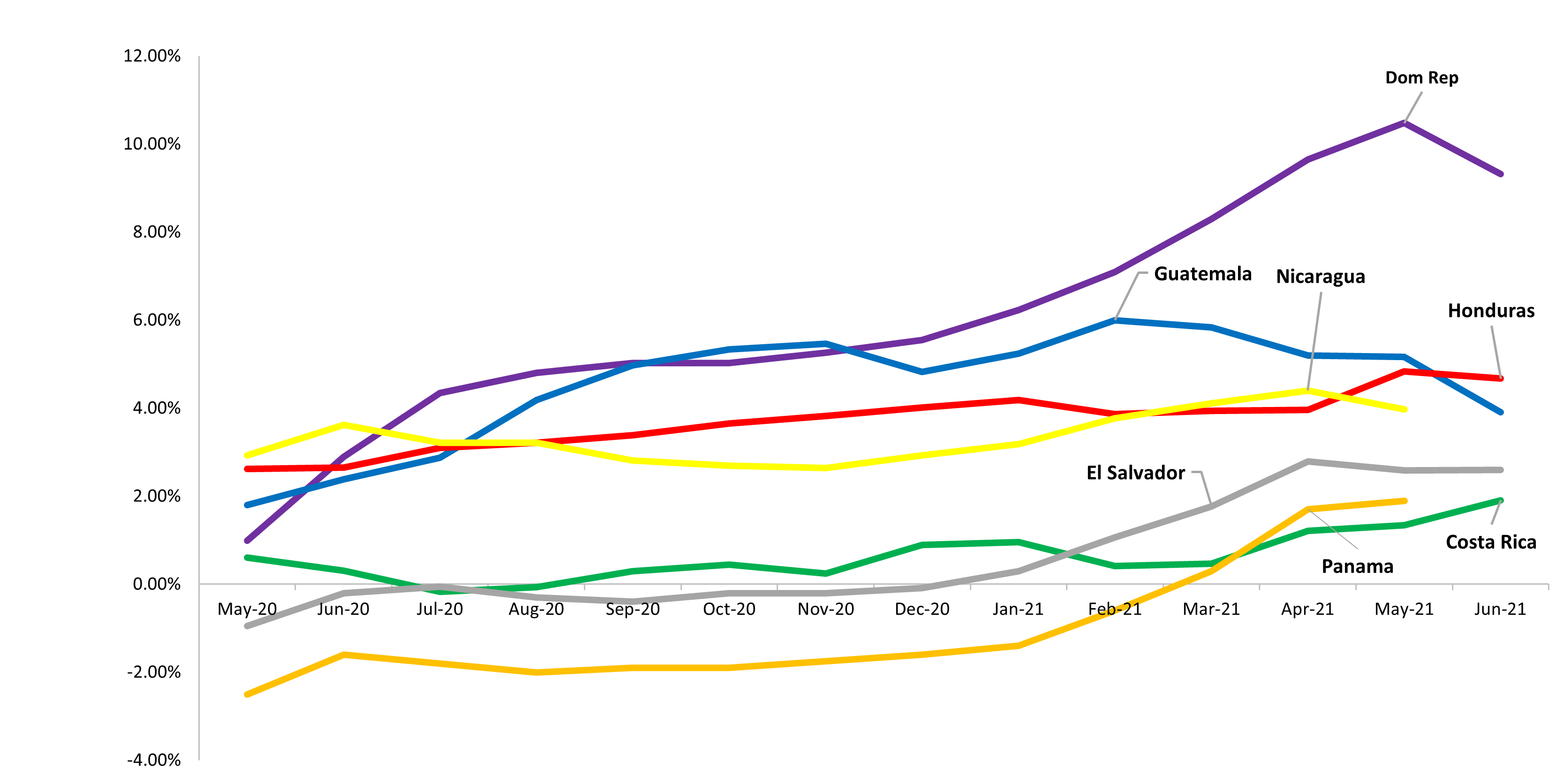
    Central America & Caribbean:​ Inflation
    Monthly year-on-year figures

    Central America & Caribbean, selected countries: GDP growth (%)
    Quarterly figures are year-on-year growth
    GDP  2020* 2021 forecast** Q2 2020 Q3 2020 Q4 2020 Q1 2021
    Costa Rica -4.2 3.2 -7.4 -6.4 -5 -1.3
    Dominican Republic -6.7 7.1 -16.9 -7.2 -2.9 3.1
    El Salvador -7.9 5.0 -19.2 -10.2 -2.3 3.0
    Guatemala -1.5 4.6 -8.9 -1.4 3.0 4.8
    Honduras -9.0 5.0 -18.5 -7.9 -7.6 1.3
    Nicaragua -2 2.0 -7.9 -2.5 -1.9 3.4
    Panama -17.9 12 -38.4 -23.6 -10.9 not available
    *From local central banks **Forecasts from the United Nations Economic Commission for Latin America & Caribbean July 2021
    Quarterly growth based on figures from the local central banks


  • CARIBBEAN: Despite risks, Caribbean tourism is bouncing back

    Patrick de Courcy 10 August 2022 Hits: 2011

    The Caribbean summer Carnival season, with events running across June, July, and August, is now underway after an enforced two-year break caused by the coronavirus (Covid-19) pandemic in 2020 and 2021. The return of festivities comes amid positive signs for the crucial tourism sector.

    Already this year Trinidad and Tobago was able to hold its carnival on the traditional dates in February, with other countries delaying until the summer. In Barbados, that meant later street parades for the Crop Over festival. Jamaica's carnival, usually held in spring, was delayed to July this year, and has just concluded. In Grenada, Spicemas 2022 is due to be held in early August. In Bahamas this year’s festivities, including the Junkanoo parade, were held in April. Vincy Mas has meanwhile returned to St Vincent and the Grenadines.

    The return of carnival has been closely watched by those trying to assess the strength of the recovery in tourism, one of the Caribbean's main industries, a prime source of foreign currency, and a generator of employment. “Carnival...is the largest economic impact event in Jamaica. It’s number 1 in terms of what we have for the economy” says Kamal Bankay of the Jamaica Carnival National Stakeholders’ Committee. The Barbados Association of Masqueraders says Carnival there attracts US$150m a year in spending, and that there is no other event “that pulls in that kind of money in such a short space of time”. In Grenada Kelvin Jacob, head of the Spicemas Corporation, says: “Carnival is very important to our tourism. It is one of the biggest sellers and brings the largest set of people onto the island.” 

    The wider tourism picture is indeed beginning to look more positive this year. Speaking in late June, Nicola Madden-Greig, president of the Caribbean Hotel and Tourism Association (CHTA), said: “We are very excited to see that Caribbean tourism is recovering much faster than had been anticipated originally, and we are seeing that we are the second fastest recovering globally.” She added that the region was still behind its pre-pandemic 2019 peak by 36.1% but that in terms of its contribution to GDP for 2021 the sector was up by 36.6% over 2020 and had recovered some 311,000 jobs.

    Madden-Greig was using data from the UK-based World Travel and Tourism Council (WTTC). This showed that, at a global level, tourism’s contribution to GDP nearly halved from 10.3% in 2019 to only 5.3% in 2020, but it rose again to 6.1% last year. For the Caribbean region, that V-shaped pattern of recession and recovery was more pronounced, with the comparable figures being 13.9% in 2019, 7.1% in 2020, and 9.1% in 2021. Last year Caribbean tourism GDP was US$39.3bn, and the sector employed 2.35m people (still beneath the pre-pandemic total of 2.75m). Visitor spending, at US$18.2bn last year, is still taking time to recover from the pre-pandemic total of US$36.4bn. Most tourists still come from the US (61% of the total last year), followed by France (4%), Canada (3%), and the UK (2%).

    More recent statistics suggest that the Caribbean recovery is gaining pace. Madden-Greig said arrivals in January and February this year were weak because of continuing worries over the Omicron Covid variant, but that the March-June period in contrast saw “really strong demand”.

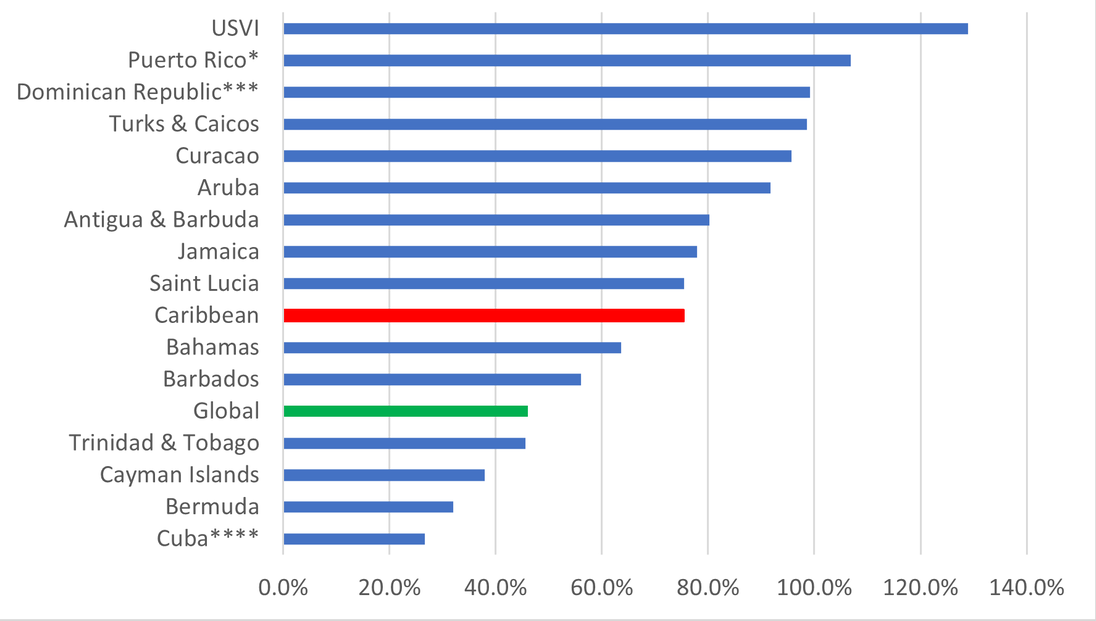
    According to a June 2022 report by Spain-based travel data and analytics company Forward Keys, international tourist arrivals on the books in the Americas, Q3 2022 vs 2019, showed that in the Americas different sub-regions are recovering at different rates. Leading the way are the countries bathed by the Caribbean Sea: Mexico, Central America, and the Caribbean (+5%). Top-performing destinations in the sub-region include Costa Rica (+24%), the Dominican Republic (+13%), and Jamaica (+17%), which have surpassed their performance in summer 2019 and 2021. Quickly catching up are destinations such as Panama (- 29%), Barbados (-18%), and Guatemala (-12%). While these have not achieved their 2019 levels, they have significantly improved on their 2021 performance. Meanwhile, arrivals in the Turks and Caicos (+47%), El Salvador (+24%), and Belize (+23%) have levelled out.

    For the region, simply “revving up” the tourism sector is not sufficient. Governments have to face some big short-and-long term challenges. One key issue is that the sequence of external shocks that have hit the industry is not necessarily over. Covid-19 is still present, and vaccination rates in many Caribbean islands are low. In Jamaica and St Vincent half of the population remains unvaccinated, meaning a damaging new spike in contagion cannot be ruled out (and indeed, might even spread as a result of Carnival-themed mass public events). The region also must battle with climate change and the damage inflicted by hurricane seasons. A sobering report on The Bahamas by the Inter-American Development Bank (IDB) says a combination of Dorian, the Category Five storm that hit the island in August/September 2019, causing US$3.5bn worth of losses, and the later outbreak of Covid 19 (another US$9.15bn in losses) was devastating. The report states the Bahamian economy will only return to pre-pandemic levels by 2024.

    YTD 2022 as % of YTD 2019

    Note: this refers to total tourism arrivals per country. Those registering over 100% (only two) are back up to pre-pandemic levels.

    Source: Tourism Analytics

    For the Caribbean region as a whole the pandemic shock was rapidly followed by further global disruption caused by the war in Ukraine, with associated increases in international energy prices and negative impacts on the domestic cost of living. The World Bank has predicted a slowdown in global economic growth, although it still expects Caribbean GDP to rise 6.9% this year and by 6.5% in 2023 largely because of the tourism revival.

    That said, there are measures governments can take to try and sustain and strengthen the current recovery. One is to improve airlift. While the major destinations are reasonably well-served by commercial airlines, the pandemic-related collapse of regional airline LIAT has left a gap in air services. Edmund Bartlett, Jamaica's tourism minister (who also chairs the Organisation of American States Inter-American Committee on Tourism - OAS-CITUR) has called for policies to allow regional carriers to develop. He has also suggested a move to a jointly managed airspace and a common Caribbean visa regime.

    Demands from tourism executives

    Tourism executives have called for increased training, upgrades in infrastructure, better support and financing for job creation by small and medium-sized enterprises (SMEs) in the tourism sector, more effective marketing, and investment in the growing use of IT and digital business processes. Jamaica’s tourism minister, Edmund Bartlett, has also sought to build links with Middle East: in July he participated in the first “Caribbean Saudi Arabia Summit” held in the Dominican Republic, where he spoke of developing new markets in Asia, Africa, and the Middle East.      

    Cuba

    Cuba reported 682,297 arrivals in the first half of this year, over five times the comparable period last year. Still, the country is one of the four slowest to recover. The Cuban government says it is aiming to host over a million visitors in July-October and is trying to upgrade its stock of available hotel beds. For 2022 as a whole it wants to attract 2.5m tourists. That is still very significantly below the pre-pandemic total of 4.27m visitors.

  • BRAZIL: Former Lava Jato judge keeps senate seat

    Abbi Dicker 23 May 2024 Hits: 1984

    The top electoral court (TSE) concluded an impeachment trial on 21 May in which it ruled in favour of Senator Sergio Moro, affiliated with the centre-right party União Brasil (União). Moro stood accused of excessive campaign spending in the 2022 congressional election, but all seven TSE judges decided to absolve him of the charges. Media speculation had been building on whether the former judge who oversaw the Lava Jato corruption probe would lose his senate seat, but his political career remains intact, as the prosecution has stated that it will not appeal the TSE ruling. 

    The prosecution against Moro was led by lawyers representing the right-wing Partido Liberal (PL) of former president Jair Bolsonaro (2019-2023) and a coalition of left-of-centre parties, including the ruling Partido dos Trabalhadores (PT) of President Luiz Inácio Lula da Silva. The charges of excessive spending were based on the fact that Moro launched his bid for the presidency in 2021 but then dropped out of the presidential race in 2022 to run for a seat in the senate instead. The PL, PT, and other parties alleged that his congressional campaign benefitted from the high spending of his presidential campaign.

    In April, Moro was absolved of the charges by the regional electoral court of Paraná (TRE-PR), the state he represents as a senator. Now, the TSE has upheld the ruling of the regional court. Both courts decided that there was insufficient evidence to suggest that Moro intentionally violated electoral rules and there was not enough certainty about which spending belonged to his presidential and senatorial campaigns.

    Judges of both the TSE and TRE-PR said that there was not enough evidence that Moro expected his presidential campaign to crumble. In 2021, he was going to run as the candidate for a smaller centre-right party, Podemos (Pode). In early 2022, before he dropped out of the race, some polls even put Moro as the third-placed candidate behind Lula and Bolsonaro. Moro later switched his party affiliation and joined the larger União Brasil. However, União ultimately decided that it did not want Moro as its candidate, instead opting for Senator Soraya Thronicke, who finished in fifth place in the first round of the October 2022 presidential election.

    Speaking at a press conference following the TSE’s decision to absolve him, Moro praised Brazil’s judiciary and senate. National daily Folha de São Paulo reported that the senate’s president, Rodrigo Pacheco, and the president of the TSE, Alexandre de Moraes, had been discussing Moro’s case in recent weeks. De Moraes reportedly assured Pacheco that the case would be reviewed on purely technical, legal terms, and that Moro would be judged as a senator, not as the former judge of Lava Jato. Moro’s rulings in relation to the sprawling corruption investigation raised him to national prominence from 2014-2018 but also earned him a lot of enemies, as powerful politicians from across the political spectrum, including Lula, were implicated in Lava Jato.

    When journalists asked Moro about his future political ambitions, he said that for the time being he would focus on his role as a legislator. He ruled out the possibility of running for president again in 2026, saying that he would continue to form part of the opposition against Lula and the PT. Moro went on to praise the governors Ronaldo Caiado (União) of Goiás, Tarcísio de Freitas (Republicanos) of São Paulo, and Romeu Zema (Novo) of Minas Gerais. All three conservative governors have been floated in the media as potential successors to Bolsonaro to unite the Brazilian right against Lula in 2026.

    Lava Jato rulings overturned

    Supreme court justice José Antonio Dias Toffoli decided on 21 May to annul all the court cases and rulings against Marcelo Odebrecht made by the 13th Federal Court of Curitiba, where Sergio Moro previously presided as a judge. Marcelo Odebrecht was the former CEO of the construction company Odebrecht (now known as Novonor), one of the main companies implicated in Lava Jato. Dias Toffoli has long been known as a critic of Lava Jato, who has dismantled Moro’s rulings due to procedural breaches and a lack of impartiality.

  • URUGUAY: Presidential favourites coast to victory

    Abbi Dicker 04 July 2024 Hits: 1918

    Uruguay’s primary elections on 30 June confirmed that the country’s next president is likely to be one of two candidates: Yamandú Orsi, of the main left-wing Frente Amplio (FA) opposition coalition, or Álvaro Delgado, of President Luis Alberto Lacalle Pou’s centre-right Partido Nacional (PN, Blancos), the party which enjoys most support within the ruling five-party coalition.

    In the FA primary elections, Orsi, a member of the Movimiento de Participación Popular (MPP) faction, which includes the Movimiento de Liberación Nacional-Tupamaros (MLN-T) of former president José Mujica (2010-2015), comfortably defeated Carolina Cosse, the mayor (intendant) of Montevideo and a former cabinet minister whose main support comes from the Partido Comunista de Uruguay (PCU) and the Partido Socialista (PS), by 61%-37%, with Andrés Lima a distant third on 2% or 3%. Orsi immediately proclaimed Cosse as his running mate in the first round of presidential elections on 27 October.

    Delgado strolled home in the PN primary contest, defeating Laura Raffo by 74%-21%, with Jorge Gandini third on 5%. Unlike Orsi, however, Delgado eschewed teaming up with his closest challenger for October’s first round, although Raffo pledged her support for his candidacy. Instead, Delgado chose a newbie, Valeria Ripoll, as his running mate.

    Ripoll only joined the PN last year, although she was keen to stress she had done so “out of conviction”. She was previously general secretary of the Asociación de Empleados y Obreros Municipales (Adeom) trade union and affiliated with the FA as a member of the PCU. She was suspended, however, over differences with the Plenario Intersindical de Trabajadores-Convención Nacional de Trabajadores (PIT-CNT), the country’s umbrella trade union movement, in what she criticised as political persecution.

    Delgado, who praised Ripoll’s “courage and commitment”, appears to be seeking to appeal to a different voting demographic that he hopes could swing the election his way: floating voters or left-leaning voters that would not ordinarily support his party. The accuracy of local pollsters in predicting the outcome of the primary elections suggests that he will need to expand his horizons as they all point towards a triumph for Orsi in a likely second round run-off against Delgado in November.

    Before that stage, Delgado will need to navigate his way through to the main berth on the five-party multi-colour coalition ticket. His only real threat will come from Andrés Ojeda, a lawyer and television personality, who won the primary election of the right-of-centre Partido Colorado (PC, Colorados). In the most competitive of the primary elections, Ojeda won 41% of the vote. Robert Silva, a former president of the national administration of public education (2020-2023), won 23% of the vote, edging out Gabriel Gurméndez on 18.4% and Tabaré Viera on 17.6%. Ojeda and Silva will stand on a joint ticket.

    Delgado presented himself as the continuity candidate and said he had asked President Lacalle Pou to head a PN senate list in October; Ojeda described himself as “super different” to Delgado, providing “maximum renewal and freshness”. This could be a valuable asset amid signs of public disillusionment with the political class, possibly due to the persistent high number of homicides and violent crime through successive FA and PN administrations. The turnout of around 36% was the lowest since primary elections (for which voting is not obligatory) were introduced in 1997.

    Delgado’s gamble

    Laura Raffo’s heavy defeat, the largest margin of difference since primary elections were first staged in 1997, may have informed Álvaro Delgado’s decision to choose Valeria Ripoll as his running mate, but the announcement was not universally welcomed among PN members, with some booing and jeering. It is a gamble. But Delgado will be hoping that it can galvanise support for his candidacy in areas where the PN does not fare so well, particularly Montevideo.

    In absolute terms the FA won more than 400,000 votes in the primary elections, exceeding expectations and eclipsing its haul in 2014 and 2019. By contrast, the PN barely mustered 300,000, only two-thirds of those who voted for the party in 2019, albeit the lopsided nature of the primary contest, as correctly forecast by the polls, might have contributed to the low turnout.

  • RASTREANDO TENDENCIAS

    LatinNews 23 September 2011 Hits: 615

    MEXICO | Fast & Furious. El miércoles pasado, el senador John McCain (R, AZ) pidió que el senado realice audiencias sobre la controversial operación federal, Fast & Furious que permitió que más de 2.000 armas de alto poder ingresen a México. Al menos una de esas armas, que se suponía estaban siendo monitoreadas por agencias del gobierno de EU, fue usada para asesinar a un agente de la Patrulla de Frontera de EU, Brian Terry, y varias otras han sido recobradas de otros escenarios de crímenes. En total, las autoridades de EU reconocen haber perdido el rastro a casi todas las armas en la operación. Fast & Furious se inició en 2009, bajo la dirección de la Oficina de Alcohol, Tabaco, Armas de Fuego y Explosivos. Terry fue asesinado el 14 de diciembre de 2010. El gobierno de EU también cambió la jurisdicción de la investigación de Arizona, donde tuvo lugar la mayor parte de la operación Fast & Furious, a San Diego, California. Los Republicanos esperan que las investigaciones del congreso forzará a Eric Holder, el secretario de justicia, a asumir la responsabilidad de los fracasos de Fast & Furious (y su aparente encubrimiento) y renunciar.

  • BRASIL: Pese a su intransigencia, finalmente renuncia Carlos Lupi

    LatinNews 12 December 2011 Hits: 104

    El ministro del trabajo de Brasil, golpeado por la corrupción, Carlos Lupi, del Partido Democrático Trabalhista (PDT), de izquierda, presentó su renuncia el 4 de diciembre, exactamente cuatro semanas después que la prensa publicó una serie de alegatos éticos y de actos ilegales contra él. La dura intransigencia de Lupi (en cierto momento él dijo que “haría falta una bala, y una grande” para removerlo a él) convirtió su salida en algo bastante pintoresco. Sin embargo hay más problemas en ciernes para la Presidenta Dilma Rousseff, en la forma de un creciente escándalo ético centrado en su cercano colega ministerial y amigo de toda la vida, Fernando Pimentel.

    Rousseff ha dejado que Lupi espere inquieto debido a que ella desea reemplazarlo recién en enero, en su primera y formal reorganización del gabinete. Ella rechazó deliberadamente la presión del PDT, que deseaba que Lupi saliera rápidamente para poder nombrar un sustituto y seguir adelante. Como Rousseff ha designado solamente a un ministro interino en reemplazo de Lupi, la reorganización de enero luce ominosa para el PDT. El poder de negociación del PDT descansa en sus lazos con la importante organización de sindicatos, Força Sindical. (Rousseff también es una ex miembro del partido). El gobernante Partido dos Trabalhadores (PT), que está aliado con la rival Central Única dos Trabalhadores (CUT), está interesado en recobrar el control del ministerio del trabajo, que había conducido en 2003-2007. Una opción para Rousseff es re-fusionar los ministerios del trabajo y de bienestar social, bajo el control del principal aliado en la coalición de gobierno, el Partido do Movimento Democrático Brasileiro (PMDB), entregando al PDT el ministerio de agricultura a modo de compensación. El ministerio de agricultura, actualmente controlado por el PMDB, fue también acosado por un escándalo de corrupción a inicios de este año, por tanto, el PMDB no está en posición de discutir.

    Un comentador en el diario Folha, que junto con la revista Veja destaparon varios de los escándalos que ahora han costado seis cabezas ministeriales desde junio, describió a la Presidenta Rousseff esta semana como una “asesina serial” de altos funcionarios de dudosa moralidad, señalando que la presidenta se está probando a sí misma “con acciones” en vez que con palabras. Eso podría leerse como una astuta referencia al predecesor de Rousseff, Lula da Silva (2003-2010), de quien ella heredó todos esos ministros.

    Pimentel, el ministro de desarrollo, industria y comercio exterior, está bajo escrutinio sobre las ganancias que él registró en 2009-2010 a través de su compañía consultora, P-21 Consultorias e Projetos. Anteriormente alcalde de Belo Horizonte (2001-2008), Pimentel ha sido cercano a Rousseff desde sus días en la guerrilla y jugó un importante rol en su campaña de 2010. Él insiste que sus ganancias, de unos R$2m (US$1,1m), fueron legítimas. En Brasil, los miembros electos pueden tener una fuente privada de ganancias, pero la oposición sugiere que hubo tráfico de influencia. El ministro que primero perdió su cargo este año, el número dos de Rousseff, Antônio Palocci (también del PT), fue forzado a renunciar en circunstancias similares, por tanto ella encontrará difícil resistir la presión de la oposición para convocar a Pimentel ante el congreso.

    • Copa Mundial

    En estos momentos, el ministro de ciudades, Mário Negromonte, estaba testimoniando ante el senado sobre alegatos de irregularidades en su oficina relacionadas con la Copa Mundial de Fútbol de 2014. Negromonte, del Partido Progresista, negó que exista ninguna acción ilegal, a la sesión del congreso asistieron pocos legisladores, y duró apenas una hora.

    Rousseff: mantener la calma y seguir adelante

    El instituto nacional de estadísticas informó oficialmente cero crecimiento real del PIB sobre una base trimestral, en los tres meses que terminaron en setiembre. De hecho, en realidad, hubo una leve contracción de 0,04%. El resultado anual fue 2,1%, el más débil desde el tercer trimestre de 2009. El consumo privado descendió 0,08% trimestre en trimestre, en línea con las primeras medidas oficiales para enfriar la recalentada economía interna. En línea con eso, las importaciones cayeron 0,37%. En el aspecto positivo, el resultado muestra que las palancas de la política oficial trabajaron eficientemente. La Presidenta Rousseff dijo también eso el 6 de diciembre, “el PIB, que deliberadamente tuvimos que desacelerarlo, aún creció en alre3dedor de 3,2% [en 2011]. Y eso no es algo pequeño, considerando la crisis en EDU y Europa”. La política monetaria ahora ha revertido al modo de estímulo, que debería tener efecto desde el cuarto trimestre, ayudando a compensar un debilitado sector externo. La administración Rousseff también tiene espacio para maniobrar en el aspecto fiscal y por tanto, incluso si Brasil entra en una recesión técnica, sería de poca duración. En este mismo momento, el país tiene pleno empleo y salarios estables, y el crecimiento del crédito y la gran expansión del mercado interno proveen un importante amortiguador. Eso no significa que Brasil es inmune –su alta dependencia del financiamiento externo lo vuelve muy vulnerable a los impactos externos de la magnitud que se despliega en Europa.

  • BOLIVIA: Se aproxima la primera prueba para los jueces electos

    LatinNews 09 January 2012 Hits: 752

    El Presidente Evo Morales y su gobierno enfrentan nuevas acusaciones de la oposición de ‘judicializar la política” después de la remoción del gobernador regional opositor de Beni, Ernesto Suárez, sobre alegatos de corrupción, y el anuncio de una orden de arresto para el restante gobernador opositor, Rubén Costas, de Santa Cruz. La movida, que sigue a la eyección de Mario Cossío de Tarija un año antes [IL-11-01], se produce en momentos en que Morales está prometiendo una nueva “era de justicia” basada en la “independencia, transparencia e inclusión” siguiendo la asunción esta semana de los 56 nuevos jueces para las altas cortes elegidos en elecciones históricas el 16 de octubre. Disipar esas acusaciones bien podría ser el primer desafío para los nuevos funcionarios.

    La asamblea regional de Beni de 28 miembros votó el 16 de diciembre para destituir a Suárez, luego que el fiscal regional anunció los cargos formales relacionados con malversación, negligencia en el cumplimiento del deber, tráfico de influencia y delitos económicos contra el Estado. Eso ha estado planteado desde principios de año cuando primero se ordenó el arresto domiciliario del gobernador regional en relación a las acusaciones, aunque luego se le permitió continuar realizando sus tareas [IL-11-20].

    La votación fue el fruto de una alianza entre el Movimiento al Socialismo (MAS) de Morales, que obtuvo 20 bancas en la elección municipal de abril de 2010, y una facción disidente del derechista Movimiento Nacionalista Revolucionario (MNR) del ex Presidente Gonzalo Sánchez de Lozada (2002-2003) que tiene tres bancas. (La organización política de Suárez, Primero el Beni, tiene 10). Por otro lado, Cossío –cuya salida se dio a una maniobra similar entre el MAS y una agrupación regional, Poder Autonómico Nacional (PAN)– fue reemplazado temporalmente por un miembro del MAS, Lino Condori; Suárez fue sustituido interinamente  por Haisen Ribera Leigue, del MNR (aunque el acuerdo ha causado disgusto dentro de la dirección nacional del MNR que desde entonces ha expulsado del partido a Ribera y a los tres legisladores regionales).

    Al menos ocho alcaldes también han sido removidos por razones legales, siete de ellos estaban alineados con la oposición. Esto ha agregado a las acusaciones contra el MAS de que busca recobrar posiciones perdidas en las votaciones de abril de 2010 (ver más abajo). Las primeras elecciones para reemplazar a los funcionarios removidos también tuvieron lugar el mes pasado, en Sucre, la capital de Chuquisaca; Quillacollo, una municipalidad en Cochabamba; y Pazña, Oruro. De estas, la contienda para reemplazar a Jaime Barrón –el primer alcalde opositor de una capital regional en ser removido– atrajo la mayor atención dada la importancia estratégica de Sucre: es el asiento de la rama judicial del gobierno de Bolivia y ha sido la fuente de considerable oposición a Morales en el pasado ya que al ciudad demanda que Sucre, la única capital de Bolivia hasta 1899, debería ser la capital conjunta con La Paz.

    Forzado a renunciar en junio de 2010 por supuesta complicidad en la violencia contra partidarios indígenas de Morales en mayo de 2008, Barrón ha sido reemplazado interinamente por un aliado del MAS. Sin embargo, la elección del 18 de diciembre produjo una victoria para una alianza opositora compuesta de grupos locales, Líder, País y la Unidad Nacional del líder opositor nacional y magnate del cemento, Samuel Doria Medina, cuyo candidato, Moisés Torres, derrotó a su rival del MAS por 46,5% ante 37,7%, de acuerdo con cifras preliminares.

    ¿Primera prueba?

    Mientras Costas, de Santa Cruz, está indudablemente buscando impulsar su perfil público denunciando la ‘judicialización de la política’ por el gobierno (su orden de arresto, por no cumplir con una convocatoria de la corte emitida por el fiscal del estado en relación al supuesto complot de asesinato del presidente en abril de 2009 [IL-09-16] discutiblemente socava su caso), también enfrenta otras 13 investigaciones legales. Eso, junto con la insistencia de Suárez que luchará para limpiar su nombre a través de las cortes, será una prueba clave para los nuevos jueces electos en la votación del 16 de octubre, en términos de disipar las preocupaciones acerca de su legitimidad. Eso proviene de las quejas de la oposición con relación a la participación de la legislatura controlada por el MAS en el proceso de selección y el hecho que el día de la votación, el número de boletas nulas y en blanco excedían por lejos a los votos válidos registrados [IL-11-42].

    • Elecciones

    Aunque el gobernante Movimiento al Socialismo (MAS) ganó seis de las nueve regiones en general en las elecciones municipales de abril de 2010, por otro lado perdió siete capitales regionales, lo que sirve para exponer los límites de su hegemonía. Desde la elección, Jaime Barrón y René Joaquino, el popular opositor de izquierda, tres veces electo alcalde de Potosí, han sido suspendidos –el último habiendo sido reemplazado por otro miembro menos popular de su agrupación política, Alianza Social (AS).

    • Boliviamar

    Después de su visita a Perú, el Presidente Morales anunció que la agenda bilateral para 2012 incluye el desarrollo del comercio entre los dos países, basado en el acuerdo de octubre de 2010 para renovar ‘Boliviamar’ (un acuerdo de 1992 bajo el cual Perú cedió a Bolivia 163 hectáreas de tierra a 17kms de Ilo, incluida una franja de 5kms de territorio costero, por 99 años [IL-10-42]) y la cooperación en la lucha contra el tráfico de drogas y el contrabando. Ya hubo algunos signos de progreso con relación a lo último; el mes pasado se anunciaron planes para establecer un comité bilateral de frontera para impulsar la seguridad fronteriza y reprimir el delito.

    • Bolivia y Perú consolidan lazos

    El Presidente de Bolivia, Evo Morales, celebró las recientes festividades en Perú donde se reunió con el Presidente Ollanta Humala, señalando más calidez en las relaciones entre los dos países, que fueron en gran medida frías bajo el predecesor de Humala, Alan García (2006-2011) debido principalmente a la animosidad personal entre los dos líderes.

    Durante su visita a Perú, Morales hizo flotar la posibilidad de construir un ferrocarril binacional que recorrería desde la frontera Boliviana-Brasilera hasta el puerto peruano de Ilo. Eso marca un abandono de la propuesta previa de restaurar las vías férreas entre el puerto chileno de Arica y la capital de Bolivia, La Paz, que los chilenos habían esperado estuviera listo y funcionando este año; a fines de noviembre, el gobierno boliviano objetó la propuesta de Chile de permitir a la Empresa Portuaria de Arica (EPA) reabrir la línea ferroviaria en conjunto con su Empresa de Ferrocarriles del Estado, sobre la base que eso daría a EPA una posición muy dominante en lo que es una importante salida comercial para Bolivia.

    El giro total sobre la propuesta ferroviaria y el acercamiento entre Bolivia y Perú llega en medio de renovadas tensiones entre ambos países y Chile, pues las antiguas disputas fronterizas están por llegar a un punto crucial, en la Corte Internacional de Justicia (CIJ) en La Haya; el 12 de diciembre, en una entrevista con el diario local La Tercera, el ministro de defensa de Chile, Andrés Allamand, había avivado las tensiones, remarcando que en su opinión, el año 2012 estaba camino a ser un año “complicado” en términos de la relación de Chile con Perú y Bolivia [IL-11-50]. Allamand advirtió que la actual inestabilidad política en ambos países era preocupante, pues eso tradicionalmente conducía a un incremento en los sentimientos nacionalistas anti-chilenos.

  • BRAZIL: Official and parallel truth commissions launched

    LatinNews 17 May 2012 Hits: 4571

    President Dilma Rousseff this week swore in the seven members of Brazil’s new truth commission, which will examine human rights abuses committed both by the state and left-wing guerrillas in the period 1946-1988 with a focus on the last military junta (1964-1988). The ceremony was attended by Brazil’s former presidents José Sarney (1985-1990), Fernando Collor de Mello (1990-1992), Fernando Henrique Cardoso (FHC, 1995-2002) and Lula da Silva (2003-2010). Not everyone is happy. Victims’ relatives complained that they wanted a ‘truth and justice’ commission, while retired military officers have announced a parallel commission to ‘refute’ accusations.

    The commission will sit for two years and will not have any judicial or prosecutorial powers. However, despite the complaints of victims’ relatives, the assumption is that the commission’s findings could open the door to future legal cases. Technically, Brazil’s 1979 Amnesty Law prevents that, although in response to a case brought by victims’ relatives the Inter-American Court on Human Rights last year ordered Brazil to open judicial proceedings, which potentially could force the state to derogate the Amnesty Law. The Supreme Court last year upheld the Amnesty Law, a ruling that was crucial to the military’s decision to agree to the truth commission proposal. The government also agreed that the commission examine abuses on both sides by way of a gesture to the military. That decision remains controversial. This week Fernando Henrique Cardoso said he believes that only crimes committed by the state should be examined, although he added yesterday that the commission “opens the doors to reconciliation”.

    Upon announcing the commission members last week, President Rousseff stated “We cannot permit that in Brazil truth is corrupted by silence”. Rousseff, herself a former political prisoner and torture victim, has repeatedly insisted that she is not “in the business of revenge”.

    The commission’s objectives are to clarify the facts and circumstances of cases of grave human rights violations between 1946 and 1988 and promote the circumstantial clarification of cases of torture, death, forced disappearances, the hiding of corpses and the authorship thereof, including cases that occurred abroad. The commission will have full access to public records and may request interviews with anyone of interest, who will have a “duty to the state” to oblige. Individuals whose lives might come under threat as a result of their cooperation can be assigned protected status. The commission can also hold public audiences. It will decide whether to name names publicly in the final report and can opt to submit these to the president only. Legal experts suggest that the commission could also advise that the Amnesty Law is not constructive [to national reconciliation].

    • Composition of truth commission

    The seven members of the truth commission, all personally selected by President Rousseff are: José Carlos Dias, a lawyer and former president of the São Paulo state peace and justice commission who also served as justice minister (1999-2000) under FHC; Gilson Dipp, a magistrate on the supreme court of justice and the supreme electoral court; Rosa Maria Cardoso da Costa, Rousseff’s former lawyer during the junta; Cláudio Fonteles, a prosecutor general (2003-2005) under Lula da Silva; Maria Rita Kehl, a high-profile psychoanalyst who edited a leading opposition journal during the military regime; and José Paulo Cavalcanti Filho, who was justice minister under José Sarney. The seven members will each receive a monthly salary of R$11,179 (US$5,700). END BOX

    • Seeking the truth

    An emotional President Rousseff choked back tears as she declared that Brazil was not done with its history: “Shadows and lies are not capable of promoting concordance…Force can hide the truth, fear can delay it, but time will bring it to light. Today, that time has come”.

  • BRAZIL: When does a helping hand become a hindrance?

    LatinNews 07 February 2013 Hits: 1357

    Argentina is not the only Mercosur country fiddling with costs and prices. The economic policy signals coming out of Brazil are getting muddier by the day, confusing the markets and deepening the bearish investor sentiment on the country. The local Bovespa has fallen 3.45% to date this year and is down almost 10% on a year ago.

    On 5 February President Dilma Rousseff said the government was looking to eliminate federal taxes on the basic food basket in order to reduce inflation, without providing details. With the productive side of the economy failing to buck up, the government is trying to stem inflation without raising the benchmark Selic interest rate from its record low 7.25%. The government also announced that it would temporarily remove (from 1 April to 31 July) a 10% import tariff for the purchase of 1.0m tonnes of wheat from outside of the Southern Common Market (Mercosur), amid lower production in Brazil and Argentina. Announcing changes to the concession framework in order to encourage more private investment in the country’s crumbling road network, Finance Minister Guido Mantega told a São Paulo business forum that Brazil “is on a crusade to reduce production costs”.

    Rousseff began the year (and her presumptive 2014 re-election bid) with major cuts in electricity tariffs (residential and commercial); while the government has continued to roll over payroll and other tax reforms in a bid to cut business operating costs (and avoid industrial sector layoffs). Although the business sector welcomes these official efforts to trim the extortionate ‘Custo Brasil’, the concern in some parts is that this ‘crusade’ will slip over into permanent meddling, as in Argentina, which ultimately could have the unintended effect of deterring private sector investment (as in Argentina).

    President Rousseff, who has been talking up the economic prospects for the year, reassured Brazilians that lower food and electricity costs would offset recent fuel price rises. The cash-strapped state oil giant Petrobras was given the go-ahead by the government to increase wholesale refinery gasoline prices by 6.6% and diesel by 5.4% as of 30 January. This was the second increase in the past six months, but the government absorbed the cost to consumers of the last one (in June 2012) by cutting taxes. The CEO of Petrobras, Maria das Graças Foster, has hinted that the company will look for additional price increases sooner rather than later, after Petrobras announced its worst fourth quarter operating result since 1999.

    • Petrobras

    In 2012, Petrobras produced 2.0% less oil and posted a 36% year-on-year drop in net profits to R$21.18bn (US$10.65bn), from R$33.3bn (US$16.74bn) in 2011. Despite a better-than-expected income result in the fourth quarter, the overall result was the company’s lowest annual income in eight years. Petrobras partly blamed the weak US dollar, which pushed up its fuel import costs, and said it would pay lower dividends in order to concentrate on its ambitious US$227bn five-year investment plan. Ordinary shares fell 8.3% to R$16.6 on the Bovespa in response, their weakest level since January 2006.

    The market is concerned about the company’s mounting debt/ebitda ratio (2.8%, above its targeted ceiling of 2.5%) and its ability to deliver on its production targets. Private shareholders fear the company may have to return to the market again in search of fresh capital, meaning a potential dilution of their holdings. Critics again blasted the ruling Partido dos Trabalhadores (PT), accusing it of damaging interference in the company. Adriano Pires, of the Centro Brasileiro de Infraestrutura (CBIE), told the daily Valor, “It’s a shame…they have created PTbras and this is the result. It’s lamentable to see a company like Petrobras present results like this with oil above US$100”. Das Graças Foster admitted that 2013 would be another “difficult year”.

    • Industrial production slow to recover

    Industrial production contracted 2.7% year-on-year in 2012, the Ibge reports, led by a 12% fall in output of capital goods, signalling stagnant investment. Industrial output was been negative for five consecutive quarters now. Despite a string of official stimulus measures, the key vehicle sector, which accounts for about a fifth (20%) of the industrial base, has dragged down the overall result. The domestic passenger car sector remains strong thanks to tax and credit incentives for consumers, but exports are weak. The heavy vehicles sector (agri vehicles, lorries and buses) is in a steep funk. The Ibge stressed that the pace of the IP decline has gradually ebbed, but acknowledged that the capital goods sub sector is still the worst-performing.


  • BRASIL: Controversial programa de doctores es apoyado por los electores

    LatinNews 17 September 2013 Hits: 586

    A pesar del rechazo de la profesión médica brasilera al programa del gobierno ‘Mais Médicos’, que incluye la importación de doctores extranjeros para asistir en áreas remotas carentes de cuidados de salud, una nueva encuesta de opinión sobre la reacción del público a esta política halló que una abrumadora mayoría estaba a favor. El estudio, comisionado por la Confederação Nacional dos Transportes (CNT) y publicado el 10 de septiembre, que se basó en una muestra de 2.002 entrevistados, halló que el 73,9% apoyaban la iniciativa. Más del 40% de los entrevistados describieron la calidad del cuidado actualmente proveído por el sistema público de salud brasilero, como “horrible” o “malo”. Sin embargo, el apoyo del público, no ha podido evitar los considerables problemas que acarrea esta política.

    De acuerdo con las estadísticas de la Organización Mundial de la Salud (OMS), Brasil cuenta con 1,8 doctores por cada 1.000 habitantes. Aunque pobre en comparación con Uruguay (3,7) y Argentina (3,2), Brasil aún supera generosamente a Chile (1), y no está muy lejos detrás de EU (2,4). Sin embargo, existen grandes variaciones regionales, con el estado de Ceará teniendo solamente 1,05 doctores por 1.000 habitantes. Amazonas y Bahía tienen un promedio poco mejor. El gasto en el sistema nacional de salud de Brasil llega al 3% del PIB, debajo del nivel recomendado por la OMS, del 5%. Más de 700 municipalidades carecen de un doctor. El gobierno ha puesto la escasez nacional de doctores en 53.000.

    Para hacer frente a la escasez, el gobierno anunció el lanzamiento del programa Mais Médicos el 8 de julio, que permite que doctores extranjeros calificados asuman puestos en lugares faltos de personal. De acuerdo con el gobierno hay 374.000 doctores practicantes en el país. El objetivo es llegar a los 600.000 para el 2026. El programa Mais Médicos apunta a elevar la proporción a 2,7 doctores por 1.000 habitantes para el 2017.

    Cuatrocientos doctores cubanos llegaron el 26 de agosto (de un total planeado de 4.000). Bajo el acuerdo, elaborado con el gobierno, los cubanos no tendrán permitido mudarse de sus destinos designados o practicar la medicina fuera del ámbito del programa. A pesar de esto, la oposición de los médicos locales permanece feroz.

    Mauro Brito, miembro del Conselho Federal da Medicina de Brasil, que controla las licencias médicas profesionales del país, dijo que la política está destinada al fracaso. “La Presidenta Dilma [Rousseff] fue erróneamente asesorada, y ella ha hecho un anuncio motivado electoralmente. Es una falacia decir que acá no hay suficientes doctores”. Varios grupos de profesionales médicos han lanzado demandas judiciales contra el gobierno en un intento por frenar el programa, citando la supuesta falta de calificaciones de los doctores extranjeros y de la lengua portuguesa. El gobierno también ha quedado bajo ataque por enviar los salarios de los doctores cubanos directamente al gobierno cubano, para que éste los desembolse.

    Coléricos médicos locales alegan que los recién llegados despojarán de oportunidades de trabajo a brasileros. Un informe de Folha de São Paulo halló que 11 ciudades en cuatro estados planean despedir a doctores a fin de recibir a los equipos del programa Mais Médicos. Cada prefectura recibe una subvención de R$10.000 (US$4.400) junto con cada doctor para financiar el programa. Los doctores brasileros alegan que si esta práctica se extiende, la misma socavará el propósito central del programa: proveer más doctores.

    Sin duda, consciente de los resultados de la encuesta, Rousseff  firmemente defendió la iniciativa el 11 de septiembre. “He visto una carta que dice ‘gracias Presidenta Dilma por Mais Médicos’. Es deber de un gobierno escuchar las exigencias del pueblo. Cuando algo es en interés del pueblo del país no hay un interés mayor”, ella dijo, señalando que en EU el 25% de los doctores nacieron en el extranjero, y en Canadá, el 30%. El número de doctores extranjeros en Brasil es actualmente del 1,78%. Hablando en São Gonçalo, un suburbio marginado de Rio de Janeiro, la presidenta insinuó los orígenes privilegiados de sus críticos. “¿Ustedes saben dónde no hay doctores acá? No en Ipanema, no; no en Leblon. Sino aquí”.

    • Multimillonarios de Brasil

    Las 124 personas más ricas de Brasil tienen activos que totalizan R$544mm (US$238,6mm), o el 12,3% del PIB del país: uno de los más desiguales en el mundo. Los 124 están incluidos en la última publicación de la revista Forbes, que reúne a brasileros con fortunas de más de 1.000 millones de reales (alrededor de US$438m). Al tope de la lista figura Jorge Paulo Lemann, el principal inversionista en el fondo, Capital 3G, seguido por Joseph Safra, el propietario del banco Safra con activos valuados en US$14,9mm. De acuerdo con datos del censo del 2010, la mitad de la población de Brasil vive con un ingreso mensual de menos de US$130 per cápita.

  • In Brief- Venezuela

    LatinNews 23 December 2013 Hits: 2220

    ECONOMY | INE chief denies inflation massage. Elías Eljuri, the head of Venezuela’s national statistics institute (INE), denied on 22 December that the delay in the publication of the latest inflation figures was in any way related to INE/central bank manipulation of the figures, which were due on 20 December but have yet to appear. Eljuri said the data would be released today (23 December), explaining that the delay owed to the fact that November was “an atypical month” and that the agency had to “revise the valuation of some indicators” at a time when the government led by President Nicolás Maduro had intervened in several consumer sectors, led by the household appliances sector, in a crackdown on alleged price abuse. Eljuri admitted to supply shortages in the country: “In this country there shouldn’t be shortages with all the imports, but there is, of some products”. There is evidence that food price inflation remains very high despite all the official efforts to boost supplies. The central bank’s headline national consumer price index (INPC) rose 5.1% month-on-month and 54.3% year-on-year in October. Local press reports suggest it was between 2.5% and 3.5% month-on-month in November, with an annual rate of 59%.

  • VENEZUELA: EU mantiene presión retórica

    LatinNews 09 May 2014 Hits: 320

    EU permanece levemente enfrentado –al menos en público– con el resto de América Latina sobre Venezuela. John Kerry, el Secretario de Estado de EU, dijo el 7 de mayo que estaba “profundamente preocupado” acerca “del deterioro de la situación” en Venezuela.

    Kerry hizo sus comentarios en una conferencia sobre las Américas en Washington. “Los graves desafíos y el empeoramiento económico y social en Venezuela sólo pueden resolverse con el aporte de éstas personas”, dijo, afirmando que los manifestantes tenían “quejas legítimas”. “Creemos que el futuro de Venezuela lo debe decidir el pueblo de Venezuela”, siguió diciendo Kerry. “Pero no se equivoquen: nosotros nunca dejaremos de defender  los derechos humanos básicos que son esenciales para cualquier democracia en funciones, incluyendo las libertades de expresión y de reunión”.

    Mientras tanto, el mismo día, el canciller de Brasil, Luiz Alberto Figueiredo, declaró en su testimonio ante el comité de asuntos exteriores de la cámara baja brasilera que los esfuerzos de mediación de la Unión de Naciones Suramericanas (Unasur), que él está liderando junto con sus colegas de Colombia y Ecuador, habían facilitado el diálogo político entre el gobierno de Venezuela y la oposición y puesto en vigencia las condiciones para una reducción de la violencia en las calles.

    Como era predecible, el gobierno venezolano acusó a EU de interferencia, pero también sugirió que la declaración de Kerry fue una leve crítica a la propia Unasur. Una declaración oficial se quejó de que “las declaraciones de insurgencia hechas por el Secretario de Estado John Kerry, quien busca crear una falsa impresión del Gobierno Bolivariano con relación al proceso del diálogo entre el gobierno y la oposición.” Y agregó que los comentarios de Kerry “también reflejan una profunda falta de conocimiento de la realidad venezolana” y los llama un signo de la “insolencia en contra de Unasur y la Santa Sede en el proceso del diálogo hacia la paz nacional”. El representante local del Vaticano está actuando como testigo de buena fe en las conversaciones.

    Sin embargo, simultáneamente, el Vicepresidente Jorge Arreaza anunció que la cuarta reunión programada entre el gobierno y la oposición había sido pospuesta por segunda vez, pendiente de los resultados de las mesas de trabajo establecidas para discutir cuestiones que incluyen la violencia fatal que ha resultado en 41 muertes desde febrero; la propuesta de la oposición de una ley de amnistía para los prisioneros políticos y los exiliados (hasta ahora rechazada por el gobierno); la descentralización; y los largamente retrasados nombramientos en altos puestos judiciales.

    Hay rumores de que Kerry ha trabajado con la Presidenta de Brasil, Dilma Rousseff, entre bambalinas, por ejemplo para enfriar el temperamento en las facciones de línea dura de la derecha en la oposición venezolana cuando las protestas llegaron a su punto más alto en febrero y marzo; esto dio al gobierno liderado por el Presidente Nicolás Maduro algún espacio crítico para respirar, con Brasil alegando que urgentemente se necesitaba impedir una potencial ruptura institucional que surja de cualquiera de las partes, pero ahora podría ser necesario obtener progresos más obvios y evidentes en la actual situación interna para calmar las preocupaciones de EU.

    Por ejemplo, el encarcelado líder opositor Leopoldo López, líder del movimiento ‘La Salida’ que busca forzar la renuncia del presidente Maduro a través de las protestas pacíficas, finalmente sabrá si enfrentará juicio por las fatales protestas en la capital el 12 de febrero, que dieron el puntapié inicial a una seguidilla de choques fatales. López fue inicialmente acusado de terrorismo, incitación a la violencia y homicidio, pero estos cargos fueron descartados y él ahora enfrenta cargos menores incluyendo la incitación a cometer delito, y asociación con fines de cometer delitos penales. Si el juez considera que la evidencia es insuficiente para seguir con el juicio, López podría ser liberado de la prisión militar donde se encuentra recluido.

    • Racionamiento de agua

    Los cielos se abrieron sobre Caracas a tempranas horas del 8 de mayo, quizá el fantasma del ex presidente Hugo Chávez (1999-2013) respondió a los rezos del Presidente Maduro después de que el gobierno se vio obligado a anunciar el racionamiento de agua en la capital y el racionamiento de la electricidad en el fuertemente industrializado estado fronterizo occidental de Zulia, para reducir la demanda sobre la red de energía. El gobierno culpó a la reciente sequía; los críticos dijeron que esto era una evidencia más de su funesta administración. Colombia, recientemente suspendió las ventas de gas a Venezuela, para preservar combustible para sus propias necesidades durante la temporada de ‘El Niño’ de este año (que trae consigo un clima seco). De todos modos, la medida, que podría extenderse a otras partes, no ayudará a la ya castigada economía venezolana, en una semana en que las compañías automotrices de EU, Ford y GM, también están levantando banderas rojas acerca de sus subsidiarias locales.

  • BRAZIL: Firm punishments over Petrobras

    LatinNews 11 December 2014 Hits: 703

    To mark International Anti-Corruption Day, Brazil’s attorney general, Rodrigo Janot, took the opportunity to defend his handling of the investigation into the state oil company Petrobras. Lamenting the fact that Brazil “remains an extremely corrupt country,” Janot called for a complete overhaul of the company’s management and insisted that those found guilty of corruption “needed to experience jail".

    Although no-one has yet been prosecuted over the kickback scheme, charges are currently being drawn up for at least 11 executives accused of involvement.

    Janot described the scandal at Petrobras as a “fire of major proportions” which threatens the “wealth of the nation”. Under the scheme, Petrobras allegedly demanded surplus payments from contractors bidding for work, with the extra money funnelled to politicians from the ruling Partido dos Trabalhadores (PT) and allies. Many of Brazil’s biggest engineering companies are accused of complicity in the scheme, and of acting as a cartel in determining in advance the victors of each project bid.

    “In the face of such disastrous management of the company, what Brazilian society expects is the most complete and thorough investigation of the offence, with the punishment of all those involved,” Janot said. “Fundamental reform is expected, including, without prejudgement or an attempt to apportion blame, the eventual replacement of its management.”

    Last week the news magazine Istoé reported that Janot had met with the lawyers of some of the senior executives accused. According to the magazine, the lawyers sought a deal whereby their clients would accept a degree of responsibility if their companies were allowed to continue to bid for public works contracts. Many of these companies, and their shareholders, fear they may be blacklisted from bidding for government contracts over their involvement in the corruption scheme.

    Given the magnitude of the scandal, and the involvement of some of Brazil’s most prestigious companies, there is nervousness on all sides about the wider economic implications of banning these companies from public works bids. Recently, the head of Brazil’s anti-trust watchdog, Vinícius Marques de Carvalho, argued that while no company should be considered “too big to punish”, the punishment should not render companies financially unviable.

    Without mentioning Istoé by name, Janot denied that he was considering any kind of deal with the accused. “I would never accept any deal that would absolve criminal conduct or grant impunity to any offender,” he said. “The decision is to get to the bottom of the criminal and civil responsibility for those who ran this scheme. There will be no rest. The attorney general’s office will not outsource or ignore its duty to enforce the greater interests of the nation.”

    Rousseff blamed for scandal

    A Datafolha survey published in the daily Folha de São Paulo on 7 December showed that a majority of Brazilians believe that President Dilma Rousseff bears a least some responsibility for the wrongdoing at Petrobras. According to the report, 43% of Brazilians think Rousseff has “a lot of responsibility” for what went on, while 25% believe that she bears “some responsibility”.

    Meanwhile, shares in the company continue to sink. The fall in the global price of oil has hit the company hard, with many analysts now questioning the viability of Petrobras’s plans to exploit its pre-salt oil fields. Although the fields are huge, the oil there is hard, and therefore expensive, to extract.

    Petrobras shares trade on the New York Stock Exchange, and on 8 December the company was hit by its first US lawsuit. Peter Kaltman, an investor, filed a suit in a Manhattan court alleging that the company made knowingly false statements and misled investors. A day later, at least 10 Brazilian investment funds joined the suit. Janot, and a team from the attorney general’s office, will travel to the US in January to work with the Securities and Exchange Commission (SEC) and the Department of Justice on the case.

    • Share price

    Petrobras PN shares fell 6.2% to R$11.5 (US$4.4), its ON shares fell 6.4% to R$10.7 (US$4.1). Both values are the lowest since 2005. The company’s delayed earnings report is due to be filed on 12 December.