All Categories

Subcategories

  • COLOMBIA: Odebrecht probe raises questions

    LatinNews 06 December 2018 Hits: 912

    Colombia’s President Iván Duque has presented the supreme court (CSJ) with a shortlist of candidates for the role of ad hoc prosecutor in the investigations into the government corruption scandal centred around the Brazilian construction firm Odebrecht. The appointment of an ad hoc prosecutor is meant to provide assurances that the investigations will be exhaustive and transparent after Colombia’s attorney general himself was implicated in the scandal [WR-18-46]. But detractors have questioned the impartiality of some of the proposed names on the shortlist.

    President Duque submitted his shortlist to the CSJ on 4 December. It includes three names: CSJ Justice Margarita Cabello; presidential legal adviser Clara María González; and Leonardo Espinosa, the dean of the faculty of law at the Universidad Sergio Arboleda. In a Twitter post announcing the shortlist, Duque said that his three nominees offered “guarantees of transparency and professionalism” and that any of them would make a good ad hoc prosecutor. However, no sooner were the names made public than objections began to arise.

    Some jurists argue that sitting public officials should not be eligible for the shortlist given the nature of the case, which would rule out both Cabello and González. Others maintain that the eligibility requirements to be appointed ad hoc prosecutor should be the same as those for the position of attorney general, which include not having served as a magistrate in the last 10 years. Again, this would affect Cabello. CSJ justices have also expressed concern that Cabello and González may be ineligible due to potential conflicts of interest. González has a dual role as a sitting government official and ad hoc prosecutor tasked with investigating potential corruption by her colleagues and/or superiors.

    Meanwhile in the case of Cabello, the conflict lies in the fact that as a senior CSJ magistrate she was involved in appointing her fellow justices, which would make her selection by the other CSJ justices open to criticism of bias. Notably, while CSJ justices have said that the conflict of interest affecting González can be easily resolved by her resigning her government post, justices have reportedly asked Duque to replace Cabello’s name in the shortlist to avoid any suspicions of bias. At the political level, opposition figures such as Senator Antonio Sanguino of the centre-left Alianza Verde (AV) have complained that the nominees have clear political affinity with Duque and the main leader of the ruling Centro Democrático (CD), former president Alvaro Uribe (2002-2010).

    The Odebrecht investigations extend all the way back to Uribe’s presidency and could embroil the incumbent senator. Pointing out that Cabello was appointed by Uribe; that González was part of Uribe’s electoral campaign team; and that Espinosa is a well-known Uribista sympathiser; Sanguino asked rhetorically “Is it possible to know the truth about Odebrecht with a shortlist of ad hoc prosecutors from the bowels of Uribismo?” Duque reacted by arguing that all of those shortlisted have impeccable reputations, while denying that there are any impediments to any of them assuming the position of ad hoc prosecutor.

    Petro tries to save his reputation

    On 3 December Senator Gustavo Petro, the defeated 2018 presidential candidate of the Colombia Humana centre-left opposition coalition, publicly apologised to all his supporters for his “imprudence” after he was filmed receiving and counting wads of cash from one of his political allies. The video emerged on 28 November when Senator Paloma Valencia of the right-wing Centro Democrático (CD) showed it to the senate plenary. Valencia claimed that the video dates back to 2009, showing Petro receiving irregular campaign contributions for the 2010 general election, and demanded an investigation.

    Petro, who regularly denounces government corruption, denied the allegations in a 40-minute video posted on his Facebook page. He admits that the recording is legitimate and shows him counting money (some US$6,300) collected by his campaign manager, Juan Carlos Montes, to help pay for the internal party elections of the Polo Democrático Alternativo (PDA) in 2005. “I need to ask for forgiveness to those that have voted for me for receiving cash in the past. Although it was not a crime, I should have been more prudent…. I’m now paying the consequences,” Petro said, before adding that the emergence of his video with Montes “is not a coincidence but an attempt to cover up the biggest corruption case in Colombia” in reference to the Odebrecht investigation.

    Petro denies any wrongdoing, pointing out that receiving cash donations was not illegal at the time. But his explanations have failed to wash, with some of his Colombia Humana allies calling for him to fully clear up the incident, including the provenance of the funds. “This deserves a social sanction and maybe even a legal sanction…this hurts Colombia’s political process. The explanations provided are not satisfactory,” Senator Antanas Mockus of the Alianza Verde (AV) said.

    • Unclear origin

    Gustavo Petro initially said that the money in the video was a contribution made by the well-known local architect Simón Vélez. After Vélez denied this, Petro said that the money had been loaned to Montes by Vélez and that Montes offered to use it to pay for the party election. But Vélez has also denied this. Meanwhile Abelardo de la Espriella, a local lawyer, claims that a confidential source has told him that the money received by Petro came from drug kingpin Daniel ‘El Loco’ Barrera, who was arrested in 2012 and extradited to the US where he is currently serving a 35-year prison sentence. De la Espriella has said that he will present evidence of this to investigators.

  • ARGENTINA: Voters angry and volatile ahead of October polls

    Patrick de Courcy 14 April 2023 Hits: 3044

    Date: 22 October 2023

    Type: General election: presidential, legislative

    Main contenders: Frente de Todos (FdT) coalition, which is led by the ruling Partido Justicialista (PJ, Peronists). The main opposition coalition is Juntos por el Cambio (JxC), which includes parties such as Propuesta Republicana (Pro), Unión Cívica Radical (UCR), and Coalición Cívica-Afirmación para una República Igualitaria (CC-ARI)

    A growing lack of trust

    For 40 years since the restoration of democracy in 1983, Argentine elections have been orderly, continuous, and relatively predictable, with the winners alternating between coalitions of the centre-left and the centre-right. But 2023 might change at least some of that, given an intense economic crisis, and signs that voters are turning away from the traditional political establishment.

    Two recent incidents suggest that Argentine voters are in an angry mood. On 6 March television news channel Todo Noticias covered the funeral of a 12-year-old boy who had been caught in the crossfire in gun battles between rival drug gangs in Rosario, the country’s third largest city. The channel rolled with live pictures as local residents ransacked and looted the home of one of his alleged killers. In a separate incident on 3 April the security minister for Buenos Aires province tried to talk to striking bus drivers in La Matanza, who had called a strike after one of their fellow-workers had been shot dead by armed robbers. Rather than talk, the strikers punched and kicked the minister who, bloody and bruised, had to be rescued by police. Of course, two incidents alone don’t make any kind of a trend. Argentina has a solid reputation for managing peaceful elections. But opinion polls show there is a growing lack of trust in the ability of the political establishment to come up with solutions to problems such as inflation, unemployment, corruption, and crime.

    This year’s general elections will play out over three key dates. On 13 August the country will hold primary elections in 24 key constituencies (23 provinces plus the city of Buenos Aires). They are known by the acronym PASO which stands for open, simultaneous, and obligatory primaries (primarias abiertas, simultáneas y obligatorias). However, despite the name, some provinces still hold their own primaries on different dates.

    The second key date comes on 22 October when citizens cast their vote in presidential and legislative elections. At stake are the choice of president and vice-president, 130 of the 257 seats in the Chamber of Deputies and 24 of the 72 seats in the Senate. Deputies are elected to four-year terms while senators serve for six years; legislative elections are staggered and held every two years. To win the presidency in the first-round ballot a candidate needs to gather at least 45% of the votes cast, or 40% while at the same time achieving a 10-percentage point lead over his or her closest opponent. If those metrics are not reached, a run-off second ballot will be held to decide between the two most-voted candidates on 19 November. The newly elected government will then take office on 10 December this year.

    Deeply unhappy voters highlight inflation and crime

    Opinion polls show voters are deeply unhappy over the state of the country. Despite the efforts of the current centre-left ruling coalition, the Frente de Todos (FdT), inflation has been rising sharply, breaking into three digits for the first time in February (when the 12-month inflation rate reached 102.5%, way above the IMF-set target of 60%). The country experienced hyperinflation in the 1980s and 1990s, but for most current voters it is an entirely new experience. A severe drought may also push the economy into recession this electoral year. Low foreign currency reserves mean a new foreign exchange crisis could add to the cocktail of problems playing out before the polls.

    A survey by Universidad de San Andrés published in early April asked voters about their views on government policy. A massive 92% said they were “totally dissatisfied” with economic policy, against 6% who said they were “totally satisfied”. Other areas with large dissatisfaction rates included security (89% dissatisfied), social policy (79% dissatisfied), and education (78% dissatisfied).

    An interesting point from the San Andrés survey is that supporters of the country’s two main coalitions seem to be somewhat in agreement over the country’s ills. Supporters of both the ruling FdT and the centre-right opposition Juntos por el Cambio (JxC, also known as Juntos) say inflation is the country’s number one problem. It is identified as such by 59% of FdT voters and by 67% of JxC voters. They also agree that “delinquency, robbery, and insecurity” is the number three problem (31% of FdT voters and 44% of JxC supporters). They disagree, however, over the Number 2 problem. Thirty-one percent of FdT supporters say it is poverty, while 50% of JxC voters say it is corruption. Both also worry over the state of the judiciary, politicians, drug trafficking, and foreign debt, among a range of other problems.

    The battle of three thirds

    To be electorally successful, any Argentine politician must do two things. First, he or she must be in the winning coalition. Second, he or she must find a way of being in the top faction within the top coalition, in other words winning what is called la interna. This year, making those calculations is particularly complex because the country seems to be transitioning away from a battle between two dominant coalitions to a new and potentially three-way contest.  

    In very broad terms, for the last 80 years Argentina has been split between centre-left populism on the one hand, characterised by Peronism (the Partido Justicialista founded in the 1940s by Juan Domingo Perón) and a range of centre right forces such as the Unión Cívica Radical (UCR) on the other. The ideological division between these forces runs deep and is known as la grieta – the rift or fault-line. Of course, other actors (not least the armed forces) have played a part, but for the last 40 years the grieta has been a central feature of every election. If these were normal times, we might expect, given the current government’s poor performance and low popularity, that the elections would see a strong swing to the centre-right, favouring JxC.

    But these are not necessarily normal times and a challenge to the two dominant coalitions has emerged – the libertarian far right, the party known as La Libertad Avanza (LLA) led by economist Javier Milei. Milei, who admires Donald Trump in the US and Jair Bolsonaro in Brazil, presents himself as an anti-establishment candidate who will close the central bank, slash government spending, privatise state-owned companies, and follow a deeply conservative social agenda including banning abortion. The candidate’s brash style is proving attractive to young voters and to those who want to punish the political establishment.

    If opinion polls are to be believed, over the last six months LLA has consolidated enough electoral appeal to at least begin to challenge the ‘establishment duopoly’ formed by FdT and JxC. Between the beginning of March and 4 April a total of 20 opinion polls were published. On average these gave JxC 30% support, with the ruling FdT on 26% and LLA on 19.3%. Looking back over time, the gap between JxC and FdT has been narrowing. While LLA is in third place it has been growing steadily and is positioned to play a key role, particularly if there is a second-round run-off in November. It is also important to note that, with the primaries due in four months’ time, and the first-round ballot coming up two months after that, the race at this stage is still wide open.

    Parties manoeuvre around the primaries

    Much will therefore depend on what happens in the August primaries. It is worth noting that in recent Argentine experience the primaries have performed at least two distinct functions. One is to settle the internal matter of who will run for which elected posts. The other is as a kind of early litmus test of voting strength which can be used to create a ‘bandwagon effect’ attracting floating voters.

    Within the ruling FdT the primaries are looking problematic. In an ideal world the coalition would have already reached an internal agreement on who to nominate as president and vice-president, as well as on its nominees for congress. This would then form a single list to be voted on at the PASO primaries which would send out a positive message of unity to its supporters and maximise the time available for campaigning. By early April however it had become clear that such an agreement was unlikely to materialise, thanks to the long-standing internal battle between President Alberto Fernández and Vice President Cristina Fernández de Kirchner.

    The president had still not ruled out standing for re-election, a decision bitterly opposed by much of the coalition because of his high levels of unpopularity. The vice-president has also been somewhat unclear over her intentions. Facing a court-ordered prison sentence for corruption she was thought to favour running for the senate (which would preserve her immunity from prosecution) while endorsing one of her allies such as interior minister Eduardo ‘Wado’ de Pedro. Other potential candidates include economy minister Sergio Massa (somewhat overshadowed by the ongoing surge in inflation) and the current ambassador to Brazil, Daniel Scioli. The problem facing the party is that although Fernández de Kirchner is popular with her base (17.9% would vote for her as president according to an early April GOP/Trespuntozero poll) she also has very high rejection rates.

    In JxC, on the other hand, the recent decision by former president Mauricio Macri (2015-2019) to drop out of the 2023 race has helped thin out the field. According to opinion polls the front runners in this race are now the mayor of Buenos Aires, Horacio Rodríguez Larreta, and former security minister Patricia Bullrich (2015-2019), both members of the Propuesta Republicana (PRO) party. Other contenders for the JxC nomination include María Eugenia Vidal, the former governor of Buenos Aires province (2015-2019), and Martin Lousteau, an economist and UCR senator. Rodríguez Larreta and Bullrich are making clearly differentiated political pitches. Rodríguez Larreta wants to build bridges across the political centre-ground, appealing to moderate Peronist voters to build a consensual approach to economic and security policies. Bullrich in contrast has positioned herself as a hawk, promising a radical crackdown on crime and drug trafficking. In short, she hopes to attract floating voters that are currently aligning themselves with the far-right Javier Milei camp.

    Notably the Universidad de San Andrés survey places Bullrich in pole position as currently the most popular presidential contender with 40% of respondents giving her a positive image rating as either “good” or “very good”. Further down the list come Vidal and Rodríguez Larreta, (both with 37%). Milei comes fourth with a 34% positive rating. The best placed FdT figure in this poll is Fernández de Kirchner who comes 11th with a 22% positive rating; President Alberto Fernández trails in 19th place with a 13% positive rating.

    The outcome remains uncertain. It is worth remembering that opinion polls have been mistaken in the past. At this stage however the FdT ruling coalition looks the most likely lose (punished over inflation and crime); the far right looks set to capture more of the protest vote than ever before; and some version of the centre-right looks likeliest to be forming Argentina’s next government.

  • TRACKING TRENDS

    Patrick de Courcy 25 May 2023 Hits: 2826

    ARGENTINA | Economy slows. Argentina registered GDP growth of 5.2% in 2022, but the government’s hopes of similarly high growth in 2023 in the run-up to presidential and congressional elections in October look dim.

    Argentina’s economic activity in March increased by a paltry 0.1% on February, the national statistics institute (Indec) reported this week. Accumulated economic growth in the first quarter of the year was 1.5%, according to official figures.

    At the sectoral level, electricity, gas, and water (up by 13.6%) and mining and quarrying (up by 12.1%) stood out, but agro-industrial activity contracted by 12.0% year-on-year in March due to what the government led by President Alberto Fernández has described as the most severe drought in Argentina’s history.


    BRAZIL | Fiscal framework approved. The Brazilian government’s long-awaited bill for new fiscal discipline rules has won enough votes in the lower chamber of congress and will now move on to a vote in the senate. The main text of the bill was approved on 23 May by 372 votes in favour and 108 against. On 24 May there was another vote on some amendments to the main text, but all the amendments were rejected.

    The main provisions of the bill include a limit on the government’s spending increases to 70% of revenue growth. It will also set a target for 2024 to eliminate the primary fiscal deficit and to attain a primary budget surplus for 2025 and 2026. If it misses its target in the previous year, the government would be limited to increasing spending by only 50% of the previous year’s revenue increase.

    The passing of the bill marks a major boost for the government led by President Luiz Inácio Lula da Silva in its balancing act to control the country’s fiscal deficit and debt-to-GDP ratio, appeasing investors and the markets, while also pushing for more investment and spending for its social programmes.


    BRAZIL | IMF assessment of Brazil. A team from the International Monetary Fund (IMF), led by Ana Corbacho, concluded a fortnight’s visit to Brazil on 16 May during which it consulted Brazilian authorities and other stakeholders about the country’s economic outlook. Corbacho’s final report included optimistic comments regarding fiscal and monetary policies and medium-term growth prospects.

    The IMF projected Brazil’s economic growth to slow to 1.2% this year, down from 2.9% in 2022. But 2024 is expected to see 1.4% growth and 2% over the medium term. Corbacho expressed support for “the authorities’ commitment to improve Brazil’s fiscal position”, highlighting the government’s aim to achieve a primary fiscal surplus of 1% of GDP by 2026. She went on to describe the country’s monetary policy stance as “in line with the inflation targeting framework that has served Brazil well”, a nod to the central bank’s position of sticking with high interest rates.

  • JAMAICA: Fiscal success creates new opportunities

    Sarah Sheldon 28 May 2024 Hits: 1072

    Over the last decade Jamaica has notched up a highly unusual victory in a long running regional saga. It has cut its debt-to-GDP ratio from a crippling 144% at the end of 2012, down to a more manageable 72% by the end of 2023. The government wants to go further, reducing it to 60% over the next four years. This exceptional achievement has triggered a wide-ranging discussion about the lessons to be learned and whether the country is in a better position to protect itself against looming climate change threats.

    The sheer scale of Jamaica’s turn-around is captured in a paper published at the end of March by US think tank Brookings Institution and written by Serkan Arslanalp (International Monetary Fund), Barry Eichengreen (University of California at Berkeley), and Peter Henry (Stanford University). They point out that the country cut its debt ratio by half despite sluggish growth (annual average GDP growth was only 0.75% during the decade), and despite its vulnerability to hurricanes, floods, droughts, and earthquakes. The period covered included the disastrous coronavirus (Covid-19) pandemic which plunged Jamaica’s key tourism industry into deepest recession. More climate change threats could be on the way: on some measurements Jamaica is considered the third most disaster-prone country in the world.

    The report says two key factors have helped reduce the debt burden. One was the adoption of “strong but flexible fiscal rules” with clear targets for achieving a primary fiscal surplus (7.5% of GDP), for the public sector wage bill (not more than 9% of GDP), and for the debt-to-GDP ratio (not more than 60%). There is an “escape clause” that can be invoked if there are large external shocks. The second and potentially decisive factor has been the construction, over a period of decades, of a broad consensus that the cost of fiscal adjustment needs to be “widely and fairly shared”. This cross-party approach was strengthened in 2013 when discussions began on what was later to become the Partnership for Jamaica Agreement. The fiscal agreement remained in force despite a change in government in 2016. While other heavily indebted Latin American and Caribbean countries may adopt the first factor of the ‘Jamaican model’ for fiscal targeting, it may be more difficult for them to emulate that second factor: creating a consensus-building culture can take years.

    Writing in World Politics Review in late March, Robert Looney, a professor at the Naval Postgraduate School in Monterey, California, takes a more guarded view, suggesting that Jamaica’s economic recovery may have come “at the expense of preparedness for the effects of climate change”. He warns that extreme weather will continually threaten the core sectors of agriculture and tourism, meaning that “the country’s economic future will likely become more problematic”.  However, it can be argued that the reduction in the debt-to-GDP ratio helps create additional fiscal space to deal with future shocks and the government has this on its agenda.

    Blue-Green Facility

    On 17 April the Jamaican government announced the creation of a US$500m ‘Blue-Green Facility’, with the financial support of the World Bank and other multilateral financial institutions, intended to “catalyse climate finance by introducing systematic, coherent, and scalable approaches towards adaptation and mitigation needs”.

  • MEXICO: Proposed US tax on remittances causes concern

    Patrick de Courcy 19 June 2025 Hits: 3394

    US President Donald Trump’s proposal to impose a 3.5% tax on remittances would cost the Mexican economy more than US$2.6bn per year, according to the Center for Global Development (CGD), a think tank with offices in Washington and London.

    The tax, which has been lowered from an initial proposal of 5%, is part of Trump’s ‘big beautiful bill’, which was approved by the lower house of congress in May but was still under discussion in the senate at the time of writing. CGD has estimated that remittances will fall as the tax eats into what migrants can send home, as well as by discouraging them from sending remittances at all. According to its calculations, Mexico would stand to receive US$2.61bn less in remittances per year if the tax is introduced.

    Remittances to Mexico were worth US$64.75bn in 2024, equivalent to nearly 4% of Mexico’s GDP. It is therefore no surprise that President Claudia Sheinbaum has pushed back against the proposal, highlighting on 14 May a cross-party Mexican senate statement describing the tax as “unjust” and “discriminatory”. 

    Remittances have already been falling, according to figures from the central bank (Banxico), which show that in the first four months of the year remittances to Mexico totalled US$19.02bn, down 2.5% on the US$19.50bn received in the same period of 2024. Gabriela Siller, the head of economic analysis at Mexican private bank Banco Base, blames the drop on the deterioration in the US labour market and migrants’ fear of being deported due to Trump’s hardline migration policy.  

    A further hit to remittances as a result of the proposed tax would have significant effects on the many Mexican households that rely on this money to pay for basic necessities, likely pushing many into poverty. This would create serious headaches for the Sheinbaum government, whose support rests in large part on improving the lives of the country’s poorest citizens. Although the president could attempt to blame Trump’s tax, any worsening in living conditions would likely impact her support and drive demands for more social spending, which would be difficult to satisfy given the country’s difficult fiscal outlook.

  • PERU: Can the police cut it?

    Abbi Dicker 04 December 2025 Hits: 544

    On 1 December Peru’s interior minister Vicente Tiburcio, flanked by police chief Óscar Arriola, announced a major purge and reform of the Policía Nacional del Perú (PNP), the national police force. Rebuilding citizen trust in the PNP will be a big challenge.

    According to Tiburcio, 1,456 police officers have been dismissed on disciplinary grounds, including 570 who faced accusations of corruption. For context, government sources say there are around 130,000 members of the PNP. So, the announcement means just over 1% have been purged. The interior minister said the PNP has suffered from “recurring illegal practices”, some of which are “systemic”. All ranks were involved in various types of wrongdoing including corruption, favouritism, information leaks, and abuse of power.

    An updated disciplinary code, officials say, will make it easier to push out the culprits to early retirement. A new office of institutional integrity is designed to combat corruption, promote transparency, and support whistleblowers. There is also a new points-based system of performance appraisal.

    Officers are required to take lie detector (polygraph) tests. Those scoring less than 52 in the assessment will be placed on a transfer list and may be forced to take early retirement. There will also a be new unit, the Special Office of Summary Procedures (Oficina Especial de Procedimiento Sumarísimo) which will fast track investigations and dismissals.

    Tiburcio recognised that there is a crisis within the PNP; that many Peruvians have little trust in the police; and that fighting corruption is key to regaining trust and integrity. A poll by the national statistics institute (Inei) covering the first half of this year found that only 14.2% of respondents trusted the police. Another polling agency, Instituto de Estudios Peruanos (IEP), found that confidence in the police dropped from 37% in July 2024 to 29% in January 2025.

    • Police perceptions

    A slightly more positive summary came from the World Justice Project (WJP) which found that 61% of respondents believed that the police “treat all people with respect” – but that dates back three years, to 2022. 

    Some numerical comparisons give additional context to PNP performance. There is an international benchmark that defines adequate levels of policing at roughly 300 officers per 100,000 members of the population. Peru is somewhat higher at 388-390 police officer per 100,000 inhabitants. It has fewer police per capita than Argentina (615), for instance, but significantly more than under-policed Brazil (268).

    While this means Peru is relatively well-policed, many security analysts argue that its performance lags. In part this may be because police are unevenly distributed around the country, and given high turnover, many are less experienced and yet to be fully trained. PNP leaders and government officials have claimed it is necessary to hire an additional 40,000 to 60,000 police.

    Call for protection after attack on presidential candidate

    The electoral authorities called on the government to step up security measures after an attempt to gun down one of the country’s 39 registered presidential candidates.

    The intended victim was Rafael Belaúnde of the conservative Libertad Popular party. Belaúnde is the grandson of twice-former president Fernando Belaúnde Terry (1963-1968 and 1980-1985). He was attacked by two motorcycle riders who shot at least three bullets through the windscreen of his car, leaving him bloody but free of serious injury.

    The attack happened on 2 December in the Cerro Azul neighbourhood of southern Lima where Belaúnde owns a real estate business. Pedro Cateriano, the founder of Libertad Popular, described the attack as a “bad start of the campaign”. Piero Corvetto, the head of electoral agency Oficina Nacioal de Procesos Electorales (ONPE) condemned the attack and called on all electoral participants to reject violence.

    Roberto Burneo, the president of the national electoral court - Jurado Nacioal de Elecciones (JNE) - called on the presidency and congress to protect the security of the electoral system, to protect electoral candidates, and to protect the citizenry in general. Earlier, on 28 November, Percy Ipanaqué, a lawyer and congressional precandidate for the left-wing Juntos por el Perú (JP), was shot dead in Piura, leading his party to demand a “rigorous and immediate investigation”.

  • GUATEMALA: New port authority part of infrastructure modernisation drive

    Sarah Sheldon 21 September 2026 Hits: 25

    On 5 August Guatemala’s congress voted to create a new autonomous national port authority (APN) as part of efforts to attract investment, overhaul the country’s logistics sector, and improve competitiveness.

    Under the new legislation (Decreto 20-2026), the APN will be an autonomous state entity with five directors: four public officials and one representative from the private sector. The APN replaces the national port commission (CPN), an official technical and advisory entity which was created in 1972. Its establishment marks the culmination of a process started in 2024, when Decreto 26-2024 required that its creation be debated.

    The new legislation also reorganises which state entities are responsible for the country’s ports; introduces new rules for the development of infrastructure; brings port protection standards in line with international norms; sets out a long-term planning model for ports; and provides for a transitional period of 18 months for the new institutional structure to be implemented and the functions of existing port authorities to be transferred or wound down.

    Guatemala’s ports have experienced significant congestion in recent years, with reports of ships facing long queues to unload at both of the country’s main port terminals – Puerto Quetzal in the Pacific department of Escuintla and Santo Tomás de Castilla in the Atlantic department of Izabal. In May national daily La Hora reported that from 3-5 May for example, there were eight ships in port at Puerto Quetzal, but another 23 offshore waiting to dock. This adds to shipping costs and pushes up the price of imported goods for consumers. 

    Efforts to address this were complicated by a legal fight over who had the right to operate the Terminal de Contenedores Quetzal (TCQ) container terminal at Puerto Quetzal. The issue was entangled in the corruption scandal that brought down former president Otto Pérez Molina (2012-2015), and this held back investment at the port due to a lack of legal certainty, although the case was finally resolved in favour of APM Terminals (APMT), the Dutch subsidiary of Danish shipping company Maersk in April 2017. There have also been wider allegations about corruption at the port, which President Bernardo Arévalo, who took office in January 2024, has cited as a contributing factor to operational dysfunction. 

    The idea is that by reforming port governance, Guatemala will be able to attract investment in port facilities to upgrade and modernise them, increasing capacity and facilitating the flow of goods and industrial inputs. It is also the latest in a series of attempts by Arévalo to kickstart investment, following the Ley de Infraestructura Vial Prioritaria roads law, approved on 12 November 2024, and the competition law signed in December that year.

    The law constitutes “one of the most significant reforms to Guatemala’s port framework in decades,” said UK-headquartered advisory group IR Global in a statement published on 7 August. According to the statement, one of its main benefits will be to consolidate what was previously a “fragmented legal and institutional structure,” by “creating a comprehensive framework for the planning, development, authorization, operation and supervision of Guatemala’s port system”. This includes the creation of new mechanisms allowing private participation in port developments, such as public-private partnerships and port administration agreements, providing new avenues for attracting much-needed investment. 

    The move has been met with great enthusiasm at home and abroad. Guatemala’s private sector welcomed the law, with the leading private-sector lobby, Comité Coordinador de Asociaciones Agrícolas, Comerciales, Industriales y Financieras (Cacif), along with the US chamber of commerce (Amcham) in Guatemala, among those to issue support statements. The initiative also has backing from the US administration led by President Donald Trump, with the US embassy in Guatemala releasing a statement on 3 August calling on lawmakers to back the bill. According to the statement, the reform is a “decisive step towards increasing Guatemala’s competitiveness, boosting trade with the US and generating growth for the whole region”.

    It is also worth noting that a team from the US Army Corps of Engineers (Usace) visited Puerto Quetzal in February 2025 to assess the facility and discuss future cooperation on infrastructure projects [EB-25-06]. Usace has since committed to feasibility studies, and the US Inspector General will oversee Guatemala’s selection of a construction contractor “to ensure fairness and transparency,” according to a statement, last updated in March 2026, from the US International Trade Administration, a US government agency. In addition, the International Monetary Fund (IMF) suggested that "timely implementation of the ports law…would help reduce legal and procedural uncertainty and crowd in private participation” in a report published on 5 August. 

    Backing from Guatemala’s powerful business lobbies, as well as Washington and the IMF, suggests that the new law has a good chance of attracting investment in the country’s ports. However, new institutional structures and legal frameworks are unlikely to be sufficient to overcome the negative effects of the continued influence of corruption networks over procurement and construction, which has held back project development. In effect, technical changes will confront a political economy that has resisted Arévalo’s reform efforts.

    While the Puerto Quetzal project, overseen by the US, has a better chance of proceeding without major corruption issues, attracting private investment in projects that will require significant long-term investment is likely to remain a challenge for Guatemala. And with general elections scheduled for June 2027, uncertainty around political risk will continue to be a drag on investment decisions. In addition, US elections in 2028 could also affect investor confidence, with a future government in Washington potentially taking power with different policy priorities in trade and international relations.

    Remittance record

    On 6 August Guatemala’s central bank (Banguat) released new figures showing that the country received remittances totalling US$2.47bn in July. This is the highest monthly figure on record for remittances sent back to family members living in Guatemala from expatriates residing primarily in the US. The July figure, which was up by 4.2% on the same month a year earlier, brings remittances for the first seven months of the year to US$15.45bn, a year-on-year increase of 6.6%. These figures reflect the resilience of remittance inflows amid evolving US law enforcement and migration policy shifts, sustained by a community of more than 3m Guatemalans living in the US, most of them with irregular status.

  • Risk pointers

    LatinNews 14 December 2011 Hits: 218

    *** Echoes of 9/11 in Islamist warning to Kenya.  Since the Kenyan military began a military operation on 16 October against Islamist militants in Somalia, there has been a string of terrorist attacks against civilian and military targets.  The attacks have been mostly in the northeast and in the capital against military vehicles, police installations, entertainment centres, bus stops, and churches.  Scores of people have been killed and injured in attacks that the government blames on the Somali Islamist group Al-Shabab.

    After two attacks on 11 December in Mandera and Wajir, Al Shahab issued a statement saying: “We thank our sustainer [Allah] who enabled some of the mujahideen to carry out bomb attacks on a Kenyan vehicle.  Until we destroy the tall buildings in Nairobi, we will continue targeting Kenya vehicles.”  The reference to “tall buildings in Nairobi” is clearly a reference to the 9/11 attacks on the World Trade Centre as well as a warning.

    There have been at least a dozen terrorist attacks attributable to Al-Shabab since the launch of Kenya’s military operation in Somalia.  On 28 October, a senior Al-Shabab official, Shaykh Mukhtar Robow, urged militants “to stop throwing grenades at buses and instead focus on massive explosions”. 

    *** Egypt’s Muslim Brotherhood looks for better ties with Iran.  Isam al-Uryan, the deputy head of Egypt’s Freedom and Justice Party (FJP), the political arm of the Muslim Brotherhood (MB), has said that Egypt will improve its relations with Iran under the MB’s influence.  In an interview with the Iranian Fars News Agency published on 8 December, he said: “The Arab Republic of Egypt has returned to the region as an important and great power and will not be under the influence of America and the West.”  However, he added that the MB was “a middle-of-the-road party” and that it wanted to implement sharia law “in a fair manner that will respect human rights and personal freedoms and people’s choice of customs, denominations, and lifestyle”.

    *** Turkish president underlines threat to Israel from Arab democracy.  On 11 December Turkey’s President Gul gave an interview in which he argued that the coming of democracy to the Arab world was a serious problem for Israel as it meant that Arab governments now have to take public opinion into account, which is exactly the point that this service has been emphasizing since the beginning of the Arab Spring.  Gul said: “These communities are meeting democracy for the first time.  The moment millions of Arabs start being government by democracy, what citizen is going to tolerate a foreign policy that has no self-respect, one that does not appeal to them?  Not one.”  For Gul, there is only one answer: for Israel to make “an honest peace” with the Palestinians.  He added: “Israel needs to see this.  In its region it used to be on good terms with Turkey.  Now look at it.  Even the Americans are saying ‘we have had enough’.”

  • CARIBBEAN POINTERS

    LatinNews 08 August 2012 Hits: 1523

    *** ST KITTS & NEVIS GETS DEBT RELIEF AND IMF SUPPORT. In mid-July, the British government informed St Kitts & Nevis (SKN) Prime Minister Denzil Douglas of “the full cancellation of all your government’s debts to DFID [Department for International Development]”. The UK’s Minister of State for International Development, Alan Duncan, wrote to Douglas saying that the decision had been taken on the basis of SKN’s “sound economic management, good governance, and commitment to poverty eradication”.

    This welcome news for SKN was followed up on 3 August by the successful completion of an IMF review of a 36-month Stand-by Arrangement (SBA). The completion of the review enabled the immediate disbursement of US$4.76m, to bring the total disbursed under the SBA to US$60.21m. The total SBA, agreed in July 2011, is for US$79.15m.

    The IMF review noted: “While the outlook for the St Kitts & Nevis economy is for a moderate recovery, weaker domestic activity and the persisting difficult global environment pose challenges...”

    After three years of declining economic activity (with contractions of 5.59% in 2009, 2.69% in 2010, and 2.00% in 2011), SKN is expected to show growth in 2012 of just under 1%. It is targeting a debt/GDP ratio of 89.3% for 2012.

    *** IMPROVING CRIME RATE FOR THE BAHAMAS. The crime rate in the Bahamas for 1 January-24 July was down 9% compared with the same period in 2011. The murder rate was down 14%, rape down 11%, and attempted rapes were down by 65%. The improvement in robberies was less dramatic, with a 2% fall. There was also, within that figure, a 21% increase in armed robberies from 512 to 617.

    Not surprisingly, the new Progressive Liberal Party (PLP) government of Prime Minister Perry Christie, which swept to power on 7 May beating the Free National Movement (FNM) by 29-9 seats in the 38-seat parliament, has sought to take the credit for the improvement. On 1 August, National Security Minister Bernard Nottage told parliament: “The prime minister was sworn in on 8 May. Between 8 May and the end of this month [July]...murders are down by 24%, rapes are down by 6%, attempted rapes by 56%, unlawful sexual intercourse by 43%...robbery is down by 20%...As the prime minister said, we are trending in the right direction.” Nottage had to concede, however, that armed robbery was up during this period by 49%.

    *** GRENADA RULING PARTY TO HOLD CONVENTION. Grenada’s ruling National Democratic Congress (NDC) is to hold its 2012 convention, originally scheduled for 8 July, on 30 September. The party has been in turmoil due to internal splits, often seen as between the rural supporters of Prime Minister Tillman Thomas and the ‘urbanites’. Thomas must call an election by next year at the latest, and the September convention is the NDC’s last opportunity to put its house in order.

  • CHILE: Coup commemorations shake-up the election

    LatinNews 19 September 2013 Hits: 4383

    Falling just over two months before the 17 November general election, the 40th anniversary of the coup that ushered in the dictatorship of General Augusto Pinochet (1974-1990) inevitably took on added political resonance. Legacies of the Pinochet era, like the privatized higher education system and the binomial electoral system, are key issues in the 2013 campaign.

    Forty years on from the 11 September 1973 coup against the left-wing former president Salvador Allende (1970-1973) and his Marxist Unidad Popular government, Chile remains politically divided, albeit less so than a decade ago.

    In a report* released on 3 September by the Santiago-based think tank and pollster Centro de Estudios de la Realidad Contemporánea (Cerc), 55% of respondents considered the Pinochet dictatorship “bad” or “very bad”, up from 35% in December 2009. Just 9% said it was “good”, down from 21% in 2009.

    Yet a not insignificant 16% of respondents still considered the military “justified” in its actions in 1973, down from 36% in 2003; 41% held General Pinochet directly responsible for the coup, up 17 points on 2003.

    A full three quarters of respondents (75%) believe that traces of the dictatorship remain today. The Pinochet regime is most synonymous abroad with its notorious human rights record, with 3,216 people still officially missing and 38,254 others recognised as survivors of political imprisonment and/or torture.

    *The Cerc interviewed 1,200 people across Chile on 10-22 June, with a 3% poll error margin. The report, entitled ‘Barometro Cerc a quarenta años del golpe militar’ is available at  http://www.cerc.cl/cph_upl/A_4_decadas_del_Golpe_Militar.pdf

    Apologies

    The build-up to the 11 September anniversary was marked by some unprecedented apologies. On 4 September, the national magistrates association issued a statement apologising for the judiciary’s actions during the dictatorship. “The time has come to ask for the forgiveness of victims... and of Chilean society", the judges’ statement ran. Two days later, Supreme Justice Court (CSJ) President Rubén Ballesteros acknowledged that the court was responsible for “serious actions and omissions” during the Pinochet era, although he notably stopped short of issuing an apology.

    The country’s national TV network, Televisión Nacional de Chile (TVN), which under the dictatorship complied with government censorship and avoided mention of reports of police brutality or opposition rallies, commemorated the anniversary by broadcasting previously unseen footage of the era and running powerful documentaries.

    On 12 September lawyers presented a criminal complaint on behalf of 119 individuals against Agustín Edwards, the owner of Chile’s leading business daily, the conservative El Mercurio newspaper and its eponymous media network, for his role in collaborating with the Pinochet regime. A Santiago appeals court justice, Mario Carroza, who since January has been working on an investigation into who instigated the coup after admitting a complaint by relatives of the disappeared, said that Edwards would be called to testify as a witness in the case.

    Some key political figures made similar gestures. Interior Minister Andrés Chadwick, a former advisor to Pinochet, reiterated sentiments he first expressed last year when he said that he had regretted being part of a government that violated human rights. Senator Hernán Larraín, a former president (2006-2008) of the conservative Unión Demócrata Independiente (UDI), the senior partner in President Sebastián Piñera’s ruling Coalición por el Cambio, also made headlines on 27 August when he apologised for the coup.

    Yet the issue is still divisive for the Piñera government. The president himself has previously stressed the fact that he voted ‘no’ in a 1988 plebiscite on whether Pinochet should stay in power for a further eight years. In an interview with the national daily La Tercera on 31 August, Piñera ruffled feathers within both the UDI and his own Renovación Nacional (RN), the junior party in the Coalición, by stating that there were “passive accomplices that knew and didn’t do anything, or didn’t want to know and also didn’t do anything”.

    This prompted complaints from the leaders of both the UDI and the RN, Patricio Melero and Carlos Larraín respectively. Melero said Piñera’s remarks were “unjust”, while Larraín said it caused “discomfort”. That Piñera’s conciliatory bent was not shared by everyone in the ruling coalition was also evident in remarks by UDI figures like Deputy Iván Moreira, who ahead of the coup anniversary told reporters that “Pinochet saved the lives of a complete generation” by preventing the country from descending into civil war. The UDI also came under fire from the opposition for refusing to sign up to a statement issued by the legislature explicitly condemning the military coup that brought Pinochet to power. Gustavo Hasbún, the UDI bench leader in the lower chamber, dismissed it as a “political stunt” and said that “history could not be reinterpreted”.

    Given these mixed signals, President Piñera’s speech commemorating the coup was much anticipated. Delivered on 9 September at a ceremony at the presidential palace, Piñera was clear to condemn the human rights violations under Pinochet, stating: “Phenomena like torture, terrorism, political assassinations or forced disappearances can never be justified without falling into a serious moral vacuum”. He stressed that much more could have been done to safeguard human rights. He also asked for help in healing the country and made a plea for anyone with information about the ‘disappeared’ to come forward.

    Yet, at the same time, Piñera also said the coup was not “a surprise” given “repeated violations of the rule of law” and “political, social and economic chaos” under the Allende government. He noted that “responsibilities for the coup were more shared than some maintain”.

    This echoes one of the two basic arguments used to defend the Pinochet legacy – that by 1973 Chile was a deeply polarised country on the brink of civil war and economic collapse. The other is that the free market reforms implemented under the Pinochet regime provided the basis for Chile’s subsequent economic prosperity.

    Illustrating Piñera’s difficulties in trying to act as a voice for national reconciliation, only three of the nine presidential candidates accepted Piñera’s invitation to attend the 9 September ceremony at the presidential palace: the ruling coalition’s Evelyn Matthei (of the UDI), Alfredo Sfeir of the Partido Ecologista and Ricardo Israel of the centrist Partido Regionalista de los Independientes (PRI).

    The Agrupación de Familiares de Detenidos Desaparecidos (AFDD), which groups family and friends of the disappeared, later criticised the various apologies as too “abstract and insufficient”.

    Meanwhile Former President Michele Bachelet (2006-2010) of the centre-left opposition Concertación, who is the leading presidential contender in the 2013 race, spoke at Santiago’s museum of memory and human rights the same day. While acknowledging an “absence of dialogue, intolerance and polarisation” under Allende, she was clear that the “responsibilities for installing the dictatorship, crimes committed by State agents, the violation of human rights, are not justifiable, are not inevitable and are the responsibility of those who committed them and those who justify them”. Bachelet, who, along with her mother was tortured before going into exile while her father, an air force general, died of a heart attack in prison (following torture) under Pinochet, went on to demand an end to impunity surrounding crimes committed under Pinochet.

    • Clashes on the day

    The government deployed an additional 8,000 Carabineros to the capital in anticipation of any violence or demonstrations on 11 September. In the event, 264 people were arrested and 42 Carabineros injured – including General Rodolfo Pacheco, the head of the Carabineros in the Santiago metropolitan area. Yet Interior Minister Chadwick described the events as “much calmer” than other commemorative acts in recent years, like the ‘Day of the Young Combatant’ marking the deaths of the brothers Eduardo and Rafael Vergara Toledo, slain by police on 29 March 1985. Last year there were 228 arrests and 22 people injured in clashes between police and protestors marking that incident.

    Calls for justice

    Bachelet was not the only one calling for an end to impunity. To mark the 40th anniversary of the coup local and international human rights organisations like Amnesty International (AI) demanded an end to the 1978 Amnesty Decree Law, which excludes all individuals (on both sides) involved in human rights violations between 11 September 1973 and 10 March 1978 from criminal responsibility.

    On 10 September AI issued a statement highlighting that at least 262 individuals have been sentenced for human rights violations and that there are more than 1,100 judicial proceedings still open. While noting that “some judicial decisions have circumvented the application of the amnesty law”, AI said that the law’s continued existence was “incompatible with Chile’s international human rights obligations.

    However on 13 September, Justice Hugo Dohmestch, a CSJ spokesperson announced that as of 1 October an unspecified number of judges would be exclusively assigned to investigating human rights violations committed under the dictatorship, up from the current seven. The Agrupación de Familiares de Ejecutados Políticos (AFEP), which groups relatives of executed politicians, welcomed the move.

    In AI’s annual report on human rights (May 2013), the NGO pointed to other signs of progress towards national reconciliation in Chile, including the indictment of eight former military officers in connection with the murder of the well-known singer-songwriter and political activist, Víctor Jara, one of the most emblematic cases of human rights violations under Pinochet. In late December 2012, two of the officers — Pedro Pablo Barrientos Núñez, a former lieutenant who is now a US citizen, and a former colonel, Hugo Sánchez Marmonti — were accused of direct responsibility for the murder, with the six held to be accomplices. On 30 January Chile’s supreme court approved a judge’s request to have Barrientos extradited from the US to face trial in Chile, although Chile’s foreign ministry has not yet moved on this request. The Jara case is under renewed scrutiny after a San Francisco-based human rights organisation, the Center for Justice and Accountability (CJA), on 4 September filed a lawsuit in a US federal court on behalf of Jara’s wife and daughters against Barrientos, in line with two laws that allow US courts to hear allegations of human rights violations committed in another country.

    On 30 August, the International Day of the Disappeared, a representative of the Santiago appeals court, Leopoldo Llanos, announced new charges against Manuel Contreras, the jailed former chief of Pinochet’s secret police force, Dirección de Inteligencia Nacional (DINA), as well as some 20 other military officials in relation to the disappearances of Juan Aurelio Villarroel Zárate and Clara Canteros Torres, as well as the murder of Eduardo Canteros Prado, all linked to Chile’s Partido Comunista. Contreras is already serving more than 200 years for human rights violations

    First step to replace binomial system

    On 10 September Chile’s 38-member senate approved an initiative to reform the country’s electoral system. Among other things, the initiative, now being discussed in the 120-member lower chamber, proposes amending article 47 of the 1980 constitution, which fixes the lower chamber should be fixed at 120 deputies.

    This is widely considered the first step to replacing the binomial electoral system, which assigns two seats to each constituency and under which electoral candidates must win by a two-thirds majority of the votes cast, stacking the odds in favour of Chile’s two main political alliances.

    The initiative is based on an unexpected deal reached in July by the RN leader Carlos Larraín and Senator Patricio Walker of the Concertación’s largest and most moderate party, Democracia Cristiana [RBS-13-07].

    • Line-up

    On 19 August, the registration deadline, nine candidates registered to run in the 17 November elections. This is the highest number of presidential election candidates in Chile for the last 75 years. The leading four are: former president Michelle Bachelet (2006-2010), who is running for the left-wing opposition Concertación; Evelyn Matthei of the ruling Coalición por el Cambio; Marco Enríquez-Ominami of the Partido Progresista (PRO), and Franco Parisi, an independent. The other five candidates (who barely register in the polls) are: Roxana Miranda (Partido Igualdad); Alfredo Sfeir (Partido Ecologista Verde); Marcel Claude (Partido Humanista) Tomás Jocelyn-Holt (independent) and Ricardo Israel (Partido Regionalista de los Independientes).

    • Juan Emilio Cheyre

    On 21 August Juan Emilio Cheyre, the head of Chile’s electoral service (Servicio Electoral, Servel), resigned. A former head of the military (2002-2006), Cheyre quit after appearing on the TV programme ‘El Informante’ the previous day in which he spoke publicly about his role in handing over to a convent a two-year child, Ernesto Lejderman, the son of two left-wing activists killed during the military coup. Lejderman, who was subsequently raised by his grandparents in Argentina, also appeared on the programme. Cheyre, who was carrying out military functions in La Serena at the time he handed over Lejderman, had appeared as a witness in a case against three former military officials in 2007. On 9 September lawyers presented a new case against Cheyre in a La Serena court for kidnapping and torture.

    • Dictatorships united

    On 14 September the Brazilian daily O Globo shed new light on the cooperation between the Pinochet regime and Brazil’s last military dictatorship (1964-1985). According to 17 September report in the daily O Globo, Brazil’s military provided the Pinochet government with toxins including Botulinum toxin that political prisoners allege were used against them by Chile’s DINA. According to the report, the toxin may have been sent to Santiago in diplomatic pouches.

  • ARGENTINA: Second strike of the year yields same result

    LatinNews 11 June 2015 Hits: 951

    In the second general strike of 2015, labour unions opposed to the government of President Cristina Fernández succeeded in shutting down transportation services in several of the country’s major cities, including Buenos Aires, on 9 June. Three transport unions are protesting against the government’s decision to cap salary increases at 27% this year, arguing that the figure does not match the 30% inflation forecast for 2015. They also want the income tax threshold raised to allow the poorest workers more of their take-home pay. Though the strike was successful in paralysing parts of the capital, the government response suggests a breakthrough is unlikely.

    Representatives from the Central de Trabajadores de la Argentina (CTA) and the umbrella Confederación General del Trabajo de la República Argentina (CGT) set up road blocks at dawn on the main roads into the capital. Ports were also shut down, rubbish went uncollected and fuel deliveries came to a standstill. All domestic flights were cancelled for the day, as well as some international flights. It was the fifth national strike since 2007. “The strike was convincing,” Hugo Moyano, leader of the dissident faction of the CGT said at a press conference. “It will be regarded as a historical milestone.” Luis Barrionuevo, leader of the CGT Azul y Blanco, claimed negotiating with the military dictatorship was easier than talking to the present government. Further action was promised if the government failed to heed its demands.

    So far, the government has given no impression it was moved by the industrial action. Aníbal Fernández, the cabinet chief, minimised its impact and said the strike “served for nothing”. He repeated his longstanding assertion that it was designed to impact the forthcoming elections. “This is a political strike,” he said. Candidate lists for the open, mandatory and simultaneous primaries due to be held on 9 August will close in just over a week’s time. But striking unionists are looking increasingly bereft of options as the election approaches.

    While trade unionists have traditionally been well-represented on party lists, the places on the ticket of the ruling Frente para la Victoria (FPV, Kirchneristas) faction of the Partido Justicialista (PJ, Peronists) will go to pro-government union officials. With the presidential election increasingly a two-horse race between Daniel Scioli, the likely FPV candidate, and the centre-right Mauricio Macri, from Propuesta Republicana (PRO), there is no credible left-wing option for militant unionists.

    Sergio Massa, the third-placed candidate, is a dissident Kirchnerista turned opposition leader of the Frente Renovador (FR) faction of the PJ. On 10 June, he reiterated his decision to stay in the race, despite the fact he is haemorrhaging support. A day earlier he lost the backing of Gabriel Katopodis, the mayor of San Martín in the province of Buenos Aires, who reverted back to the FPV. Katopodis was one of the founders of the FR and one of Massa’s closest allies, so his decision to jump ship is deeply damaging to Massa’s prospects. Over the past few weeks, several high-profile FR supporters have abandoned the party, either reverting to the FPV or joining Macri’s PRO.

    • Poverty in Argentina

    Speaking during her visit to Rome over the weekend, President Fernández claimed that the poverty rate in Argentina was below 5%. The figures quoted by Fernández came from the discredited official statistics agency, Indec, from 2013. If true, Argentina has a poverty rate below most Organisation for Economic Co-operation and Development (OECD) members, including Denmark, Norway and the UK (see sidebar).

    • Poverty

    The poverty statistics cited by President Fernández were disputed. The Universidad Católica Argentina argues the figure is 27.5%, while the trade union movement puts the poverty rate at between 18% and 29%. Even within the government there is disagreement, with the speaker of the lower chamber of congress, Julián Domínguez, claiming earlier this year that the figure was 14.9%. President Fernández was speaking at an event at the United Nations Food and Agriculture Organization (FAO) in Rome, where she was being presented with an award to recognise Argentina’s achievement in cutting back the undernourishment of its population to under 5% since 1990.

  • ECONOMIC HIGHLIGHTS

    LatinNews 19 February 2021 Hits: 1800

    COSTA RICA/PANAMA | Trade dispute before WTO. On 14 January Costa Rica formally requested World Trade Organization (WTO) dispute consultations with Panama regarding measures imposed by Panama that restrict or prohibit the import of products such as strawberries, dairy products, meat products, pineapples, and bananas from Costa Rica. Measures contested by Costa Rica include Panama’s February 2020 announcement of a ban on imports of strawberries due to the alleged detection of oxamyl residues that exceeded Panama’s maximum legal levels for this substance; Panama’s failure to renew sanitary approval regarding meat products, which expired on 30 June 2020; its January 2019 decision to ban imports of fresh pineapple from Costa Rica due to the alleged detection of the pink hibiscus mealybug pest; and a ban on imports of plantains and bananas from Costa Rica announced in October 2019, until a technical review of the existing phytosanitary requirements had been completed. Costa Rica claims that the import restrictions are inconsistent with provisions under the WTO’s Agreement on the Application of Sanitary and Phytosanitary Measures and the 1994 General Agreement on Tariffs and Trade. The request for consultations formally initiates a dispute in the WTO. Consultations give the parties an opportunity to discuss the matter and to find a satisfactory solution without proceeding further with litigation. After 60 days, if consultations have failed to resolve the dispute, Costa Rica may request the convening of an adjudication by a panel.

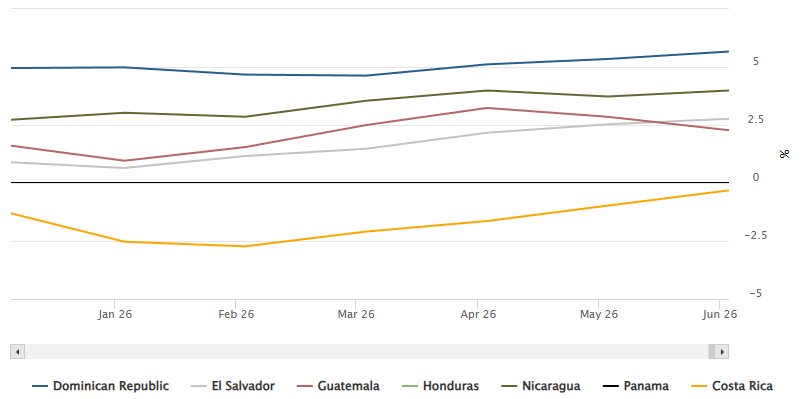
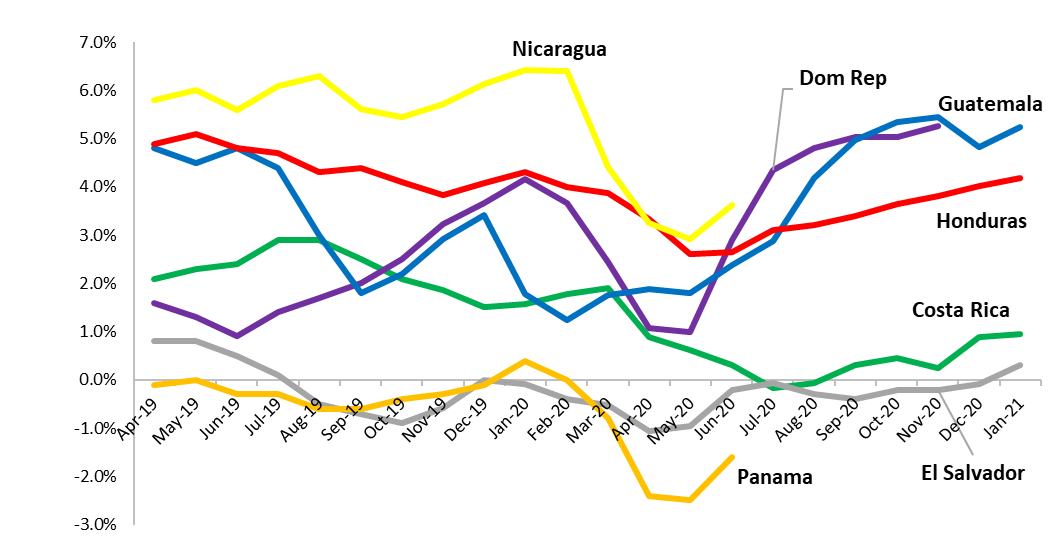
    Central America & Caribbean:​ Inflation
    Monthly year-on-year figures

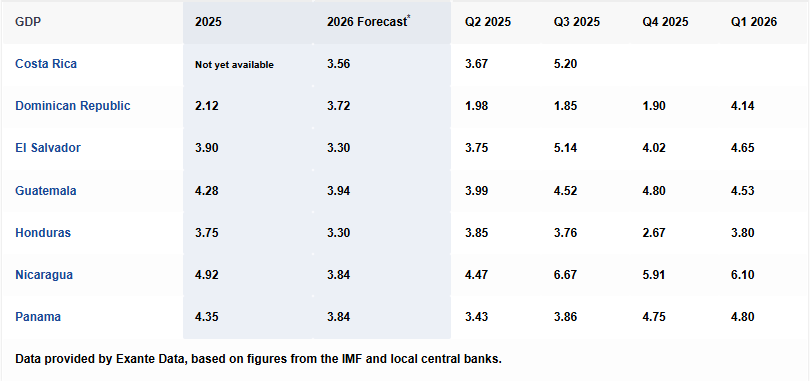
    Central America & Caribbean, selected countries: GDP growth (%)
    Quarterly figures are year-on-year growth
    GDP  2020 forecast* 2021 forecast* Q1 2020 Q2 2020 Q3 2020
    Costa Rica -4.8 3.0 0.8 -8.6 Not yet avaliable
    Dominican Republic -5.5 5.0 0.0 -16.9 -7.2
    El Salvador -8.6 3.5 0.8 -19.2 -10.2
    Guatemala -2.5 3.5 0.7 -9.6 -2.0
    Honduras -8.0 4.5 -1.5 -18.5 -7.9
    Nicaragua -4 1.3 1.8 -7.9 -2.5
    Panama -11 5.5 0.4 -38.4 -23.6
    *Forecasts from the United Nations Economic Commission for Latin America & Caribbean December 2020
    Quarterly growth based on figures from the local central banks


  • COSTA RICA: Major drugs haul

    Patrick de Courcy 27 August 2021 Hits: 4376

    In July Costa Rica’s security minister Michael Soto confirmed that the country’s authorities had seized 4.3 tonnes (t) of cocaine in a single seizure. This is the country’s second biggest single haul after officials found 5.48t in February 2020 at APM Terminals port of Moín hidden in a container due to be shipped to The Netherlands. It once again illustrates Costa Rica’s significance as one of the primary destinations in the region for the transit of cocaine, owing to its strategic location, long stretches of coastline, and the relatively small size of its security forces.

    Announcing the haul on 18 July, Soto said the drugs were seized at Gastón Kogan dock, Moín port, Limón province, during a routine inspection. He did not give further details but the local press reported that they was found in a container coming from Colombia. Soto said that with the latest drug seizure, authorities had so far confiscated 10.698t of cocaine this year.

    According to the US State Department’s latest (March 2021) International Narcotics Control Strategy Report (INCSR), during the period January-October 2020, Costa Rica seized over 43t of cocaine, exceeding the record of 35.1t confiscated during the same time period in 2019. It adds that the Costa Rican government led by President Carlos Alvarado reports having disrupted over 17 international drug trafficking organisations in 2020. It underlines that “concerns of violence have intensified the government’s fight against drug trafficking, leading to greater police professionalisation, advances in community security programmes, and improved success in drug interdiction and disruption of drug trafficking”.

    JOC

    The INCSR report on Costa Rica highlights as examples of this institutional strengthening, the fact that in 2019 Costa Rica established the country’s first-ever Joint Operations Centre (JOC), bringing together all major law enforcement entities and enhancing coordination of alerts, assets, and operations. It describes the new centre as the public ministry’s 24/7 command and control node for coordinating, directing, and monitoring joint law enforcement operations, and maintains continual communication with the US and other partner nation operations centres.

  • COLOMBIA: Duque’s US trip pays dividends

    Patrick de Courcy 14 October 2021 Hits: 4171

    Colombia’s President Iván Duque packed a lot into his 11-12 October visit to the US, meeting the heads of the International Monetary Fund (IMF), the World Bank, the Inter-American Development Bank (IDB), the Organization of American States (OAS), and the investment banks JPMorgan Chase and Goldman Sachs. The trip proved fruitful, with Duque announcing that he had secured US$2bn in finance from the World Bank, which he said would be used for environmental initiatives and to create opportunities for young Colombians.

    President Duque made a whistle-stop tour of key lenders over two days in New York and Washington, DC. The focus of the trip was economic, and in that regard it appears to have been a success, with Duque announcing that he had secured over US$2.3bn of foreign investment. The bulk of investment pledges came from the World Bank, which Duque said had committed to mobilising US$2bn towards mitigating climate change, strengthening Colombia’s health system, protecting biodiversity, and increasing youth employment opportunities. Duque also met Kristalina Georgieva, the IMF’s managing director, with whom he said he had a “productive” meeting regarding an extension of Colombia’s flexible credit line (FCL) beyond the end of his presidential term in May next year. Colombia has had an FCL with the IMF since 2009, but only used it for the first time in December 2020, when it withdrew US$5.4bn to stabilise its balance of payments during the coronavirus (Covid-19) pandemic.

    A solution to bee decline?

    On 11 October, scientists at Bogotá’s Universidad del Rosario called on the private sector to invest in a superfood they have discovered which, they say, will protect bees from the effects of pesticides – potentially offering a solution to the decline of the pollinating insects which is threatening future harvests of many crops. The researchers said that the superfood can be administered in either a syrup or solid form, and it can be left in areas where bees gather in search of pollen. According to the environmental NGO Greenpeace, bees pollinate 70 of the 100 most consumed human food crops, which together account for around 90% of the world’s nutrition.

  • CHILE: Alternative approach adopted

    Patrick de Courcy 21 July 2022 Hits: 3738

    In a combative interview on 15 July Chile’s President Gabriel Boric said that there was no question of the 1980 constitution approved during the military dictatorship being retained. Boric said that if voters failed to approve the constitution drafted by the elected constitutional convention (CC) over the last 18 months in a referendum on 4 September then the entire process would have to start again with a new body elected to rewrite the constitution. Five days later, however, members of his left-wing Apruebo Dignidad coalition and allies backed a bill in the senate reducing the high threshold needed to reform the constitution. This suggests that a piecemeal reform of the 1980 constitution could be the most likely approach should voters, as polls suggest, reject the CC’s draft constitution.

    “We will have to prolong the process for another year and a half, and go right back to scratch,” President Boric said when questioned in an interview with the local channel Chilevisión about what would happen if the ‘reject’ option comes out on top in September’s referendum on the draft constitution. Boric said there was a very clear mandate to reform the constitution, with 80% of people having voted in favour of this in a referendum in October 2020. Boric said there was “widespread agreement that the constitution we currently have does not represent a social accord in Chile” and needs to be superseded.

    Boric also stressed that any new constitution would have to be drafted by “a body especially elected for this purpose”. Some allies in congress demurred. Senator Fidel Espinoza of the Partido Socialista (PS) said that “the recently concluded constituent process cost a lot of money and we cannot waste [further resources] when the country is going through difficult times”, in reference to the cost-of-living crisis. A survey by Cadem for the national daily La Tercera at the weekend, however, showed that 74% of respondents favoured going through the process again if the current draft is rejected in September.

    But, on 20 July, the senate voted by 41-2 to approve a bill lowering the majority needed to reform the constitution from two-thirds to four-sevenths. The bill was presented by the centre-left opposition Democracia Cristiana (DC) and won the support of Apruebo Dignidad and its main ally Socialismo Democrático. The government spokesperson Camila Vallejo said “we have no problems with this bill”, which must now go to the lower chamber of congress for approval. Its passage looks assured as it also enjoys the support of the right-wing opposition. This could be problematic for the government. Voters rejected the idea of congress being involved in reforming the constitution in the 2020 referendum

    Presidents respond

    Speaking at a press conference in Peru this week, Chile’s former left-wing president Michelle Bachelet (2006-2010; 2014-2018) publicly supported the ‘approve’ option, saying the new constitution was imperfect but a step forward. Other political figures have been more cautious. Former president Ricardo Lagos (2000-2006) has not revealed how he intends to vote, but earlier this month said the constitutional debate should continue beyond the September referendum, to find a text which would build consensus. Former president Eduardo Frei Ruiz-Tagle (1994-2000), meanwhile, has said he will vote to ‘reject’ the constitution.

  • MEXICO: Political violence in the spotlight

    Patrick de Courcy 25 November 2022 Hits: 2226

    Armed attacks in Mexico’s municipality of San Miguel Totalapan, Guerrero state left at least 20 dead on 5 October. The attacks appeared to target local government officials, with municipal mayor Conrado Mendoza Almeda of the opposition Partido de la Revolución Democrática (PRD), his father – also a former municipal mayor - and several municipal officials all killed. Photos circulating in the local press in the aftermath of the attack showed the municipal government building riddled with bullet holes in a stark reminder of the dangers facing Mexican politicians - and those working at the local level in particular.

    Deputy federal public security minister, Ricardo Mejía Berdeja, concluded that the attack resulted from a turf war between two drug trafficking organisations (DTOs): Los Tequileros and the Familia Michoacana. Indeed, one of the supposed leaders of the Familia Michoacana, José Alfredo Hurtado “El Fresa”, posted a video on social media claiming he had been the target of the attack, along with Mendoza and his father. Hurtado stated that Familia Michoacana members were attending a meeting convened by Mendoza when the massacre occurred. However, armed men claiming to be Los Tequileros members also released a video in which they blamed Hurtado for the San Miguel Totalapan massacre, saying they were not “cowardly enough” to kill so many innocent people.

    • Los Tequileros

    Los Tequileros is believed to have begun operating in the Tierra Caliente opium poppy growing area of Guerrero around 2011. After expanding its base, in 2016 it engaged in a violent turf war with the Familia Michoacana, the group that traditionally dominated the area, and began undertaking kidnappings and extortion of the local population. The group was seemingly expelled from the area after local citizens formed an armed self-defence group and rose up against them. Mexican authorities announced that the group’s leader, Raybel Jacobo de Almonte “El Tequilero”, had been killed in 2018. The recent attack in San Miguel Totalapan could be a sign of Los Tequileros’ comeback.

    Although the truth surrounding the incident remains unclear, the massacre signals how local politicians can become caught up in rivalries between criminal groups. Rubén Salazar, the director of local consulting firm Etellekt, told Spanish newspaper, El País that the recurrence of violence against local politicians highlights a pattern of “narco-politics and impunity”.

    According to Salazar, the lack of a coherent national security strategy means that local politicians are vulnerable to violence caused by DTOs. Consequently, he says local governments can be forced to strike deals with particular criminal groups for protection reasons which can, in turn, exacerbate rivalries and cycles of violence.

    On the same day as the San Miguel Totalapan attack, Gabriela Marín Sánchez, a state deputy for the local Morelos Progresa party, was killed by two gunmen in the city of Cuernavaca, Morelos state. Mejía stated that revenge or a political matter could have motivated the attack, although noting that the motive had not yet been established.

    Just two days earlier, Pedro Díaz Martínez, the former municipal president of the local council in San Martín Itunyoso (Oaxaca state), was also shot and two other people were injured during an indigenous assembly in the municipality.

    Later, on 14 October, Mario Cedillo Infante, the mayor of Guerrero municipality (Coahuila state), was abducted with eight other people after being followed by armed men in trucks on the outskirts of Nuevo Laredo city in nearby Tamaulipas state. Following a joint search by the police and the army, Coahuila’s governor, Miguel Angel Riquelme, announced on Facebook that Cedillo and his companions had been set free. These incidents indicate the variety of threats posed to local politicians, even outside of election cycles.

    According to Salazar, 60 local politicians have been killed since President Andrés Manuel López Obrador took office in December 2018, including 18 mayors, 31 councillors, and 11 administrators. Such attacks are part of a long history of violence towards local politicians in Mexico. According to Etellekt, 1,271 politicians have been assassinated since 2000, including 144 aspiring or confirmed electoral candidates. The vast majority (81%) of victims were running for municipal positions. Although attacks spiked in the run-up to the June 2021 mid-term elections [SSR-21-06], Etellekt notes that levels of political violence have remained high since.

    According to Salazar the risk of further attacks against politicians is likely to increase in the run-up to the 2024 general elections. Salazar told local press that existing pacts between organised crime groups and local authorities are likely to be broken as new parties assume power in municipal and state governments, leading to retaliation attacks on new or former local authorities, and deepening the wave of political violence in Mexico.

  • PARAGUAY: Peña under pressure over Taiwan visit

    Abbi Dicker 04 June 2026 Hits: 483

    Paraguay’s President Santiago Peña shored up ties with Taiwan during a four-day state visit in May, affirming Paraguay as one of the few remaining countries to officially recognise Taiwan as a sovereign state. Despite this continued diplomatic engagement, Peña faces significant domestic pressure as his popularity wanes and critics argue that maintaining ties with Taiwan rather than with the People’s Republic of China sacrifices major economic opportunities.

    During the visit to Taiwan from 7-10 May, the Paraguayan delegation signed several cooperation agreements with their Taiwanese counterparts. These included commitments to foster deeper ties in areas such as cybersecurity and artificial intelligence (AI), with one memorandum of understanding for Taiwan to invest in the construction of digital infrastructure in Paraguay, such as a data processing centre for AI. Taiwanese companies such as electronics manufacturer Foxconn also expressed interest in opening subsidiaries in Paraguay.

    The rhetoric from Peña and other officials during this Taiwan trip emphasised the opportunities for Paraguay to integrate further into the supply chains of high-tech industries. Taiwan’s President Lai Ching-te also accompanied Peña to an industrial research park in the city of Tainan. According to a Paraguayan government statement, the delegation was seeking to better understand the technology and development models that have helped to position Taiwan as a global leader in computer chip manufacturing and other high-value sectors.

    Other agreements covered sectors such as trade and agriculture, with deals that looked to boost bilateral agricultural technology research initiatives, as well as a breakthrough for Paraguayan exports, with Taiwan authorising shipments of poultry. With this approval, the Taiwanese market will now be open to receiving shipments of Paraguay’s three main meat products – beef, pork, and poultry.

    China tensions

    However, Peña’s latest Taiwan trip has also drawn criticism from the Chinese government in Beijing. On 12 May Chinese foreign ministry spokesperson, Guo Jiakun, accused Paraguay of being a “pawn” of Taiwan’s “separatist” forces. Guo affirmed the People’s Republic of China’s claim over Taiwan and warned that “the wheel of history will not wait for any country, and deviating from the One China principle will only lead to isolation in the international community”.

    The spokesperson also highlighted that there is strong support among various economic sectors in Paraguay to deepen relations with China instead of Taiwan, claiming that opinion polls show 90% public support for boosting China ties. “This clearly shows that establishing diplomatic relations with China corresponds to the fundamental long-term interests of the Paraguayan people, while the connivance with Taiwan’s authorities does not enjoy popular backing,” he said.

    Paraguay’s ruling Asociación Nacional Republicana-Partido Colorado (ANR-PC) has for decades sided with Taipei over Beijing. This dates back to the 1950s, amid the efforts by Paraguayan military dictator, General Alfredo Stroessner (1954-1989), to shore up ties with global anti-communist figures such as Taiwan’s former nationalist leader Chiang Kai-shek (1948-1975). But Paraguayan opposition parties have in recent years been echoing the calls from the country’s agricultural exporters to try to boost access to the Chinese market, raising pressure on the ANR-PC government.

    Philippines visit

    After departing Taiwan, President Peña travelled to the Philippines where he met with the country’s right-wing leader and fellow US ally, President Ferdinand Marcos Jr, the son of former Philippine dictator Ferdinand Marcos (1965-1986). Although no major deals were announced by the Paraguayan delegation in Manila, Peña reportedly discussed opportunities to boost trade and cooperation on agriculture.

  • ECONOMIC HIGHLIGHTS

    Abbi Dicker 16 July 2026 Hits: 482

    GUATEMALA | FTA with Peru takes effect. On 1 July a new bilateral free trade agreement (FTA) between Guatemala and Peru took effect. In a joint statement, the two governments said that bilateral trade totalled US$1.22bn from 2020-2025, which they said indicates the potential for further growth. According to the same statement, for Guatemala, the new deal will benefit exports such as medicines, confectionary, paper, cardboard, aluminium products, and sauces. For Peru, the deal will benefit exports of grapes, blueberries, citrus fruits, asparagus, coffee, cocoa, textiles, and various manufactured goods. The FTA was first signed in Guatemala City on 6 December 2011, while a supplementary protocol was inked in Lima on 23 April 2025 to clear up outstanding issues.

    PANAMA | Canal expansion 10-year anniversary. On 28 June the Panama Canal Authority (ACP) commemorated the 10th anniversary of the opening of its expanded waterway. In a statement issued on 26 June, the ACP said the canal expansion “represented the largest infrastructure project since the opening of the original canal in 1914, generating tangible benefits for both Panama and the world”. It highlighted that “during the first eight months of Fiscal Year 2026 (October 2025 through May 2026), 8,593 transits were recorded, of which 27.7% correspond to Neopanamax vessels [the largest that the canal can handle], representing 2,385 transits”. It added that as of May 2026, over 31,000 transits had passed through the expanded locks since their inauguration and noted that the expanded canal “now accounts for more than 50% of the total revenues generated by the interoceanic waterway”.

    Central America & Caribbean: inflation rate
    Percentage variation (year-on-year)

    Central America & Caribbean: GDP growth (%)
    Quarterly figures are year-on-year growth

  • In Brief - Costa Rica

    LatinNews 02 March 2012 Hits: 1647

    Costa Rica | Chinchilla conducts minor reshuffle. On 1 March President Laura Chinchilla reshuffled her cabinet after Planning Minister Laura Alfaro announced she was stepping down to take up a teaching post at Harvard University. Chinchilla has replaced Alfaro with Communications Minister Roberto Gallardo, who headed up the planning portfolio under the Oscar Arias administration (2006-2010). Gallardo in turn has been replaced by Francisco Chacón, a deputy for the ruling Partido Liberación Nacional (PLN) who has also served as former deputy minister for foreign trade (1994-1997) and spokesperson for Chinchilla’s political campaign. Carolina Delgado, the deputy director of agriculture for the national production council (CNP) will take over Chacón’s seat. The officials will take up their new posts on 15 March.

  • Risk pointers

    LatinNews 05 December 2013 Hits: 438

    *** Australia rallies to Japan.  Commonsense tells one it would be the case (as we argued last week), but high-level sources have since confirmed that China’s unilateral action to declare an air defence identification zone (ADIZ) that covers the disputed Senkaku/Diaoyu Islands has strengthened both Prime Minister Shinzo Abe’s resolve and case for boosting Japan’s defence capabilities, including by changing the constitution.

    As regards wider reactions, it has been interesting in particular to see Australia providing such strong support for Japan given its past proclivity for hedging.

    Beijing’s ambassador to Canberra was called in to explain what China thought it was up to with its provocative move, and Foreign Minister Julie Bishop issued a statement saying that Australia “has made clear its opposition to any coercive or unilateral actions to change the status quo in the East China Sea”.

    Prime Minister Tony Abbott, for his part, described Australia as a “strong ally” of Japan.  The best that former prime minister Kevin Rudd could do in 2009 was to refer to Japan as “a critical strategic partner”.  Now Abbott has called Japan a “strong ally”.

    As one Australian expert noted: “Australia is injecting some much needed clarity about its strategic priorities.  Australia strongly believes that US primacy in Asia is vital both to its own interests and to the regional order more generally, and that any effort by China to change that setting will be destabilizing.”

    And it was a reasonably brave move given Australia’s former proclivity for hedging.  It prompted China to respond by saying: “China urges the Australian side to immediately correct its mistakes so as to avoid hurting the cooperative relationship between China and Australia.”

    There are, of course, many influential voices in Australia and elsewhere urging their governments not to fall out with China in the interests of business, trade, and economic growth, but these voices are not currently in the ascendancy.

    *** Mending fences with Hezbollah.  In what will be taken as further bad news by Saudi Arabia and Israel, Lebanese sources have been reporting increased European interest in improving ties with Hezbollah despite the categorization of Hezbollah’s military wing as a terrorist group by the EU.  Sources in Lebanon say that the Europeans, led by France, wish to rebuild contacts with the political wing of the group in part because of the growing threat from Sunni takfiri and fundamentalist groups.