All Categories

Subcategories

  • TRACKING TRENDS

    LatinNews 11 October 2012 Hits: 1589

    ECUADOR | Oil sector disputes. On 5 October the World Bank’s International Centre for Settlement of Investment Disputes (Icsid) ruled that Ecuador must pay US$1.77bn plus interest in compensation to the US oil firm, Occidental Petroleum Corporation (Oxy), for the cancelling of a contract conferring exploitation rights on Amazonian oil wells in 2006. Ecuador refused to pay Oxy any compensation arguing that the fact that Oxy sold 40% of its exploitation rights to Canadian firm, AEC, without notifying the Ecuadorean authorities violated Ecuadorean law and invalidated the contract. However, the Icsid tribunal, in a split decision, ruled that the cancellation of the contract had been “equivalent to an expropriation” and in clear violation of a bilateral investment protection agreement (TBI) signed by Ecuador and the US. The Ecuadorean government rejected Icsid’s ruling, with President Rafael Correa describing it as “another blow” to his country, adding that his government was preparing a challenge. On 8 October Ecuador’s attorney general, Diego García, said that Ecuador will seek to annul the ruling on the grounds that the Icsid tribunal lacks the “jurisdictional competence” to rule on the validity of the contract signed between the two parties.

        The negative Icsid ruling was tempered by the 9 October decision by the US Supreme Court not to intervene in a lawsuit filed against another US oil firm, Chevron Corporation, in Ecuadorean courts. After nearly two decades of dispute, last year a court in Ecuador ruled that Chevron had to pay US$18bn in compensation for environmental damage committed in the Amazonian region where the company operated during the 1990s. Chevron maintains that the judicial process in Ecuador had been flawed and requested the US judicial system to intervene on its behalf. However, the Supreme Court said that it would not consider Chevron’s request.

    • Oil sector slumps

    On 7 October Ecuador’s central bank released its economic data for the second quarter which showed that GDP had increased by 5.2% year-on-year on the back of better-than-expected performance of the construction and aquaculture sectors. However, according to the bank, the economy’s driving force, the oil sector, recorded a 1.3% decrease in the quarter which amounted to a 0.9% year-on-year decrease. Last year Ecuador’s economy grew by 7.9% on the back of a strong oil sector performance, but this year oil production has been affected by the scheduled maintenance works at the country’s main oil refinery at Esmeraldas and the economy’s overall performance is expected to be considerably lower. This forced the central bank to reduce its initial growth forecast of 5.4% for the year to 4.8% back in July.

  • CHILE: ECONOMIC OVERVIEW

    LatinNews 14 August 2013 Hits: 2678

    New minimum wage proposal: On 29 July President Piñera unveiled his new minimum wage proposal, which would increase the current monthly rate of Ch$193,000 (US$381) to C$210,000 (US$411). This is the second minimum wage proposal put forward by the Piñera government this year, after congress rejected its previous offer of an increase to C$205,000 (US$401).

    Piñera’s latest offer, which he noted represented a nominal readjustment of 8.8%, or 7.9% in real terms (based on annual inflation in the 12 months to May 2013), was approved in general by the lower chamber on 5 August and is currently being discussed in the senate. The government’s latest offer is still far below the C$250,000 (US$489) demanded by the country’s main union, Central Unitaria de Trabajadores (CUT).

    Alluding to the CUT’s demand, President Piñera claimed that there had been an average 4% real increase in salaries since he took office in March 2010, noting that if this “rhythm of nominal readjustment is maintained, we could reach the figure of C$250,000 by 2015”.

    Growth: On 5 August Chile’s central bank reported that the country’s economic activity index, Indicador Mensual de Actividad Económica (Imacec), rose 4.2% year-on-year in June. According to the bank’s press release, on a seasonally adjusted basis the Imacec rose 1% from the previous month, and was up 4.6% year-on-year. This was above the 3.5%-4.0% increase forecast by local analysts. The Imacec is considered a proxy for the country's GDP, as it includes 91% of the goods and services used to determine GDP growth. In July, the central bank cut its real annual GDP forecast by half a percentage point to 4%-5 after Chile’s copper commission (Cochilco) reduced its forecast for the international average price of copper, Chile’s main export commodity, from US$3.57 per pound (lb) to US$3.27/lb. The bank said it would issue another new growth forecast on 19 August.

  • ECUADOR: Inminente aprobación de la reelección indefinida

    LatinNews 06 June 2014 Hits: 581

    La prohibición constitucional que impide al Presidente de Ecuador, Rafael Correa, buscar la reelección por tiempo indefinido será levantada dentro de poco tiempo. Durante su discurso sobre el estado de la nación, el 24 de mayo, Correa expresó que después de una “profunda reflexión” había decidido buscar la aprobación por parte de Asamblea Nacional de nueva legislación para abolir los límites de términos para todos los funcionarios elegidos. Cinco días más tarde, la dirección del gobernante Alianza País (AP), como se esperaba, resolvió respaldar la propuesta. Como la AP tiene una mayoría decisiva en la Asamblea Nacional, su aprobación está asegurada.

    El 24 de mayo Correa a sus simpatizantes apostados afuera de la Asamblea Nacional que clamaban por su reelección (las próximas elecciones presidenciales no se celebrarán hasta el 2017), que lo único que le importaba era evitar “la restauración conservadora” en Ecuador, cuya amenaza, dijo, se ha incrementado significativamente después del revés sufrido por la AP en las elecciones municipales del pasado febrero. Correa dijo que el pueblo ecuatoriano sabe que él siempre se había opuesto en principio a la reelección, pero que había decidido que los votantes “deben poder decidir si sus líderes deben ser cambiados”. Crucialmente, él dijo que ahora creía en la estabilidad de las instituciones de Ecuador lo suficiente como para apoyar la iniciativa, aunque se puede decir que éstas serían debilitadas con la reelección por tiempo indefinido, que erosiona los controles y los equilibrios.

    Seguidamente, Doris Soliz, la secretaria ejecutiva de la AP, llamo a la formación de un gran “frente de unidad nacional para la continuidad y profundización de la Revolución Ciudadana” con los aliados políticos de la AP y las organizaciones sociales. Actualmente, los alcaldes tienen permitido competir por la reelección indefinida, como Jaime Nebot, del opositor Partido Social Cristiano-Madera de Guerrero (PSC-MG), ha hecho exitosamente en la ciudad costera de Guayaquil desde el 2000.

    Correa descartó convocar a un referéndum sobre la cuestión, diciendo que “una elección acerca de otra elección [es] inviable”, aunque esto es precisamente lo que ocurrió en Venezuela en febrero del 2009, cuando el entonces presidente, Hugo Chávez (1999-2013), premeditadamente utilizó un referéndum sobre la reelección indefinida como un plebiscito sobre su popularidad, después del revés sufrido en un referéndum sobre la reforma constitucional en el 2007. Correa pudo haber empleado la misma táctica después del revés para la AP en las elecciones municipales de febrero, pero eligió no hacerlo a pesar de que su popularidad le podría haber asegurado la victoria, a diferencia de la explotación de petróleo en la reserva nacional Yasuní, sobre lo que también prefirió evitar un referéndum (ver abajo).

    Mahuad condenado por malversación de fondos

    El ex presidente, Jamil Mahuad (1998-2000), fue sentenciado el 29 de mayo a 12 años de prisión por malversación por la Corte Nacional de Justicia (CNJ) de Ecuador. No hubo absolutamente ninguna circunstancia atenuante, concluyó la CNJ, teniendo en cuenta la “enorme alarma social causada por el delito, cuyas consecuencias la sociedad ecuatoriana aún está sufriendo”.

    Mahuad fue acusado de mala administración de los fondos del Estado declarando un ‘feriado bancario’ (lo que congeló las cuentas bancarias) en marzo de 1999, lo cual precipitó una debacle financiera, llevando a 20 instituciones financieras a la quiebra. El caso contra Mahuad se ha extendido por 13 años, durante los cuales el sistema judicial ha experimentado cambios significativos. Él fue absuelto provisionalmente en junio del 2006 por la que en ese entonces era la más alta corte, el Tribunal Supremo de Justicia (TSJ), en base a que no había suficiente evidencia contra él.

    Interpol ha emitido un alerta roja en nombre de Mahuad, quien respondió a la decisión en una carta acusando al gobierno del Presidente Rafael Correa de “persecución política”. Correa desechó la afirmación, sosteniendo que esto era puramente una cuestión judicial. Su única concesión a Mahuad fue que él (Mahuad) pudo haber permitido ser “manipulado por malos asesores y por el capital financiero”.

    Mahuad dijo que él había sido “lo suficientemente valiente como para tomar decisiones impopulares durante la peor crisis económica del siglo 20 en Ecuador”. Él dijo que se había visto “compelido por las circunstancias” para congelar los depósitos bancarios.

    • El referéndum sobre Yasuní

    El proceso de verificación llevado a cabo por el Consejo Nacional Electoral (CNE) de las firmas pidiendo un referéndum sobre la perforación en búsqueda de petróleo en Yasuní, presentadas por el grupo de presión, YASunidos, fue defectuoso de acuerdo con un grupo de profesores de la Escuela Politécnica Nacional (EPN) y la Universidad Andina Simón Bolívar (UASB). Los profesores llevaron a cabo un análisis estadístico de las firmas presentadas por YASunidos, concluyendo que 673.862 del total de 757.623 eran válidas, lo que hubiera sido suficiente para convocar a un referéndum. Ellos analizaron una muestra de 2.508 formularios que contenían 20.064 firmas, usando un programa de computadora para comparar los nombres con los números de los documentos de identidad. Ellos concluyeron que mientras que algunas de las firmas eran imperfectas (‘no cumpliendo con todas las formalidades’) ellas eran técnicamente válidas.

  • COSTA RICA: Challenging times for new security minister

    LatinNews 10 February 2015 Hits: 1108

    Gustavo Mata, a former deputy director of Costa Rica’s judicial investigation organisation (OIJ), was appointed as the country’s new security minister on 5 February, following the resignation of Celso Gamboa a few days earlier.

    Highlighting the challenges that Mata will face in office, the local media accompanied the news of his appointment with statistics showing a steadily rising murder rate. Mata said that his priority was to deal with “everyday” crimes, such as robbery, assault and theft. “Costa Ricans are worried,” he said.

    Mata served in the OIJ for most of his career, though for the last nine months he worked as Gamboa’s deputy at the security ministry. As well as tackling everyday crime, Mata also promised to improve relations between the police and the investigative authorities to ensure crimes were solved more readily. “Many times when we get to crime scene, it has not been sealed off, and that is a problem. […] We have been very successful at our work, but we must be more effective, in order to secure more convictions and to remove criminals from the streets.”

    Over his year in office Gamboa had succeeded in bringing down, albeit very slightly, the number of assaults; violent robberies had been brought down more effectively. Nevertheless, the murder rate has risen significantly over the past year. Last year 471 homicides were recorded, up from the 407 in both 2012 and 2013.

    The OIJ’s deputy director, Geraldo Campos, said that the increase in murders was linked to drug-trafficking. In November 2014, Costa Rica created a new court system designed to handle cases relating to drug trafficking. While Costa Rica has avoided much of the violence prevalent in neighbouring Central American countries due to the drug trade, there are increasing signs of gang infiltration in the country. Over the past few years, Costa Rican police have seized ever increasing quantities of cocaine.

    Gamboa, who was appointed by the former president Laura Chinchilla (2009-2014), is the first cabinet minister to leave the Partido Acción Ciudadana-led administration of President Luis Guillermo Solís. He will now work as an assistant prosecutor in the attorney-general’s office. Gamboa gave little indication of why he wanted to leave the job after just a year.

    A government wobble

    Gamboa's departure comes at a delicate time for the Solís administration, and he was forced to deny reports that he had stepped down to take up a job as minister for the presidency. The man in that position, Melvin Jiménez is facing a huge amount of pressure to quit from the opposition, but so far both Jiménez and Solís have shown no signs of backing down.

    Jiménez, the right-hand man of the president, has faced repeated calls to quit by legislators who argue that, as he is Lutheran bishop, he should be prohibited from holding public office, as per the Costa Rican constitution.

    The pressure on Jiménez to step down continued to grow after one of his closest advisors was forced to quit on 17 January, following accusations of political bribery.Daniel Soley, the now former deputy presidency minister, is accused of offering the attorney general, Ana Lorena Brenes, an ambassadorial post in return for her willingness to work cooperatively with the Solís administration. In his resignation letter, Soley made no reference to the specific allegations, but only the injury to his dignity the furore had provoked. In a congressional hearing on 22 January, Soley denied offering Brenes a job in any underhand fashion. Though desperate to find some evidence linking Soley’s actions to a specific request from his boss, Jiménez, no smoking gun was found. Jiménez, and Solís, have made it clear the minister is not going anywhere.

    • New PLN president

    On 7 February the opposition Partido Liberación Nacional (PLN) elected José Maria Figueres Olsen, Costa Rica’s former president (1994-1998), to lead the party for the next four years. Figueres, the son of the party’s founder, beat former deputy and president of congress (2006-2010) Francisco Antonio Pacheco Fernández by 89-46 votes. Pacheco represented the wing of the PLN aligned with Oscar Arias Sánchez, the two-term president (1986-1990; 2006-2010).

  • JAMAICA: Return to growth confirmed

    LatinNews 07 March 2012 Hits: 1826

    It is estimated that in the final quarter of 2011, the Jamaican economy grew by 1.7% year-on-year. If confirmed, this would mean that gross domestic product (GDP) growth for 2011 is 1.5%, the first annual advance since 2007.

    Further expansion is expected in the first quarter of 2012, but the wide estimated range of 0.5-1.5%, provided by the Director-General of the Planning Institute of Jamaica, Dr Gladstone Hutchinson, suggests continuing uncertainty. He says that the expected slowdown in the rate of expansion from the December quarter “reflects the normalization of output levels in industries such as mining and quarrying, tourism and agriculture”. In the December quarter, agriculture had registered a 16.4% increase, with mining and quarrying up 8.2%, manufacturing up 2.1%, and construction growing by 1.0%.

    With government expenditure accounting for approximately 40% of GDP, the other looming uncertainty is the impact of further budget cuts. The new People’s National Party (PNP) government under Portia Simpson-Miller, elected in December, has reiterated its commitment to reducing the national debt, currently standing at J$1.619 trillion (US$18bn), which is more than 130% of GDP. On 21 February, in a second round of supplementary estimates, the new government tabled J$22.4bn (US$259m) of further cuts, to reduce total expenditure to J$525.2bn (US$6bn), with J$12.5bn (US$145m) cuts in capital expenditure and J$9.8bn (US$113m) in recurring expenditure.

    An IMF team is due in Jamaica from 7-20 March to conduct a review which will serve as the start of formal negotiations for a new programme. Just ahead of this visit, the prime minister said that Jamaica would benefit from a Greek-style bailout. She said: “If they [the IMF] could give a bailout like Greece, lord have mercy, you would see Jamaica grow and flourish.” However, she added: “We know we would never be able to get the same level as Greece, but if we could get some consideration from countries or the IMF, we would be on our way.”


  • URUGUAY: Vázquez secures support for second coming

    LatinNews 14 August 2013 Hits: 2665

    Former president Tabaré Vázquez (2005-2010) will seek the presidential candidacy of the ruling Frente Amplio (FA) in 2014. Vázquez confirmed his intention to run after receiving the support of almost all of the myriad factions within the broad left-wing coalition for his candidacy. Having left office with an approval rating of close to 80%, Vázquez should emulate Chile’s Michelle Bachelet (2006-2010) by winning primary elections at a canter, assuming any other FA politician dares to challenge him, and also like Bachelet, will be the overwhelming favourite to secure a second term.

    Vázquez met a small group of FA grandees to confirm his candidacy on 7 August. These included Senator Lucía Topolansky, the wife of President José Mujica, who belongs to the largest FA faction, Movimiento de Participación Popular (MPP), which includes the Movimiento de Liberación Nacional-Tupamaros (MLN-T); and Deputies Julio Bango and Yerú Pardiñas, the latter secretary general of the Partido Socialista (PS), Vázquez’s former party.

    Representatives of the three parties in the centre-left Frente Líber Seregni (FLS) faction of the FA, aligned with Vice-President Danilo Astori, Vázquez’s moderate former economy minister, also attended: the leader of Nuevo Espacio, Senator Rafael Michelini; the transport and public works minister, Enrique Pintado, a founder member of Astori’s Asamblea Uruguay; and the governor of the southern department of Maldonado, Óscar de los Santos, of Alianza Progresista.

    Crucially, the MPP, PS and FLS have already pledged their full backing for Vázquez, and smaller parties like Frente Unido and Baluarte Progresista have followed suit. Indeed, the only party with clout which is yet to express its support for Vázquez explicitly is the Partido Comunista (PC), which was irked by Vázquez’s decision last June to vote in an opposition-organised public consultation in favour of a referendum on the abortion law approved last October. However, there is nobody else who has the same standing in the FA, or the same ability to unite disparate factions of the coalition.

    Pre-candidates will be confirmed in the FA national convention on 23-24 November, with primary elections to be staged next June, should anybody challenge Vázquez, and presidential elections on 26 October next year.

    Vázquez stressed that the most important thing right now was for the FA to support the Mujica administration, and crucial developments such as the deep water port in Rocha, the overhaul of deficient railway infrastructure, and environmentally friendly mining initiatives, rather than focus on his candidacy.

    This humility clearly struck a chord with Mujica who responded by publicly backing Vázquez’s candidacy in an unusual round of interviews on all of Uruguay’s major television stations. “(Vázquez) projects an image of security, stability, no crazy passions, adventures or lotteries,” Mujica said. “He is a cautious, prudent man, committed to a policy of change.”

    First marijuana, next cocaine?

    Vázquez pointedly expressed his support for a bill approved at the end of July which has attracted significant international media attention – that liberalising the cultivation, sale and consumption of marijuana under the control of the State [see our sister publication The Weekly Report for an in-depth discussion of this bill].

    Speaking in an interview with the national daily El Observador on 8 August, Vázquez said that the Mujica administration’s “multidisciplinary and inter-institutional” strategy for confronting the serious issue of drugs was laudable. He said that shifting the focus away from combating narco-trafficking to other “fundamental tools” in the drug fight, such as education, prevention, rehabilitation and, above all, regulation, was crucial. Under the draft law, individuals would be able to buy up to 40g of marijuana per month for personal consumption through pharmacies but would have to register their national identity card in order to obtain the drug, and be subject to government monitoring of their habit.

    Vázquez cited his administration’s frontal fight against tobacco. “We didn’t prohibit its consumption,” Vázquez said, “we regulated how it is consumed”. Under Vázquez, Uruguay became the first country in Latin America to ban smoking in enclosed public places and put in place strict legislation requiring large health warnings on cigarette packets and banning the sale of those branded as “light” or “ultra light”. Vázquez said: “Tobacco causes 5m deaths a year while consumption of substances classed as drugs causes 200,000. Let’s not focus so much on marijuana that we lose sight of the bigger picture.”

    Vázquez also went a significant step further, during an appearance on the current affairs programme Santo y Seña, when he said that he would be in favour of legalising and regulating the use of cocaine. He swiftly added that “it is not about liberalising the consumption of drugs. (Governments) need to provide better education so that people don’t consume them… More than liberalising, it is necessary to regulate the consumption of drugs.”

    Opposition rivals

    Vázquez will almost certainly be too formidable an adversary for any candidate from the opposition Partido Nacional (PN, Blancos) or Partido Colorado (PC, Colorados). Pedro Bordaberry, the leader of the PC, said the timing of his announcement was inappropriate given the “serious security problems” faced by Uruguay: two days earlier a police officer was shot dead in central Montevideo while attempting to apprehend thieves in a post office. PN Senator Jorge Larrañaga, who lost to Vázquez in the 2004 elections and is a likely presidential pre-candidate for the PN, said his cocaine proposal was “barbarous”.

    First same-sex marriage

    On 5 August the head of the Montevideo civil registry, Adolfo Orellano, revealed that the first ever same-sex marriage between two men had been officially recorded. Back in April, Uruguay’s congress finally approved legal changes that allow couples regardless of “their sex or sexual orientation to marry on the same terms and to the same effects as previously established by law”. The legal amendment formally came into effect on 5 August.

    According to Orellano, the first recorded same-sex marriage was conducted in extremis at a Montevideo hospital between two unidentified men, one of whom is terminally ill with cancer. Orellano said that given the circumstances the couple had asked to be married despite having failed to submit a prior written request to do so. Orellano himself approved their petition to carry out the ceremony at the hospital.

    Soon afterwards, local press reported that Sergio Miranda and Rodrigo Borda became the first same-sex couple to submit a formal written request to get married. The couple will now have to wait for up to nine days before the civil registry gives them a date for their marriage ceremony.

    • Alcohol

    While Uruguay’s congress is pushing through groundbreaking legislation legalising marijuana, the government is stepping up controls on alcohol. On 1 August, the government sent congress a bill to increase taxes on alcoholic drinks; outlaw ‘sales’ of alcohol, such as happy hours and open bars; limit overnight alcohol sales; and create a regulatory unit to issue licences for the sale and distribution of alcohol.

    • Fresh bond issue

    Uruguay sold US$2bn in a new 2024 global bond at a yield of 4.521% as a part of a debt liability operation that included a debt swap, the government said on 8 August. Uruguay accepted offers to swap the new paper for dollar-denominated bonds maturing in 2015, 2017, 2022 and 2025 with a market value of US$982.5m.The rest of the proceeds will be raised in cash to cover Uruguay's financial needs. The sale was managed by HSBC and Deutsche Bank.

  • ECONOMIC OVERVIEW: COSTA RICA

    LatinNews 10 February 2015 Hits: 1166

    Unions unhappy over wages increase: Leaders of Costa Rica’s principal trade unions have reported the government to the International Labour Organization (ILO) in protest at the recent negotiations over wage rises. Union leaders argue that the government only negotiated the settlement for public sector workers which was signed on 4 February and establishes increases of between 1.08% and 1.60% for the first semester of the year, with smaller, less significant unions. Gilberto Cascante, the president of the national association of teachers (ANDE) said that the executive had acted arbitrarily to fix the wage increase following the withdrawal of the main unions from talks. “We asked the labour minister to give us time to examine the proposals in our administrative boards, and he said no. Therefore he negotiated with only those who were willing to stay, and those were minority trade unionists,” he said.

    Wage negotiations between the government and the largest public sector unions have been acrimonious for some time, but taking the dispute to the ILO raises the stakes. Union leaders are now discussing further strike action. Victor Morales, the labour minister, said that the increase was fully compliant with the law. “At the negotiation table there was always a quorum; there has always been a quorum to take the decision,” he said.

  • Haiti: Gourde and growth down; inflation and interest rates up

    LatinNews 30 July 2015 Hits: 1694

    The weakness in the currency, and higher food prices, contributed to a surge in annual inflation in Haiti to 8.0% in June, from 6.6% in May. In spite of a stabilisation of industrial production and commercial activity in the second quarter, the central bank believes that overall real annual GDP growth could be below the 2.5% anticipated in the government’s budget for the September 2015 fiscal year.

    The Banque de la République d’Haïti (BRH, the central bank) has allowed the gourde to depreciate from US$1:HTG46 to nearly US$1:HTG57 since late June. The BRH had previously held the currency broadly constant since November 2014.

    In a speech on 17 July 2015, BRH Governor Charles Castel identified a number of factors that had influenced the various players in the currency market. One [1] is the continuing deterioration in the current account. Although exports of goods and services rose by around 60% between 2009 and 2014, imports have consistently been larger, and have grown by more, increasing from just over US$2.8bn to a little under US$4.6bn in the same period. Thanks to slippage in the international price of oil, fuel imports in the eight months to the end of May this year were US$451m, down by nearly a third relative to the previous corresponding period. But the drop in the cost of oil imports, while good news, is not sufficient to make much difference to the overall balance of trade. Official aid transfers soared in 2010 as a result of the earthquake on 12 January that year. However, they have since been trending downwards. Thanks to the general growth of the US economy, remittances from Haitians living and working in that country have grown, but again not by enough to offset the fall in transfers.

    In the recent past, purchases of the Haitian currency by international organisations operating in the country have fallen – from US$113m in the nine months to the end of June 2014 to US$71m in the nine months to the end of June 2015. This is substantially the result of the winding down of the UN MINUSTAH mission. Further, liquidity within Haiti’s banking system has been boosted by seasonal falls in government revenues and increases in spending. An additional factor influencing the currency market has been heightened risk perceptions, in advance of the elections due to take place on 9 August.

    All this is in the context of a very weak structural/ institutional environment. According to the budget, the economy was expected to grow in real terms by around 2.5% in the current fiscal year. This represents a deceleration relative to growth in the September 2013 (4.2%) and September 2014 (2.7%) Fiscal Years and relative to the average over the three years to September 2014 (3.9%). The slow growth is in spite of investment having amounted to 35%-38% of GDP each year since the end of 2006. By way of contrast, the corresponding figures for the Dominican Republic and the UN’s list of 48 Least Developed Countries (LDCs) have been 16%-17% and 23-25%. As Castel notes, the near stagnation in Haiti’s economy has been due significantly to the poor quality of public spending. Further, the weakness of Haiti’s tax administration, and the large percentage of people working informally, has meant that tax revenues have fallen from 12.9% of GDP in the September 2011 Fiscal Year to 11.9% in the year to September 2014. In the Dominican Republic, by contrast, the corresponding figures have risen from 12.6% to 15.0%. In Jamaica, the rise has been even greater, from 22.2% to 25.9%.

    The weakness of the currency has contributed to a sharp uptick in inflation. Consumer prices rose by 1.9% month-on-month and 8.0% year-on-year in June. In May, the corresponding figures were 0.8% and 6.6%. The increase in annual inflation, of 134 basis points, was the strongest recorded since February 2011. In part because of the drought, there has been a fairly pronounced rise in food prices, which increased by 2.3% in June and by 8.1% over the preceding year. Clothing and footwear prices grew by 2.8% and 14.3%. These two categories account for about 57% of the basket of goods and services on which Haiti’s consumer price index is based.

    The BRH has been actively removing liquidity and supporting the currency. Over recent months, it has increased the reserve requirement ratio (RRR, the percentage of deposits with commercial banks that must be deposited with the central bank) from 40% to 48% for US$ deposits and from 38% to 44% for gourde deposits. (As of the end of April this year, US$ deposits accounted for about 57% of the total). The RRR that is applied to deposits of public sector entities is 100%. The BRH has also reduced liquidity by sales of US dollars to buy gourdes and through the sale of bonds. Collectively, these measures have taken HTG12bn out of the banking system since the beginning of October last year. The central bank has also imposed a ban on new US dollar lending, with effect from the beginning of July, and has sharply increased official interest rates. The BRH’s seven, 28 and 91-day rates now stand at 10%, 12% and 16%, having been 3%, 4% and 5% at the end of September 2014.

    According to Castel, the BRH will continue to remove liquidity from the system if necessary. The gross foreign exchange reserves available to the central bank amount to US$1.8bn, which is equivalent to around five months of imports. Net reserves amount to around US$860m (the main reason for the difference is Haiti’s allocation of special drawing rights (SDRs) with the International Monetary Fund (IMF): these are regarded by the IMF as both an asset and a liability. Gross reserves were just over US$1.9bn at the end of September 2014.

    In its early July monetary policy report, the BRH noted that economic growth in the current Fiscal Year could come in below the 2.5% anticipated in the government’s annual 2015 budget. This outcome is the result of the drought and the lack of business confidence in the run-up to the elections in August. Mainly because of lower output of food and textiles/ clothing/ footwear, the index of industrial production compiled by the Institut Haïtien de Statistique et d’Informatique (IHS, the national statistics agency) was down 7.5% year on year in the second quarter. More recently though, there are indications that industrial production and commercial activity have stabilised.

    Looking forward, the prospects for Haiti’s economy appear unexciting. The weakness of the currency will likely pressure inflation upwards for some time to come. The economy is growing, but not rapidly enough to have an impact on entrenched poverty. It is difficult to envisage a significant improvement in the overall business environment. Positive wildcards include: a possible further substantial fall in the international price of oil; higher-than-expected remittances from Haitians working in the US, thanks to the general strength of that economy; and growth in employment, trade and investment thanks to the opening of Port Lafito.

    The opening of Port Lafito

    Port Lafito was officially opened on 2 July 2015. Located 20km north of Port au Prince, it is the country’s first modern international port and terminal, with capacity to accommodate Panamax-sized ships. It currently occupies 400 hectares of oceanfront land, although this will be extended to 900 hectares in due course. Port Lafito was developed by a local conglomerate, GB Group. The port development was funded by private sector and international development banks including the State Commercial Bank – Banque Nationale de Crédit SA, The Industrial Development Fund, The International Finance Corporation (IFC – the private sector arm of the World Bank), the Nederlandse Maatschappij voor Financierings-Ontwikkelingslanden NV (FMO – the Dutch development bank) and National Insurance SA. Total investment in the port prior to the end of 2015 will amount to US$145m.

    The operation of the port (and the associated ferry terminal) will be managed by SSA Marine, the largest independent private operator of passenger terminals in the world. The port is equipped with two Liebherr LHM 420 mobile cranes, the first of their kind in the Caribbean. Port Lafito can handle containerised and loose-bulk cargo. An agreement has been reached with PortMiami to exchange information and ideas about the promotion of trade and freight between the two ports. Agreements have also been reached with Evergreen Marine and King Ocean Services to include Port Lafito as a port of call.

    According to GB Group, Port Lafito is a key element in the development of Lafito Global, an economic zone that will also include an industrial free zone, a business park and a residential precinct. The company thinks that the overall project will generate 25,000 new jobs by 2020.

    Haiti's current account (US$mn), 2009-2014

    2009 2010 2011 2012 2013 2014
    Exports of goods and services 1,034 1,016 1,312 1,324 1,567 1,655
    Imports of goods and services 2,804 4,287 4,433 4,195 4,419 4,559
    Balance of trade -1,770 -3,271 -3,121 -2,871 -2,852 -2,904


    Inwards transfers:


    Official aid 395 1,840 1,446 988 750 563
    Remittances 1,376 1,473 1,551 1,612 1,781 1,977
    Total transfers 1,771 3,313 2,997 2,600 2,531 2,540


    Outwards transfers -135 -167 -240 -232 -248 -249
    Other items 12 22 38 55 32 12


    Current account balance -122 -102 -327 -449 -537 -600
    As percentage of GDP -3.45 -1.54 -4.35 -5.69 -6.36 -6.89

    Source: BRH
  • ECONOMIC HIGHLIGHTS

    Patrick de Courcy 14 February 2023 Hits: 3382

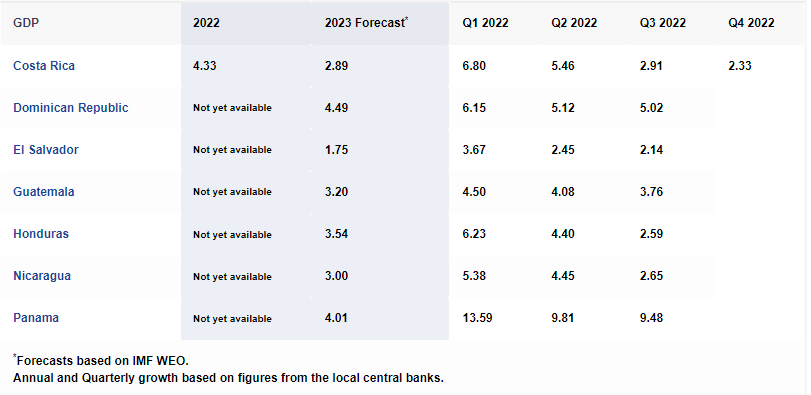
    NICARAGUA | IMF highlights strong reserves. On 27 January the International Monetary Fund (IMF) released a new report which forecasts that Nicaragua’s GDP grew 4% in 2022, supported by “external demand, remittances, and high prices for commodity exports”. The 2022 figure is down from 10.3% in 2021, which had followed a protracted contraction during 2018-2020, caused by the socio-political crisis of 2018, two major hurricanes in 2020, and the coronavirus (Covid-19) pandemic, according to the report which was released following the conclusion of an Article IV consultation. The IMF states that Nicaragua’s gross international reserves have doubled since end-2018, to over US$4bn which it notes is about six months of imports, excluding maquila. It expects GDP growth to moderate to 3% in 2023, due mainly to the global slowdown. In the medium-term the IMF expects Nicaragua’s GDP to grow by around 3.5% which it notes is “below the pre-crisis historical average as credit to the private sector and private investment cautiously recover”.

    COSTA RICA | Gov’t body hails rise in tourism. On 26 January Costa Rica’s tourism institute (ICT), a government body, released new figures showing that 2.35m tourists visited Costa Rica in 2022, of which 2.12m arrived via air. According to the ICT, the 2022 figure, which represented 75% of tourist arrivals registered prior to the pandemic, was over a million more than in 2021 and was higher than the 2.02m figure forecast for 2022 by the authorities. The ICT highlights that the US remains the main source of tourists, accounting for 1.25m tourist arrivals via air with all North American airlines operating in Costa Rica prior to the pandemic having resumed their services, as well as expanding flights.

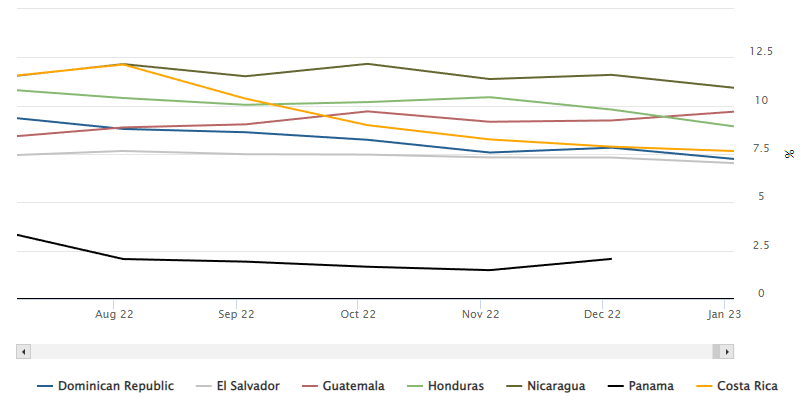
    Central America & Caribbean: inflation rate
    Percentage variation (year-on-year)

    Central America & Caribbean: GDP growth (%)
    Quarterly figures are year-on-year growth

  • BRAZIL: New public security plan unveiled

    Patrick de Courcy 05 October 2023 Hits: 2650

    Brazil’s minister of justice & public security, Flávio Dino, announced on 2 October the launch of a new crime-fighting initiative aimed at combating criminal organisations, especially gangs active in drug trafficking around large port cities, such as Salvador, the capital of Bahia state. The federal government will increase funding for security forces and aim to improve collaboration with state police and other anti-gang authorities, amid recent concern about rising violence in Bahia.

    According to a 12-13 September survey carried out by the national pollster Datafolha, violence ranked as the joint highest public concern, along with health; 17% of responses indicated ‘violence/security/policing’ as the top concern. Before President Luiz Inácio Lula da Silva took office at the start of the year, Datafolha’s December 2022 poll showed only 6% of responses ranking violence as a top concern. 

    The Lula administration launched a security initiative in July known as the ‘Programa de Ação na Segurança’ (PAS) and the programme launched this week marks a continuation of the PAS. Dino announced R$900m (US$174.7m) in funding for federal and state authorities to implement around 40 policy actions which are designed to improve institutional integration, the efficiency of police units, the policing of borders and ports, and the efficiency of the criminal court system.

    Before the launch of the latest security initiative, the national daily Folha de São Paulo interviewed Benedito Mariano, the security secretary of Diadema, a city in São Paulo state, and a founding member of Lula’s ruling left-wing Partido dos Trabalhadores (PT). In an article published on 2 October, Mariano criticised Dino’s ministry of justice & public security for not implementing enough ‘community policing’ initiatives and lamented the violent police crackdowns in Bahia, saying that it “is unacceptable [to have] 60 deaths by police action in one month”.

    Mariano also disapproved of the recent rhetoric from Dino’s deputy security minister, Ricardo Cappelli, who defended the militarised approach to policing in Bahia. The national broadcaster CNN Brasil interviewed Cappelli on 28 September and, when asked about potential excesses of police force, he said you cannot fight armed criminal gangs with “roses”.

    Federal reinforcements in Rio

    The security minister Flávio Dino also authorised on 2 October the deployment of federal security units to support the state police forces of Rio de Janeiro in their anti-gang operations. However, the state-owned news outlet Agência Brasil reported on 4 October that Dino has postponed the deployment after the federal prosecutor’s office (MPF) questioned the federal security ministry on the measures in place to ensure that the federal deployment complies with human rights protocols as determined by Brazil’s supreme court (STF) and Inter-American Court of Human Rights (Corte-IDH).

  • The ubiquity of social media

    Patrick de Courcy 16 November 2023 Hits: 621

    False news and the use of information technology for manipulative purposes takes on added importance because of the explosion of social media usage in Latin America and the Caribbean. Most of these techniques are not being tested in the background but are being deployed directly to millions of internet users. It is estimated that the region’s online population reached over 540m people at the end of 2022, making it the fifth largest regional social media market globally. Within the region Brazil (165m social media users) and Mexico (98m) are dominant. It has been estimated that audiences in the region spend an average of 214 minutes on social media every day, making it by far the most popular form of media, eclipsing more traditional media such as newspapers and linear television. According to an Atlas VPN study in 2022, the region’s heaviest internet users are the Brazilians. Argentines, Colombians, and Chileans.  

    The most common activities when users are online include liking and interacting with posts by others and sending private messages, often through platforms such as WhatsApp and Telegram.  It is estimated that in 2022 advertisers spent around US$5.3bn on social media. The overall value of the ‘influencer’ market in the region could be three times larger than that.

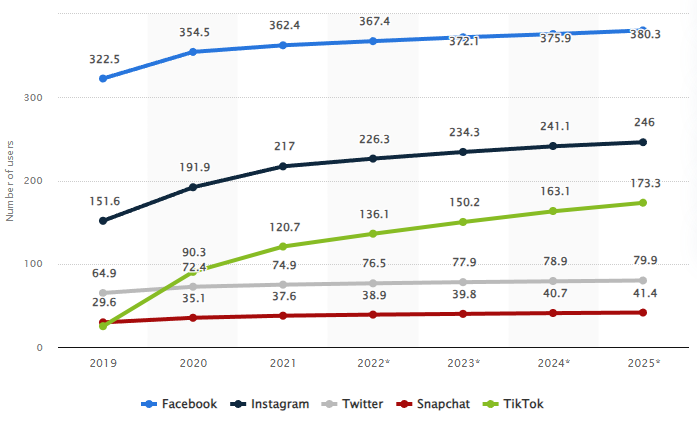
    According to projections compiled by data company Statista, Facebook will remain the most popular social media platform in the region, at 380m users by 2025, albeit with a slowing user growth rate. Chinese-owned TikTok has been the fastest growing, with a particularly strong appeal for young people. It has become the third most popular platform, expected to reach 173m users by 2025. Others include Instagram (currently the second most popular), X (formerly Twitter), and Snapchat.

    Number of social network users in Latin America from 2019 to 2025, by platform (in millions)

    Source: Statista

  • URUGUAY: El gobernante FA agobiado por las tensiones

    LatinNews 19 September 2011 Hits: 573

    El Presidente José Mujica destituyó esta semana a su ministra de desarrollo social, Ana Vignoli, en medio de serias tensiones internas dentro de la gobernante coalición Frente Amplio (FA), enfrentando a radicales contra moderados. Vignoli proviene del Partido Comunista Uruguayo (PCU), que está elevando sus ataques sobre la política económica del gobierno. El PCU domina la principal organización sindical del país, el Plenario Intersindical de Trabajadores-Convención Nacional de Trabajadores (PIT-CNT), que está amenazando con montar una huelga más tarde en este mes, sobre la aprobación del gobierno de una ley “neoliberal” clave, de participación pública-privada, para ayudar a realizar una revisión exhaustiva de la decadente infraestructura.

    La destitución de Vignoli fue el primer cambio en el gabinete desde que Mujica asumió el poder en marzo de 2010. Ocurrió poco después que la oposición y partes del FA, habían denunciado el manejo que hizo su ministerio con relación a las bajas temperaturas en Uruguay, que costó la vida de seis personas sin techo. Mujica dijo que él no esperaba que su gabinete de ministros sea perfecto, pero sí esperaba que pongan el alma en la tarea. Daniel Olesker, el ministro de salud y miembro del Partido Socialista (PS), reemplaza a Vignoli. Mujica dijo que Olesker era “más económicamente orientado” que Vignoli (lo que implica claramente que es “de mentalidad menos política”) para ayudar a resolver los problemas sociales del país. Dijo que el monto del gasto social que el gobierno intenta hacer significa que se necesita a un economista al timón para elevar la eficiencia.

    Mujica preservó el delicado equilibrio en la representación partidaria en su gabinete: el segundo de Olesker, Jorge Venegas (PCU), asumió la cartera de salud vacante. Pero, despojar al PCU del ministerio de desarrollo social debe haber provocado escozor en el partido y parece más bien un llamado al orden lanzado por Mujica. El PCU siente que es el dueño del ministerio debido a su inquebrantable compromiso para mejorar la distribución del ingreso a través de políticas sociales focalizadas.

    Mujica lo ha negado, pero es difícil disociar el despido de Vignoli de la abierta oposición del PCU a la ley insignia del gobierno, la ley de participación pública-privada. El congreso aprobó unánimemente la ley esta semana, pero un diputado del PCU se retiró desafiando a la dirección del FA, y dejando a su suplente, un miembro del Movimiento de Participación Popular (MPP) de Mujica, para que deposite su voto en su lugar. El PCU comparte las sospechas del PIT-CNT en el sentido que la ley conducirá a la privatización, por la puerta trasera, de compañías del sector público. Hay una lucha de poder entre el PCU y el MPP, que han estado celebrando reuniones de crisis para producir formas de respaldar a la administración Mujica.

    La reprimenda de Mujica al PCU es un claro gesto hacia su Vicepresidente Danilo Astori, el arquitecto de la política económica de Uruguay, cuyo sucesor escogido en el ministerio de economía, Fernando Lorenzo, ha estado recibiendo críticas del PCU. No está claro si Mujica obtuvo un quid pro quo de Astori para apoyar su impuesto adicional a los grandes propietarios de tierras (a la que Astori se opuso públicamente) lo que podría tratarse de una concesión para el PCU [IL-11-22].

    • Participación Pública-Privada

    La ley de participación público-privada (PPP) permitirá al estado atraer capital para proyectos de infraestructura, como la construcción de rutas, puentes, instalaciones de prisión y escuelas. El PCU alega que la coalición de izquierda Frente Amplio siempre ha mantenido que su “sector estratégico” debería ser conducido por el estado, y que el FA está traicionando sus raíces. Sospecha que el PPP es un escalón que forma parte del plan de privatización total de las compañías públicas. El Presidente Mujica ha sostenido desde hace tiempo que uno de los más grandes obstáculos para el desarrollo sostenido en Uruguay es la deficiente infraestructura.

  • TRACKING TRENDS

    LatinNews 11 October 2012 Hits: 1663

    REGION | Chile to lead economic growth. According to the latest forecasts in the International Monetary Fund (IMF)’s World Economic Outlook Report published on 8 October, Chile will lead the way in the Southern Cone this year with a projected growth rate of 5%. Indeed, Chile was the only country in the sub-region for which the IMF revised up its growth forecasts (from 4.3%) since its last forecast released in July. In contrast the IMF revised down its forecasts for the two larger economies in the Southern Cone: Brazil and Argentina. The Fund now believes that Brazil will close the year with 1.5% growth, down from 2.5%. Argentina is expected to post 2.6% growth, down from 4.2%. The forecasts for the remaining two economies in the region, Uruguay and Paraguay, remain unchanged with projections of 3.5% and -1.5% respectively.

    The IMF said that the downward revision in Argentina and Brazil could be attributed to the fact that both economies have suffered from ongoing global economic crises and lingering uncertainty in economic markets. However, arguably these factors should also have negatively affected Chile’s economic performance. Yet the Chilean economy has been posting impressive figures, showing enormous resilience, and seems set to all-but match its economic growth rate of 5.9% recorded last year.

    While economic performance is affected by a number of factors it is important to note that of the five countries that make up the Southern Cone sub-region, Chile is the only one that is not a member of the Southern Common Market (Mercosur) trade bloc and this may provide a plausible explanation as to why the Chilean economy has managed to perform better than its neighbours this year. Since last year trade between Mercosur has suffered as both Brazil and Argentina have engaged in protectionist practices imposing barriers to trade even within the bloc. The strong economic ties between the four Mercosur markets mean that this has significantly affected their economic performances. Chile is much less dependent on Mercosur trade.

  • RASTREANDO TENDENCIAS

    LatinNews 25 April 2014 Hits: 877

    ARGENTINA-PARAGUAY | Negociaciones sobre Yacyretá. El 21 el ministerio de relaciones exteriores de Paraguay anunció que los gobiernos de Paraguay y Argentina habían acordado comenzar la revisión de los términos del tratado que rige la represa hidroeléctrica de Yacyretá compartida por los dos países.

    Por años, el Paraguay se ha quejado de que los términos del tratado de 1974 bajo el cual Paraguay acordó reembolsar a Argentina por los préstamos que asumió para construir Yacyretá y bajo el cual los socios están forzados a vender cualquier exceso de energía producida en la planta uno y otro a precios preestablecidos (por debajo del precio del mercado), son perjudiciales para el país.

    Paraguay vende la mayor parte de su porción de la energía producida en Yacyretá a Argentina (el 94,3% de toda la energía producida por Yacyretá ahora es consumida por Argentina, lo que representa el 20% de la demanda de energía del país). Aún así, Argentina calcula que Paraguay aún le adeuda unos US$11mm (US$6,4mm en principio, más intereses) por la construcción de la represa. Sucesivos gobiernos paraguayos han rechazado esto, alegado que este no sería el caso si Argentina aceptase la venta del exceso de la energía de Paraguay producida en Yacyretá como reembolso. Por lo tanto, en el 2012, Paraguay anunció que consideraba que la deuda había sido totalmente pagada y amenazó con frenar el pago anual de interés (US$1mm) sobre la deuda. Pero esta visión no es compartida por Argentina y la cuestión se ha vuelto un punto irritante en las relaciones bilaterales.

    Desde entonces, Paraguay ha aguardado impacientemente por el 40mo aniversario del tratado (marcado el 27 de marzo), cuando se abre la posibilidad de revisar el tratado para presentar su caso. Esto ahora está fijado a tener lugar el mes próximo después de que una delegación encabezada por el canciller de Argentina, Héctor Timerman, visitara Asunción para avanzar sobre la agenda bilateral. Después, la cancillería paraguaya difundió una declaración diciendo que ambos gobiernos habían acordado lanzar el proceso de revisión del tratado durante una reunión entre el canciller de Paraguay, Eladio Loizaga, y el ministro de planeamiento de Argentina, Julio de Vido, en la “segunda mitad de mayo” en la planta de Yacyretá.

    PARAGUAY | Récord de reservas internacionales. El banco central del Paraguay (BCP) reveló la semana pasada que las reservas extranjeras del país se habían incrementado en US$267m en los primeros tres meses del año, llevando la cifra total a un nuevo récord de US$6,14mm. Las reservas internacionales de Paraguay han estado creciendo consistentemente desde el 2010, cuando estaban en US$4,16mm, apoyadas en un sólido crecimiento económico y un incremento general en los niveles de ahorro nacionales.

    Rafael Lara, miembro de la junta de directores del BCP, dijo que el “dinámico” incremento en las reservas internacionales observado en el primer trimestre del año fue conducido primariamente por los altos niveles de depósitos hechos en el sistema bancario local. Más depósitos en el sistema bancario interno se traducen en incrementados niveles de reservas a través del mecanismo del encaje legal, por medio del cual una porción de los depósitos de todos los bancos son retenidos por el BCP. Según Lara, los datos del BCP muestran que los depósitos bancarios totales en febrero (el último mes del cual las cifras están disponibles) fueron US$12,44mm, un 22% más que en el mismo mes del año pasado.

    Teniendo en cuenta que se espera que la economía de Paraguay continúe creciendo con fuerza en el próximo par de años –en su último informe sobre el Panorama Económico Mundial (WEO, siglas en inglés) del Fondo Monetario Internacional (FMI), pronostica tasas de crecimiento del 4,8% para este año (la tercera más alta en Suramérica) y del 4,5% para el 2015– es probable que las reservas del país continuarán creciendo, proveyendo una política de reaseguro contra los impactos externos para el gobierno del Presidente Horacio Cartes.

    CHILE | Emisión de bonos en Hong Kong. El 16 de abril el Banco de Chile, el segundo mayor banco comercial del país, anunció que había recaudado US$77m en bonos emitidos en el mercado de Hong Kong. Esta es la quinta emisión de bonos que el banco ha realizado en Hong Kong, donde ha conseguido reunir unos US$421m hasta la fecha.

    El director del tesoro del banco de Chile, Sergio Karlezi, dijo que los bonos a cinco años ofrecieron un rendimiento del 3,08%, similar a las emisiones internacionales previas del banco. Karlezi agregó que los fondos obtenidos a través de la operación permitirán al banco continuar expandiéndose durante el próximo par de años y consolidar su presencia en nuevos mercados, pues “el banco continúa con su política de diversificar sus fuentes de financiamiento”. En años recientes, el Banco de Chile ha emitido bonos en los mercados financieros de Suiza, Japón, EU, México, y Perú.

    • El ‘Ferrari’ de Porteiro

    El recientemente designado presidente del Banco de la República oriental del Uruguay (Brou), el cual es controlado por el Estado de Uruguay, Julio César Porteiro, dijo el 22 de abril que en su opinión, el Presidente José Mujica lo ha puesto a cargo de un ‘Ferrari’. Los comentarios de Porteiro fueron hechos después de asumir oficialmente el control del Brou, uno de los bancos líderes del país, el día anterior. Son una referencia a su designación en el 2002 como presidente del Nuevo Banco Comercial,  en parte propiedad del Estado, que fuera creado en la estela dejada por la crisis financiera del 2001-2002 de los remanentes de un número de bancos locales en quiebra. En esa ocasión, Porteiro dijo francamente que él estaba consciente de que lo habían puesto a cargo de un ‘banco Frankenstein’ que sería difícil de manejar.

  • CUBA: Still in dial-up mode

    LatinNews 02 December 2015 Hits: 335

    Almost a year after ‘17-D’, as Cubans dubbed the historic move to restore US-Cuba relations, expectations are growing on the island for faster change and for more engagement with the outside world. Many islanders, however, are disappointed with the pace of President Raúl Castro’s economic reform process, with the nascent new entrepreneurial sector still largely fenced-in by a tightly controlling state. Nowhere is people’s frustration more evident than in the continued lack of access to the Internet.

    As it did on several occasions in the run up to 17-D, The New York Times (NYT) has taken a noticeably strong editorial stance advocating greater US government and corporate engagement with Cuba. The NYT has long also called for the removal of the half century-old US embargo on Cuba. In a 30 November article by the editorial board entitled ‘Time to bring Cuba online’, the daily argued that “the only thing keeping the island in the digital Dark Ages is a lack of political will”, noting that Cuban officials can no longer blame the embargo on the island’s obsolete telecoms infrastructure, following regulatory changes implemented by the US government led by President Barack Obama in January 2015 that provide Havana with “a number of options to expand Internet coverage quickly and sharply”.

    “If the government took advantage of that, the island’s anemic economy could get a much-needed jolt, and young Cubans who are determined to emigrate, a powerful reason to reconsider”, it continues, suggesting that the US giant Google, which likewise has taken a strong stance in favour of engagement with Cuba - and whose CEO Eric Schmidt publically expressed on a trip to Havana last year an interest in helping to upgrade Cuba’s infrastructure - could help Cuba ‘plug in’. “Partnering with Google, which has enormous lobbying clout in Washington”, the NYT adds, “could advance Havana’s goal of building enough political support in Congress to repeal the embargo and would make it harder for a future president to dial back the restoration of diplomatic ties”.

    Having pledged in December 2014 to expand Internet access “without haste, but without pause”, in July 35 hotspots were set up at locations around the island. Havana has five, costing a hefty US$$2.50 an hour to use. According to US media reports, Google already has offered the Havana government a detailed plan to provide faster Internet at very little cost to the government. The NYT points out that Google could connect Cuba up to additional submarine cables, “ which would vastly improve speeds, and develop a hybrid distribution network that would include fiber-optic cables, cellular data towers and Wi-Fi access points”.

    “Cuba could also decide to do business with non-American technology companies, as Myanmar did after it began opening its political system in 2013”, it also posits. In fact, there are some indications that this is exactly what the Havana government is doing. According to reports that first circulated in June, the Havana government is working with its strategic partner China to bring broadband to the country.

    A Cuban blogger, Carlos Alberto Pérez, who produces the blog,‘La Chiringa de Cuba’, on 23 June last posted online a purportedly leaked Cuban government document that appears to be a plan to provide broadband service to Cuban homes by 2020. “The service would be based on ADSL (asymmetric digital subscriber line), which operates over copper telephone lines, and would rely on equipment from two Chinese telecoms firms, Huawei and ZTE. The cost to the Cuban consumer would be based on the speed of the connection, the amount of usage and the level of access (national or international)”, according to a translation by CNBC. Pérez told CNBC, “"They prefer to trust the Chinese, who are their friends”. By contrast, Google is viewed with suspicion in some official Cuban circles, not least because of Google’s amicable relations with the Obama government; the head of Google Ideas, Jared Cohen, is a former state department official, for example. Other observers comment that a Chinese option would offer two advantages; it would allow the Cuban government to make money from the service and would also give it the ability to monitor what people are doing online.

    However Cuba’s state telecoms company, Etecesa, responded to the leak with an official statement denying the veracity of the document, which it said was for internal planning use only and had been manipulated and was thus wrong. It added that it was looking at several investment scenarios and would duly inform Cuban consumers about the evolution of its plans. Carlos Alberto Pérez duly posted the response on his blog.

    What is clear is that there is a genuine conversation taking place within the Cuban government, but the pace of talks is slow and very cautious. The NYT suggests that the government is split between hard-liners “who are worried that broader Internet access could fuel dissent” and more progressive officials “who see the embrace of technology as a matter of economic survival”.

    General Juan Antonio Machado Ventura, one of the Cuban Revolution’s históricos, told Juventud Rebelde in July, in apparent reference to Google: “There exist people who want to give [the Internet] to us for free, but they aren't doing it with the goal of allowing the Cuban people to communicate, but rather with the purpose of penetrating us, and to do ideological work to achieve a new conquest…We must have the Internet, but our way, knowing that there is an imperialist intention to use it as one more way to destroy the Revolution…We have to do it, so that our young people aren't too distant from the world of today, but we have to explain to them why we aren't doing it more rapidly."

    Cuba-US migration talks

    Cuban and US officials held their regular biannual migrations talks on 1 December against the problematic context of the Cuban migrant crisis in Central America, which is creating diplomatic tensions in the sub-region (see page 13). As always, Cuban officials repeated the Havana government’s opposition to the longstanding Cuban Adjustment Act (1966), which allows Cuban migrants that arrive in the US (with or without visas) to become permanent residents a year and a day after their arrival, which Cuba argues encourage irregular and often dangerous migration. The latest crisis in Central America stems from the fear in Cuba that the Act will be withdrawn as part of the normalisation of bilateral relations.

    Following the talks the US State Department issued a statement noting that while the two sides had discussed the crisis in Central America, and had agreed to “expert-level meetings on how both governments will contribute to combating the smuggling organizations that take advantage of Cuban migrants”, the US “has no plans to alter current migration policy regarding Cuba”.

    Meanwhile, there were unusually large protests outside the Ecuadorean embassy in Havana after Ecuador announced that it would reinstate a visa requirement for Cubans coming to the country as of 1 December. Ecuador has been the main ‘jump-off’ point for Cuban migrants starting the journey north up through Central America and Mexico to the US border. After Cuba liberalised its migration rules in December 2012, President Rafael Correa imposed requirements in January 2013 before removing them again in April 2014. Ecuador said the latest move was an effort to protect Cubans from “unscrupulous people traffickers” and that it corresponded to broader efforts by Latin American governments to prevent migration without authorisation". The change “does not close the gates to our brother Cubans”, the foreign ministry stressed.

    As we went to press, Cuba announced an important change to its migration regulations (liberalised in 2012) to oblige certain medical professionals to get a travel permit from the health ministry to leave the country. According to state media, this is an effort to stem a massive brain-drain out the country, in part encouraged by the US migratory authorities’ ‘exceptionalism’ for Cubans.

    • “There exist people who want to give [the Internet] to us for free, but they aren't doing it with the goal of allowing the Cuban people to communicate, but rather with the purpose of penetrating us, and to do ideological work to achieve a new conquest…”
    • “As we went to press, Cuba announced an important change to its migration regulations (liberalised in 2012) to oblige certain medical professionals to get a travel permit from the health ministry to leave the country. According to state media, this is an effort to stem a massive brain-drain out the country, in part encouraged by the US migratory authorities’ ‘exceptionalism’ for Cubans.”
  • REGION: Tourism recovery under way

    Abbi Dicker 19 April 2024 Hits: 2999

    Total stay-over tourist arrivals in the Caribbean rose by 14.3% or 4m visitors in 2023, to reach 32.2m, according to data collected by the Caribbean Tourism Organisation (CTO), with signs that growth is continuing in 2024.

    CTO general secretary Dona Regis-Prosper said total arrivals have been growing on a month-on-month basis for the last 33 months. She attributed the recovery to US demand, improved tourism infrastructure, more effective strategic marketing, and better airlift (meaning increased passenger airline connections). In terms of source markets, only the US has fully recovered to surpass its pre-coronavirus (Covid-19) pandemic levels in 2019. Arrivals from Europe and Canada have grown to 88.2% and 88.1% of their 2019 levels respectively. Total arrivals from the US were up by 12.7% on the previous year to 16.3m. Arrivals from Canada were up 46.1% to 3m, while those from Europe were flat, totalling 5.2m. In terms of destinations, 11 countries are now well ahead of their pre-pandemic performance: Anguilla, Aruba, Curaçao, Dominican Republic, Grenada, Guyana, Jamaica, Puerto Rico, St Maarten, Turks & Caicos Islands, and US Virgin Islands.  

    Hotel performance

    According to the CTO, the hotel sector has been reaping some of the benefits of the tourism sector’s recovery, with the average occupancy rate rising to 65.6% in 2023 up from 61% in 2022, while the average daily spend is up 11.8% to US$330. Industry specialists say they expect further growth this year, of at least 5%-10% with more airline capacity coming onstream.

  • TRACKING TRENDS

    Abbi Dicker 24 September 2026 Hits: 342

    BRAZIL | Bolsa Família payments increased. President Luiz Inácio Lula da Silva signed a decree on 17 September to increase the social welfare payments of one of his government’s main poverty reduction initiatives, the Bolsa Família cash transfer programme. The government increased Bolsa Família benefits by 15%, which was decided based on calculating the inflation from March 2023-August 2026.

    Under the new decree, the minimum amount a household could receive is R$691 (US$135) per month, up from the minimum monthly payments of R$600. Other benefits tied to the programme have also increased, such as the ‘early childhood benefit’ for families with young children, which will now be R$173 per month, as well as the ‘citizen income benefit’ paid to individuals, which has been raised to R$164.

    According to the minister for planning and budget, Bruno Moretti, the average benefits a household could receive through the programme will now be R$777, up from the previous monthly average payments of R$675. Although the Lula administration has framed the increase in social welfare payments as a way to help households cope with inflation, right-wing opposition figures such as Senator Flávio Bolsonaro, Lula’s main rival in the presidential race, have argued that the move is an illegal attempt at boosting Lula’s re-election bid ahead of next month’s election.

    However, on 18 September supreme court (STF) justice Gilmar Mendes issued a ruling declaring that the Lula administration’s adjustments to the existing Bolsa Família programme do not violate the electoral rules that prohibit governments from offering new social benefits during an election period.

    BRAZIL | Investor confidence drops in industrial sector. Brazilian business lobby group Confederação Nacional da Indústria (CNI) released new figures on 21 September showing a decrease in its index measuring investor intention in the industrial sector. The index dropped from a score of 52.6 to 51.3 in September, which the CNI highlights as the lowest result on record since August 2020, during the coronavirus (Covid-19) pandemic.

  • Omnibus reform law placed on hold

    Patrick de Courcy 27 March 2024 Hits: 1810

    Earlier, the new government’s major reform vehicle had also run into trouble. This was an ‘omnibus’ law with 664 articles or individual reform proposals. It is formally known as the Ley de Bases y Puntos de Partida para la Libertad de los argentinos (which could be loosely translated as ‘Law of Bases and Points of Departure for the Freedom of Argentines’). Unlike the DNU it can be amended by legislators in both houses on a line-by-line basis, thereby triggering complex negotiations to get it approved. Like the DNU, but covering slightly different areas, the omnibus law contained wide ranging measures including fiscal reforms, the privatisation of state-owned companies, and electoral reforms. In a first move to try and get it approved the government agreed to drop the fiscal measures in it, such as increased soya and payroll taxes, and inflation-indexing for pensions. These and the electoral reforms were also shunted sideways, to be dealt with separately in the legislature. Other elements were also dropped, with the number of articles being pruned back radically from 664 to 224.

    But even with that pruning, it became evident that the government simply lacked the necessary congressional support. An initial Chamber of Deputies vote on the bill “in general” on 2 February mustered a majority of 144-109 in favour. The next step would have been for the bill to be voted on “in particular”, but, aware that it was short of support, on 6 February the ruling LLA party withdrew the bill back to the committee stage where it has since remained parked. The parties that lined up to support the proposal “in general” included the right wing LLA and PRO, but also the more centrist Unión Cívica Radical (UCR), Hacemos Coalición Federal, and Inovación Federal. The centre left Peronist Unión por la Patria (UP) on the other hand, acting together with left-wing parties, voted against.

    A key feature of this failed first attempt to build a consensus was Milei’s continual high-profile attacks on parties and politicians who he might need as potential allies and for coalition-building purposes. From an early point the president called those who had voted against the omnibus law “traitors”. Although officials in his government were clearly talking to politicians across the spectrum, Milei repeatedly claimed he was not negotiating and would continue with his plan “with or without the political leadership that destroyed Argentina”. Lists of deputies who voted against the omnibus law were published with accompanying mugshots made to make them look like criminals. In addition, interior minister Guillermo Francos suggested bypassing congress with a non-binding referendum.

    A number of analysts have concluded that Milei has at least considered a Plan B which would involve delaying reforms until after the mid-term congressional elections due in 2026. In that scenario the government would highlight and criticise the political establishment for its resistance to meaningful reforms, hoping that in the mid-terms the government would increase its electoral appeal and thereby come closer to achieving the congressional majority it needs to back structural reforms. This could explain why Milei appears to be deliberately polarising the debate and criticising potential allies. However, waiting until 2026 to pursue meaningful reforms can also be described as an extremely high-risk strategy. It has to be born in mind that the hoped-for macro-economic stabilisation, with an economic recovery starting in 2025-2026, is at this stage far from guaranteed.  

    Short-term relations with Argentina’s 23 provincial governors took a rapid turn for the worse because of their opposition to the omnibus bill. The ruling LLA controls no governorships; on the other hand, there are 10 provincial administrations who form part of the pro-dialogue opposition, alongside others controlled by the Peronists and by provincial parties. In the omnibus law the new president had sharply cut back federal funding for the provinces and was also promising to eradicate semi-autonomous fiduciary funds which ease provincial financing. Milei called them “black boxes” suggesting they were tainted by corruption. The governors were in effect being targeted because, through their representatives in the lower house, they had opposed the omnibus bill.

    The PRO governor of Chubut province (Ignacio Torres) threatened to cut off oil and gas supplies to the rest of the country if the government did not reinstate funds from federal taxes that had been abruptly withdrawn. The Peronist governor of Buenos Aires province (Axel Kicillof) filed a complaint with the Supreme Court against a federal government decision to eliminate a pre-existing “fiscal strengthening fund” for the province.

  • URUGUAY: Mujica forzado a hacer cambios

    LatinNews 10 January 2014 Hits: 1221

    Los cambios del gabinete han sido pocos y distantes entre sí desde que el Presidente José Mujica asumió el poder en marzo del 2010, pero el pasado diciembre se produjeron dos en cuestión de días –y en ministerios clave. Mujica aceptó de mala gana la renuncia de su ministro de economía & finanzas, Fernando Lorenzo, el 21 de diciembre, inmediatamente después del anuncio de que Lorenzo enfrentará una investigación de la corte suprema por su rol en la liquidación de la aerolínea nacional, Pluna. Mujica también designó a un nuevo ministro de trabajo & seguridad social después de que Eduardo Brenta dejó su posición a fin de competir por una banca en el senado en las elecciones generales de este octubre.

    La debacle de Pluna ha sido un continuo dolor para la administración Mujica, que la oposición va a hacer su mejor esfuerzo para destacar en este año electoral. Desde la decisión del gobierno en junio del 2012 de asumir el control total de la debilitada compañía pública-privada, ha habido una serie de investigaciones judiciales sobre alegatos de deshonestidad, mala administración e incluso corrupción en el manejo de la firma.

    Lorenzo dimitió poco después de dar testimonio sobre su papel ante un juez penal del crimen organizado, quien acusó a él y al presidente del banco estatal Banco de la República Oriental del Uruguay (Brou) de “abuso de poder” por su directa participación en la dudosa aceptación de, y el compromiso de financieramente asegurar, el intento de la firma Española-Argentina, Cosmo Líneas Aéreas, en octubre del 2012, de comprar la flota de siete aviones de Pluna por US$137m. Cosmo rápidamente se retiró de la compra, afirmando no tener suficiente capital. La corte suprema, que le aplicó al gobierno algunos dolorosos reveses el año pasado, atenderá el caso.

    Hubo una inmediata especulación en los medios locales de que el caso Pluna había expuesto el talón de Aquiles del Astorismo, las políticas económicas moderadas perseguidas por la gobernante coalición de izquierda Frente Amplio (FA) desde que llegó al poder en el 2005, llamadas en honor a Danilo Astori, el actual Vicepresidente actual, y ex ministro de economía bajo el ex presidente Tabaré Vázquez (2005-2010); y que un ministro más a tono con las facciones radicales del FA ahora sería designado.

    Mujica inmediatamente cortó de raíz esta especulación. Aceptó la renuncia de Lorenzo pero insistió en que “no tenía dudas” acerca de su “integridad ética y compromiso con el interés nacional”; enfatizó que su gobierno sentiría profundamente la pérdida de Lorenzo. Mujica estaba intencionalmente flanqueado por Astori cuando anunció la renuncia de Lorenzo, y permitió a Astori una completa libertad para designar a su sucesor.

    Astori eligió a Mario Bergara para reemplazar a Lorenzo. Bergara, quien tiene un doctorado en economía de la Universidad de California, Berkeley, sirvió como viceministro de economía bajo Astori entre el 2005 y el 2008 antes de asumir la presidencia del banco central (BCU), una posición que él tenía hasta su designación.

    Bergara dijo que él anticipaba enfrentar “un enorme desafío” para mantener la dirección de la política de Lorenzo. Su principal desafío será la perenne lucha de evitar una inflación de dos dígitos. La inflación fue del 8,51% durante los 12 meses hasta noviembre, bastante por encima del blanco del 6% fijado por las autoridades.

    José Bayardi, un ex ministro de defensa (2008-2009) reemplaza a Eduardo Brenta como nuevo ministro de trabajo & seguridad social. Brenta dejó su posición a fin de competir por una banca en el senado al frente la facción Vertiente Artiguista (VA) del FA en las elecciones generales del próximo octubre. Bayardi también procede de la VA, preservando por lo tanto el delicado equilibrio en la representación en el gabinete de las diferentes facciones políticas dentro del FA.

    • El puerto de Montevideo ‘estrangulado’ por Argentina

    El 8 de enero el centro de navegación civil de Uruguay, difundió un informe donde afirma que como consecuencia de las recientes restricciones en el transbordo de carga impuestas por Argentina, el tráfico de carga marítima que pasa a través del puerto de Montevideo cayó en 43% año en año en los últimos dos meses del 2013. Comentando el informe, Mario Baubeta, el titular del centro de navegación civil, dijo que las cifras muestran que la decisión de noviembre de Argentina de prohibir embarques destinados Argentina de ser descargados en puertos uruguayos estaba dañando la economía uruguaya. Señalando que la industria del transporte marítimo de Uruguay está “profundamente preocupada” por la cuestión, Baubeta pidió al gobierno que negocie “rápidamente” un acuerdo bilateral con Argentina en la próxima cumbre del Mercado Común del Sur (Mercosur), programada para tener lugar en Caracas el 31 de enero.

  • TRACKING TRENDS

    Patrick de Courcy 11 May 2023 Hits: 3139

    BRAZIL | Efforts to amend Eletrobras privatisation. On 5 May, Brazil’s federal attorney general’s office (AGU) asked the supreme court (STF) to change parts of June 2022 legislation which privatised the electricity company Eletrobras, particularly a clause which restricts shareholders from owning more than 10% of the company’s voting capital. Although it is uncertain whether the STF will agree to this change, it could provide an opportunity for the federal government, still a major Eletrobras shareholder, to gain more influence over its former asset, without officially renationalising the company.