All Categories

Subcategories

  • Not just cars

    LatinNews 30 April 2018 Hits: 672

    While the future of the automobile is currently at the centre of attention, the transport revolution will affect both passengers and freight, and will have an impact across all transport modes. One of the major developments in air transport in recent years has been the development of drones for a variety of uses. Unmanned aircraft have been used for military surveillance and to mount attacks on distant targets. Amazon.com, the US-based online retailer, has been experimenting with drones to deliver small loads in the US, UK, Austria, and Israel. The company says it is studying different environments in which drones might play a key part in distribution, and has considered the use of parachute-aided delivery for remote localities. BAE Systems has been conducting trials with an autonomous turbo-prop aeroplane. Various companies are developing improved automatic pilot systems, not necessarily to eliminate human pilots, but to reduce operating costs, stress, and human error.

    Around 90% of global trade takes place by sea, conducted by some 50,000 ships connecting 150 countries and employing around 1m sailors. Shipping firms move around 800m tonnes of freight every year. In the last half-century ship sizes have progressively become larger as trade has expanded and shipping companies have sought to exploit economies of scale. Here too navigation software has been progressively improved, and many analysts expect that autonomous large or smaller ships are on the horizon (the smaller ships would be used to break bulk and deliver smaller orders to local ports). Rolls Royce and the Finnish government have been involved in the AAWA initiative (Advanced Autonomous Waterborne Applications) that has been using a 65-metre unmanned prototype ship. In the US the Pentagon has invested US$120m in developing the Sea Hunter, an unmanned 40-metre vessel with an 18,000km range that can search out submarines and mines. Meanwhile, various research centres including MIT in the US and the Amsterdam Institute for Advanced Metropolitan Solutions are working on Roboat, an autonomous fleet project which can install temporary infrastructure (such as bridges).

    Of particular importance to the freight sector is the development of what are being called ‘intelligent road trains’ – convoys of trucks that use wireless coupling. The ‘train’ follows the pace set by the driver of the front vehicle. This could improve safety and cut fuel and labour costs (which represent, respectively, around 15% and 34% of total fleet operating costs). There have been experiments using these ‘platoons’ to bring and fetch freight loads to and from the port of Rotterdam. The experiment is part of an EU initiative called Vision Zero (the target is described as achieving zero accidents, zero emissions, and zero congestion). Daimler has developed an autonomous truck, the Freightliner Inspiration Truck. It is configured so that the driver can in effect put it on full automatic pilot, or use it in driver support mode where it is designed to reduce drowsiness and exhaustion on long-haul trips. Uber has also experimented with an autonomous truck.

    Because of their nature, trains have been early candidates for automation. The London Underground system has been running a driverless system in part of its network since 1967 (the Victoria line). Automation reduces costs and allows more frequent services. There are driverless passenger rail services in a number of other cities around the world, now including São Paulo, Santiago de Chile, and Lima. Officials at German train company Deutsche Bahn have said it may start running autonomous trains on parts of its national network by around 2023.

    Automated subway lines

    Alejandro Zamponi[1] of INTAL/IDB (Instituto para la Integración de América Latina y el Caribe/ Inter-American Development Bank) has predicted that cars, helicopters, ships, planes, and drones are all expected to become autonomous within the next 20 years. He cites research suggesting that as a result 13% of the globally active economic population could lose their jobs, adding 13 percentage points to any country’s existing unemployment rate. In Latin America that would mean 44m people losing their jobs by 2025. This would be the downside of a revolution that would on the other hand also bring major reductions in operating costs and transport accidents and liberate many from dull and repetitive work. Potential approaches to this new reality include introducing a universal basic wage and a tax on robots (or on certain kinds of automated system). The EU is considering what legislative and regulatory changes may be necessary in response to the rise of AVs and robotics. Zamponi suggests, “Jobs in transportation and logistics run a greater risk of being automated than jobs in education and finance because tasks involving perception and handling of social and creative intelligence are the hardest and costliest to automate.”

    According to Zamponi, automation is a process that began 200 years ago with the introduction of the textile loom and steam engine. While in that sense it is a familiar and well-known process, in reality the pace of change has been accelerating. Automation has picked up speed since the global financial crisis of 2008/2009. Average sales of industrial robots grew at 17% per annum between 2010 and 2014, compared with only 3% per annum from 2004-2008. Meanwhile, world trade increased by 6% from 1980-2014 and per capita air passenger/km has doubled since the start of this century. Automation in transport raises questions that go beyond the problems of employment and safety and include potentially major changes to the current systems governing border controls, customs, trade administration, and immigration. Zamponi points out that it will be difficult to tax goods at national frontiers if, in addition to every kilometre of border, millions of square kilometres of air space will need to be patrolled to monitor for goods carried by autonomous aircraft. “If travelling hundreds of kilometres, communicating with people who speak different languages, and hiring services becomes increasingly accessible, what will happen to the concepts of migration and nationality or that of home, in the sense of something that is located in a specific physical location?” he asks.


    [1] Alejandroi Zamponi, ‘The transportation of the future’ in ‘Robolution – the future of work in Latin American integrartion 4.0’ IDB, 20127.
  • TRACKING TRENDS

    LatinNews 21 March 2019 Hits: 5153

    VENEZUELA | Guaidó’s IDB delegate approved. The Inter-American Development Bank (IDB) has recognised Venezuelan economist Ricardo Hausmann as the chosen delegate of the opposition figurehead and interim president Juan Guaidó. The IDB’s decision was praised by the US National Security Advisor, John Bolton. The US is a founding member of the IDB and holds 30% of its shares.

    Speaking at a recent energy conference in the US, Hausmann said that if Nicolás Maduro were removed from power, Guaidó would open up the oil industry to foreign investment, because of the operational and financial weakness of the state oil company Pdvsa, in order to boost production. This plan lays Guaidó open to accusations, thrown at him by the Maduro government, that he is serving foreign interests.

    VENEZUELA | Cancelled oil contracts. Indian conglomerate Reliance Industries Limited (RIL) announced last week that its US subsidiary would no longer be purchasing crude oil from Venezuela’s state-owned oil firm Pdvsa or supplying it with oil diluents. RIL’s decision comes in response to the latest round of economic sanctions targeting Pdvsa announced by the US government in January.

    RIL is India’s largest private oil refiner and its decision will impact the Venezuelan economy. Notably, India replaced the US as the biggest buyer of Venezuelan crude in February after the imposition of the sanctions forced US firms to terminate all dealings with Pdvsa.

    • India

    The statement by Indian conglomerate Reliance Industries Limited (RIL) said that “Since the US government imposed sanctions on the government of Venezuela in late January 2019, Reliance Industries Limited has been in close contact with representatives from the US Department of State to ensure full compliance.”

    The statement goes on to explain that as a result “Our US subsidiary has completely stopped all business with Pdvsa… In addition Reliance has halted all supply of diluent to Pdvsa and will not resume such sales until sanctions are lifted”. Although it has been speculated that RIL could resume its purchase of Venezuelan crude by conducting its operations through Indian banks, the fact that the Indian government has warned companies to halt purchases of Venezuelan oil or face consequences suggests that this is unlikely, leaving Pdvsa without a major customer.

  • Bouterse sentenced for murder ahead of elections

    LatinNews 03 December 2019 Hits: 215

    As Suriname heads into an election year, President Desi Bouterse has described his sentencing for 20 years imprisonment for murder as a “political game”. The sentence was pronounced on 29 November, while the president was away on an official visit to China, for the murder in 1982 of 15 opponents of his military dictatorship that began with the February 1980 coup d’état.

    Bouterse’s response to the news when he landed back in Suriname on 1 December was to say: “The political game is played openly, so it was clear what was going to happen. We will stay within the law and regulations. Politics needs to be answered with politics.” It is not entirely clear what he meant by this, but he seems certain to appeal the verdict. There is then the question of whether he will go on to contest the May 2020 general election.

    Opposition leaders are calling on him to step down, and he has said he will consult with leaders of his Nationale Democratische Partij (NDP). At 74, the president is not in the best of health, which might also point towards reducing his commitments, but equally it would seem likely that his legal difficulties might prompt him to hold onto as much power as he can for as long as he can.

    Apart from Bouterse’s personal issues, the elections are more than usually important given that Suriname could be on the cusp of an oil boom, hoping to make discoveries to match those already made in neighbouring Guyana.

    Optimism about imminent discoveries has dissipated somewhat since Rudolf Elias, the CEO of state-owned oil company Staatsolie, made the rash – and subsequently unfounded – prediction on 15 August that the company would make its first significant oil discovery within three weeks. Nevertheless, there is a strong likelihood that oil will soon be discovered in significant quantities, and both sides of the political divide wish to be in control of the newfound wealth.

    The NDP has the advantage of incumbency, and despite the country’s poor fiscal position it has stepped up government spending ahead of the election, especially in deprived areas. The question is whether this will be enough, particularly given Bouterse legal difficulties.

    Twenty-five political parties participated in the 2015 elections. The NDP won a majority in the National Assembly with 26 seats of the 51 seats on offer. The opposition V7 coalition won 18 seats. V7 initially was formed by seven parties, of which four had participated in the Nieuwe Front voor Democratie en Ontwikkeling (NF) during the 2010 elections: the Vooruitstrevende Hervormings Partij (VHP), the Nationale Partij Suriname (NPS), the Surinaamse Partij van de Arbeid (SPA), and the Democratisch Alternatief '91 (DA91).

    These four parties were joined by the Pertjajah Luhur (PL), the Broederschap en Eenheid in de Politiek (BEP), and a party which was formerly known as KTPI. However, before the elections took place, KTPI decided to participate in the A-Combination alliance. The presidential candidate for V7 was Chandrikapersad Santokhi (leader of the VHP).

    Five seats went to A-Combination, made up of the Algemene Bevrijdings- en Ontwikkelingspartij (ABOP) of former rebel leader Ronnie Brunswijk, KTPI, and the Partij voor Democratie en Ontwikkeling (PDO). Partij voor Democratie en Ontwikkeling in Eenheid (DOE) got one seat; the Progressieve Arbeiders en Landbouwers Unie (PALU) also won one seat.

    Bouterse’s NDP is expected to lose some of its 26 seats. The president reportedly sees the VHP, with eight seats in parliament, and ABOP, with five seats, as the most potent challengers. The VHP, led by Santokhi, is Hindu-oriented, but it is trying to widen its appeal; ABOP has a strong Maroon identity.

    The NPS, the former powerhouse of Surinamese politics, appears to be making some recovery, although it is not expected to advance far beyond the three seats it currently holds. The PL, with its strong Indonesian identity, might lose some of the six seats it won at the last election. In recent months the VHP has been making a push for support in the interior which previously has been the exclusive domain of African-Surinamese parties. Interestingly given recent news, VHP leader Chan Santokhi is a former police commissioner who led the investigation into the 1982 murders for which Bouterse now faces a 20-year jail sentence.

    Reliable opinion polls are few and far between, but several surveys from earlier in 2019 did point towards a decline in popularity for the NDP.

    Courting China

    Meanwhile, Bouterse has been in China, from 27-30 November, which in itself is interesting as earlier in the year he cancelled several overseas visits most likely because of fears over his vulnerability to arrest on an international arrest warrant (there is always the danger that an international flight may be diverted to a hostile jurisdiction), and/or because of weak health. A planned state visit to India in June was cancelled, as were planned visits to Turkey, Russia, and Serbia. He was also absent from a Caricom Heads of Government meeting in St Lucia at the beginning of July. While in Beijing, Bouterse signed an agreement upgrading the Suriname-China relationship “to a strategic partnership of cooperation”.

  • REGION: Poverty rises due to economic impact of pandemic

    LatinNews 24 May 2021 Hits: 1329

    Central American economies have suffered deep recessions due to the coronavirus (Covid-19) pandemic, pushing millions into poverty and threatening to spark social unrest, according to a series of recent reports.

    One report, published by the Inter-American Development Bank (IDB) in March, estimates that 2.1m people in Central America will fall into poverty as a result of the pandemic, an increase of six percentage points on current poverty levels. The bank said that 581,000 people will fall into poverty in Guatemala; 536,000 in Honduras; 478,000 in El Salvador; 301,000 in Panama; and 247,000 in Costa Rica. The report estimates that in Honduras, the poverty rate will rise to 59.3% of the population following the pandemic, up from 53.8%; in Guatemala it will rise to 54.9%, up from 51.4%; in El Salvador it will rise to 35.9%, up from 28.5%; in Panama it will rise to 23.2%, up from 16.1%; and in Costa Rica it will rise to 19.7% up from 14.8%.

    “The Covid-19 crisis could erase social progress achieved in Central America, specifically in reduction of poverty and inequality, and also have a disproportionate effect on people who are the most vulnerable”, the IDB report says. The bank notes that social assistance programmes launched by governments have mitigated the increase in poverty rates, but this varies from country to country, and the true extent of the increase will depend on economic recovery and the performance of different sectors. Members of the vulnerable middle class are worst affected, according to the IDB, as they tend to work in sectors most hit by the crisis, such as tourism; and tend to work in small companies, which have suffered more than large ones.

    They are also not benefitted by social assistance programmes, which tend to target the most vulnerable households, which means the middle class has been squeezed while the poorest and richest are less affected. “In order to keep polarisation and social discontent from rising, governments must strengthen social services such as education and health, make their revenue and public spending mechanisms more effective, and generate more political and social inclusion for groups which are underrepresented” the IDB report argues.

    Alicia Bárcena, executive secretary of the United Nations Economic Commission for Latin America and the Caribbean (Eclac), made similar points in a statement announcing Eclac’s report, ‘Social Panorama of Latin America 2020’, published on 4 March. “The pandemic has exposed and exacerbated the region’s major structural gaps and currently, we are living in a time of heightened uncertainty in which neither the way out of the crisis nor the speed of that process is yet known” Bárcena said. “There is no doubt…the costs of inequality have become unsustainable and… it is necessary to build back with equality and sustainability, aiming to create a true welfare state, a task long postponed in the region (see sidebar)”.

    On 26 April the World Bank (WB) weighed in with recommendations as to how regional economies can recover from the pandemic in a report entitled ‘Unleashing Central America's Growth Potential’. The WB underlines that the Central American economy grew by an average of 4.5% per year between 1991 and 2017, outperforming the rest of Latin America and the Caribbean, but there was little productivity growth during this time. In terms of the impact of the pandemic, the WB estimates that Panama’s GDP contracted by 17.9% in 2020; Honduras’s by 9%; El Salvador’s by 8.6%; Costa Rica’s by 4.6%; Nicaragua’s by 2.5%; and Guatemala’s by 1.8%.

    The WB report recommends a series of reforms designed to boost productivity, which it defines as “a greater ability of firms and the workforce to produce more and better goods and services”. These include “reducing costs and barriers to trade; boosting investment in human capital, innovation, and physical and digital infrastructure; attracting private investment through improving business environment and the quality of institutions, and a greater inclusion of women and young people in the labour market”.

    There is certainly plenty for governments in the region to get their teeth into. But a good place to start is rebuilding physical infrastructure damaged by hurricanes ‘Eta’ and ‘Iota’, which hit the Central American isthmus in November 2020, to help get their economies moving again. In Guatemala, for example, on 28 April the government announced it would invest Q2.4bn (US$310m) in reconstruction work in 2021-2022, focusing on schools, houses, and roads. Construction is also continuing on a new international freight airport in Escuintla department. On 3 May government officials announced that the next phase involves a 700m extension to the airstrip which will allow it to handle fully-laden Boeing 747 aircraft.

    Officials from Guatemala’s national association of municipalities (Anam) have also signed an agreement designed to promote the creation of free trade zones (FTZs) as part of a plan to reactivate the economy and arrest increasing poverty rates. In 2020 the Guatemalan government rolled out social programmes such as the ‘family grant’, which paid out Q2,250 to the most vulnerable households measured by electricity use, and ‘food support’, which delivered parcels of basic supplies to around 31,000 households to mitigate the effects of the pandemic. However, congress decreed that each household could only benefit from one of the two programmes, and both are one-time benefits. The country continues to struggle with the pandemic, and the almost non-existent vaccine rollout, means many Guatemalans remain at risk of falling into poverty for the foreseeable future.

    In Honduras, on 3 May the agriculture & livestock ministry announced HL100m (US$4.2m) in direct payments to small farmers to help them recover from Eta and Iota. Another HL50m have been paid out to small farmers to boost production and ensure food security, the government’s national entrepreneurship and small business service (Senprende) said on 20 April. More help arrived on 22 April when congress approved reforms to the Covid-19 assistance law, which will cancel mortgage and loan repayments from a number of social lending institutions.

    However, a study from the Universidad Nacional Autónoma de Honduras (Unah) released at the end of April found that poverty rates have skyrocketed due to Eta, Iota, and the pandemic. The Unah study estimates that 70% of households live in poverty, higher than the IDB estimate, and 53.4% in extreme poverty. Unah recommends that the government rethink which families receive conditional and non-conditional cash transfers under future social programmes in order to make them more effective.

    National governments grappling with the economic fallout of the pandemic may benefit from renewed US interest in providing economic support for Central America. US Vice President Kamala Harris had a virtual meeting with Guatemala’s President Alejandro Giammattei on 26 April, promising US$310m in humanitarian aid to the region designed to combat food insecurity. Further economic support which aims to curb irregular migration to the US is also in the pipeline, although it appears likely these will be tied to the implementation of anti-corruption measures. Harris is set to visit Guatemala in June, and the trip will give a better idea if the US administration led by President Joe Biden will push for reforms in exchange for support.

    • Inequality

    Eclac emphasises that in Central America, as in the rest of Latin America, the slide of the new middle class is a process that had started before the pandemic, which has increased household debt that adds to uncertainty and a feeling of vulnerability. Eclac believes that social discontent will encourage demands for change and exacerbate social conflict.

  • ECONOMIC HIGHLIGHTS

    Abbi Dicker 19 April 2024 Hits: 2498

    ARGENTINA| HSBC to sell its banking operations. The UK-based bank and financial services group HSBC Holdings announced on 9 April plans to sell its business in Argentina to local private financial group Grupo Financiero Galicia for US$550m, along with a US$1bn pre-tax loss on the sale. In a statement, HSBC Group CEO Noel Quinn stated that HSBC Argentina was largely “a domestically focused business, with limited connectivity to the rest of our international network”. Quinn added that HSBC Argentina also generated “substantial earnings volatility for the Group when its results are translated into US dollars”, saying that Galicia, which is the largest financial group in the South American country, would be “better placed to invest in and grow the business”. 

    CHILE | Works begin on extension of Santiago metro line. On 4 April, excavation works began for the extension of Line 6 of the Santiago metro in Chile. During a ceremony to mark the start of the US$196.9m works, President Gabriel Boric hailed the 3km extension as bringing “development, equity and security” to the “historically segregated” Chilean capital. The project includes the construction of a new station, Lo Errázuriz, which will connect the Santiago metro with a planned commuter line to the satellite city of Melipilla, to be operated by state railway company Empresa de Ferrocarriles del Estado (EFE). The Line 6 extension project is due to be concluded by the end of 2027 and will benefit approximately 90,000 inhabitants, drastically cutting commuter times. The 23-minute journey between the existing Cerrillos station and Lo Errázuriz will be slashed to three minutes, while the commute between the new station and Melipilla will fall from around two hours currently to 46 minutes. A separate extension on the eastern side of Line 6 is planned to be completed in 2028, as part of the construction works of the new metro Line 7.

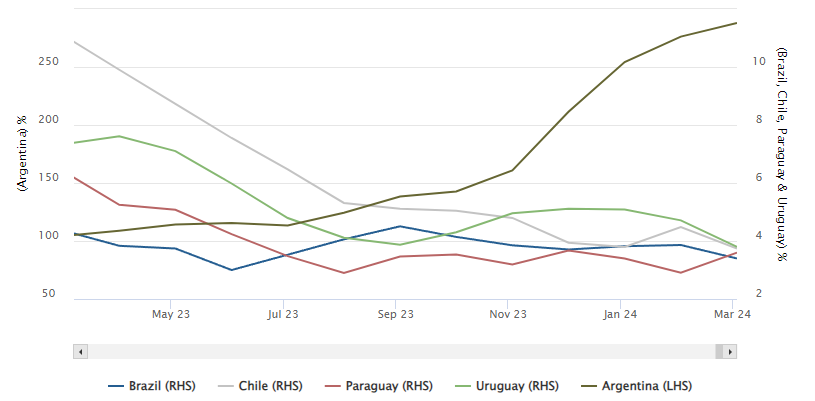
    Brazil & Southern Cone: inflation rate
    Percentage variation (year-on-year)

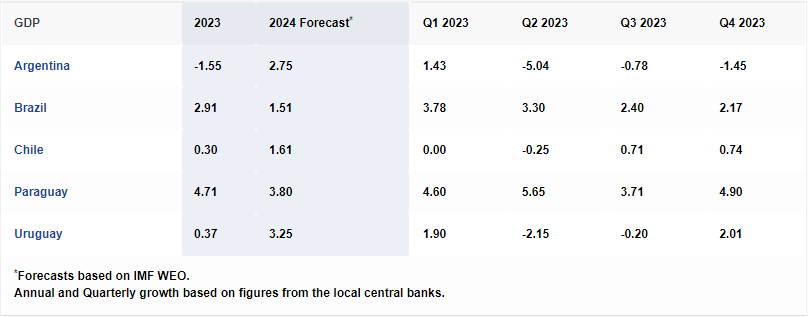
    Brazil & Southern Cone: GDP growth (%)
    Quarterly figures are year-on-year growth

  • Risk pointers

    LatinNews 06 September 2011 Hits: 270

    *** Cyprus supported by Israel and Russia.  In our 10 August issue, we noted that Turkey’s Foreign Minister Ahmet Davutoglu had warned the divided island of Cyprus against drilling for oil and gas in the Mediterranean.  He said: “We will show the appropriate reaction if any further step is taken.”  Turkey’s position is that the Greek Cypriot administration does not have the right to conduct oil and gas exploration until a government representing the whole island, including the breakaway northern Turkish element, is formed.  The Cypriot government has said it will begin drilling for hydrocarbons off the island’s southern coast on 1 October.

    We also noted that the issue forms a further bone of contention between Turkey and Israel at a time when relations between the one-time allies have deteriorated sharply.  The exploration is to take place in an 800,000 acre area bordering Israeli waters where large natural-gas finds have been made.  Greek Cyprus signed an accord with Israel last November demarcating the maritime border, but Turkey has called this agreement ‘null and void’ because it has not considered the rights of Turkish Cyprus.

    As this issue goes to press, Cypriot Foreign Minister Erato Kozakou-Marcoulis is visting Israel less than three weeks after taking office, and a Cypriot foreign ministry official says that the speed with which the new minister has arranged to visit Israel is a sign of how importantly Cyprus views support from Israel.  This is a marked reversal from 10 years ago when Greece and Cyprus were amongst the most unfriendly countries in Europe towards Israel.  The change is a direct consequence of Israel’s own falling out with Turkey.

    Separately, Cyprus has also received support from Russia in the past week over its dispute with Turkey.  On 22 August, Russian Foreign Ministry Spokesman Aleksandr Lukashevich described Cyprus’s exploration plans as being “consistent with international law and the scope of rights available to the Republic of Cyprus in accordance with the UN Convention on the Law of the Sea”.

    *** Russia’s stake in Syria.  Russian arms experts say that if international sanctions are imposed on arms supplies to Syria, it will jeopardise 10% of Russian defence industry exports. 
    Konstantin Makiyenko of the Centre for Analysis of Strategies and Technologies says: “One example is that Syria accounts for 24 out of 70 MiG-29 fighter jets which Russia’s MiG aircraft construction corporation has undertaken to supply to foreign customers, ie for one-third of the portfolio.”

    According to Makiyenko, sanctions against Iran have resulted in direct losses to the Russian aircraft and defence industries of “at least $7bn-$8bn”.

  • VENEZUELA: Sicad to debut with US$200m

    LatinNews 27 March 2013 Hits: 2196

    Venezuela’s new secondary exchange rate agency, Sistema Complementario de Administración de Divisas (Sicad), was gearing up to offer US$200m in its first auction as we went to press on 27 March. The finance ministry announced the auction just two days in advance, with little in the way of detail as to what companies/sectors could take part. Finance Minister Jorge Giordani, who has the ultimate say over this, last week warned that only companies from ‘productive’ sectors would be eligible. However, the ministry confirmed that the minimum bid rate would be BF6.30/US$1, the newly devalued official FX rate, and stipulated that bidders must put down a minimum of US$30,000 and not exceed 1% of the total auction amount (i.e. no more than US$2m).

    The Sicad replaces the recently abolished Sistema de Transacciones con Títulos en Moneda Extranjera (Sitme), which used to supply about US$40m a day in foreign exchange (mostly US dollars) to the local market. The main FX agency, Comisión de Administración de Divisas (Cadivi), supplies about US$100m a day and the (illegal) black market an estimated US$25m. The size of the initial Sicad offering may suggest that the authorities are willing to supply more currency to the local market, where acute shortages of basic goods are underpinning inflation. The black market parallel rate was still trading at BF23.4/US$1 on Monday (25 March) and BF22.86 on Tuesday, so roughly four times the official rate.

    The finance ministry announced that any profits made from the Sicad system will go towards a new special fund called the national oil profit fund, without saying exactly who would control that fund. On the assumption that the central bank (BCV) will supply US dollars at a lower rate than the official rate — local economists in Venezuela are expecting a rate of about BF10.0/US$ — the Sicad will effectively act as another devaluation, in the process generating much-needed additional fiscal revenues for the finance ministry, which is now managing a fiscal deficit of an estimated 7% of GDP (down from an estimated 11%-15% of GDP ahead of the ‘official’ devaluation in mid-February).

    Ultimately, these moves are motivated by the sheer urgency to address the distortions created by the myriad of price and exchange rate controls imposed by former president Hugo Chávez from 2003 onwards. Ahead of his bid for electoral confirmation on 14 April, Acting President Nicolás Maduro says the government is acting against “parasitic bourgeois currency speculators”. This merely dresses up with a radical rhetoric a rather orthodox solution for these distortions – their (gradual) removal.

    • US dollar bank accounts

    Simultaneously, the government also published new regulations allowing the limited use (by companies and individuals) of US dollar bank accounts in the country. Such accounts were outlawed by the late President Hugo Chávez in 2003. This was not an entirely new measure – it was first announced as ‘Exchange Convention No. 20’ back in July 2012, but until now the details (such as the required minimum opening deposit and affidavits as to the source of the funds) had not been refined by the BCV. Local banks will likely have to hold the dollars at the BCV, thereby increasing its stock of liquid international reserves. Dollar bank account holders will be able to use their funds abroad by way of ATM cards, cheques or bank transfer, and the accounts will also be eligible to earn small amounts of interest. This suggests the post-Chávez administration is moving towards a more workable local money market. When the measure was first announced in late July 2012, Armando León, a member of the BCV’s board of directors, told the state-owned Radio Nacional de Venezuela, “We want to facilitate such operations, and also it is a long-term signal for those willing to work in Venezuela”.

    • Clearout at the top of Cadivi

    Eudomar Torres, the first vice-president of the central bank, has replaced Manuel Barroso as the head of the Cadivi, the government also announced on 25 March. Barroso had held the post since 2006. Curiously, the opposition press has previously associated Barroso with the head of the national assembly, Diosdado Cabello. Torres, a technocrat, is an economics graduate from the University of Carabobo and has a couple of MAs from the University of Venezuela (in economics, finance and political economy); while also a specialist on customs and external trade. Another economist, José Salamat Khan, has been appointed Cadivi vice-president. Khan has links to the unions and is considered close to President Maduro. Coincidence or not, the attorney general’s office the next day announced a major investigation into the illegal trafficking of currency in the country.

  • COSTA RICA: Left-wing parties form pact to defend political agenda

    LatinNews 08 July 2015 Hits: 2466

    In late June, the leaders of the ruling Partido Acción Ciudadana (PAC), the Frente Amplio (FA) party and the trade union umbrella group, Patria Justa, signed an agreement entitled: “The Patriotic Agenda for the Common Good”.

    The document sets out shared objectives on public sector jobs and pay, as well as their opposition to further private sector involvement in the energy sector and support for granting the Costa Rican tax office the power to seize goods and freeze bank accounts without recourse to a judge. While the agenda is broadly consonant with the government’s aims, there are some differences. President Luís Guillermo Solís has said he is “neither for not against” the new alliance.

    Costa Rica is expecting to post a fiscal deficit this year of 6.7%. To try to bring this under control, the government is trying to increase its tax take, by fighting fraud and tax evasion, transforming the current sales tax into a value-added tax, modifying income tax and ending some fiscal exemptions. It is also looking at ways to reduce spending, with one of the ideas mooted being the reduction in bonuses paid to public sector employees. However, given the weakness of the executive’s representation in congress, with the PAC controlling only 13 of the 57 seats in congress, it is limited in its freedom to govern.

    The signatories to the agenda are firmly supportive of the government’s initial plans to strengthen the power of the tax office. This may help strengthen the finance ministry’s hand as it is currently developing a new deal on this issue following opposition from the Partido Liberación Nacional (PLN) and the Partido Unidad Social Cristiana (PUSC). The signatories also support the government’s plans to reduce the number of industries benefiting from tax breaks. However, elsewhere there are big differences, with the new grouping declaring itself opposed to a bill on public employment which would reduce salary benefits and another bill on electricity generation which would increase the permitted participation of private sector companies in energy projects from 15% to 30%.

    • Recent drug hauls point to rising trend

    US and Costa Rican coast guard agents seized more than one tonne (t) of cocaine from two Costa Rican fishing vessels on 23 June. Both boats were stopped off the country’s Pacific Coast, close to the border with Panama. It follows another major seizure of cocaine on 9 June in waters near the small town of Golfito, also on Costa Rica’s South Pacific coast.

    According to the US State Department’s International Narcotics Control Strategy Report, released in March 2015, cocaine seizures increased by more than 30% in Costa Rica over the first nine months of 2014 from the same period of 2013, to nearly 26t. This is in line with long term trends: between 2000 and 2005, Costa Rican authorities seized an average of five tonnes a year; between 2005 and 2012, that average rose to 17t. In 2013 as a whole, Costa Rica seized 20t of the drug, according to the United Nations Office on Drugs and Crime (UNODC). A 2012 report by the Organization of American States (OAS) found that Costa Rica’s per capita cocaine use is double that of Brazil’s, the world’s second-largest consumer market.

    Costa Rica is widely believed to be increasing in importance as a transit route for drugs for both Mexican cartels and ‘maras’, Central American street gangs. A recent report by Costa Rica’s judicial investigation body (OIJ), shows that the country is also hosting a steadily increasing number of gang members from the Northern Triangle of Honduras, El Salvador and Guatemala. Though their number and impact is still relatively trivial when compared to their countries of origin, the OIJ report suggest their presence is starting to spur the growth of well-armed local gangs. An uptick in violence in Costa Rica last year was attributed to a battle for distribution routes among local criminal organisations.

    • Miss Universe to miss Costa Rica

    On 1 July the Costa Rican broadcaster Teletica announced that it would not be sending the winner of its Miss Costa Rica contest to participate in the Miss Universe contest due to the xenophobic comments of the competition’s part owner, US business tycoon, Donald Trump. In the announcement of his bid to run for the US presidency, Trump declared that Mexican immigrants to the US were “bringing drugs, bringing crime. […] They’re rapists”.

  • In brief: New plan for Pemex in Mexico

    LatinNews 17 July 2019 Hits: 607

    * The general director of Mexico’s state-owned oil company Petróleos Mexicanos (Pemex), Octavio Romero, has unveiled a new business plan for 2019-2023 to address the company’s high tax burden, debt and low investment, focusing on low-cost and easy to access on-shore and shallow water fields. Romero has vowed that the plan will raise Pemex's production and improve its financial balance for 2021. He states that the main objective is to get the federal government to support Pemex in the first three years in the transition process, “so that later it will be Pemex which supports the government to finance the development and economic growth of the country”. He announced that a fiscal benefit in the payment of oil production rights should generate some M$30bn (US$1.57bn) for the company this year. He added that the federal government also plans to reduce Pemex’s taxes and duties by seven percentage points in 2020 and four percentage points in 2021, bringing its current tax rate of 65% down to 54% in 2021. The announcement of the new plan failed to reassure the markets however; on 16 July the peso fell by 0.4%.

  • ECUADOR: Noboa’s popularity masks problems

    Abbi Dicker 07 March 2024 Hits: 3904

    Not since Ecuador’s return to democracy in 1979 has a head of state enjoyed the level of popularity of President Daniel Noboa. According to a survey published by the local pollster Cedatos on 29 February, Noboa’s approval rating stands at 81.4%. The poll’s publication coincided with the completion of Noboa’s first 100 days in power. While this is traditionally a honeymoon period, during which new presidents are given the benefit of the doubt, such resounding support is unprecedented and was underscored by a figure showing 75.6% of respondents trust in Noboa’s word.

    It is a sign of just how desperate the public has grown with spiralling insecurity and violence that the respite provided by his hard-line security policies was sufficient to see his popularity soar. Other heads of state in the region facing significant insecurity problems associated with organised crime and drug trafficking will be taking note and weighing up the benefits of pursuing the model of El Salvador’s President Nayib Bukele. But it will not be long before the Ecuadorean public starts demanding solutions to other exigent problems, especially economic.

    At present, however, the overriding public concern in Ecuador is insecurity, violence, crime, and drug trafficking. These were cited as the most serious problems in the country by 49% of respondents in the Cedatos poll. An improved security situation will buy Noboa time but when it begins to be considered the norm, economic issues, such as reducing the fiscal deficit, reactivating the economy, and boosting job creation will come back to the fore.

    It was noteworthy that 20% of respondents cited unemployment and the lack of jobs and 14% the state of the economy as the most serious problems currently facing the country. Improving security will of course help the economy to no small extent. Mónica Heller, the president of the Quito chamber of commerce, said this week, for instance, that in January 25% of businesses reported being victims of extortion but this figure fell to 15% in February. Rampant insecurity also tends to act as a brake on much-needed investment to boost economic growth; country risk has fallen from 2,055 points at the start of the year to 1,321 points now, the central bank (BCE) reported this week.

    The improvement on the security front means the population is likely to be more tolerant of otherwise unpopular measures such as a planned increase in value added tax (VAT), up from 12% to 15% in April, in large part to fund heightened security spending, for now. This increase is being sold by the government as temporary but with a yawning fiscal deficit to close the temptation to retain it indefinitely will be strong.

    If the government proceeds with its plans to re-introduce hourly-paid casual labour contracts, it will meet opposition from trade union movements. Noboa should be able to get away with it given his current level of popularity but even he is steering clear of the politically sensitive issue of fuel subsidies given the violent protests that followed attempts to reduce them under previous governments.

    Human rights

    President Noboa is unlikely to face large-scale protests in defence of human rights in Ecuador. But representatives of various civil society groups gathered on 5 March to denounce human rights abuses associated with the security crackdown. Nadia Rivadeneira, of the Mujeres de Frente collective, criticised the “Bukelization” of the prevailing security discourse, taking issue with Noboa’s recent description of critics of human rights abuses associated with the crackdown as “unpatriotic”.

    Mining

    Another potential source of conflict President Noboa could face is over mining projects. On 6 March Jaime Palomino, the president of the indigenous Shuar-Arutam, accused the Noboa administration of negotiating a mining project with the Canadian firm Solaris Resource without prior consultation. Palomino said the Shuar-Arutam were opposed to the Warintza porphyry copper-gold-molybdenum project in the south-eastern province of Morona Santiago.

    Solaris Resources reported on 1 March the signing of a “cooperation agreement between the Interprovincial Federation of Shuar Centres and the Alliance for Entrepreneurship and Innovation of Ecuador”. Palomino said this “seeks to make people believe that these are agreements endorsed by all of the Shuar centres, ignoring and minimizing once again the position of the Shuar Arutam people who reject this mining project and the company”.

    The president of the umbrella Confederación de Nacionalidades Indígenas del Ecuador (Conaie), Leonidas Iza, said he would back any indigenous group opposing mining projects in Ecuador as “the mining experience has brought nothing but poverty and desolation”. Iza also questioned the intentions behind the government’s efforts to secure a free trade agreement (FTA) with Canada, insinuating that Noboa’s main motivation was benefiting the Grupo Noboa conglomerate.

    The government, which announced its intent to initiate FTA negotiations with Canada last December, has highlighted the need to attract foreign investment, and Canada is the largest foreign investor in Ecuador, with investments valued at US$2.6bn in 2022.

  • TRACKING TRENDS

    Patrick de Courcy 05 December 2024 Hits: 1515

    EL SALVADOR | Moody’s upgrade. The international credit ratings agency Moody’s has upgraded the government of El Salvador’s long-term foreign currency issuer and senior unsecured ratings to B3 from Caa1 with a stable outlook.

    Moody’s attributes the upgrade to its ratings to its view that El Salvador’s credit profile has “benefited from recent liability management operations that have significantly reduced external amortisations leading to a material decrease in repayment risk and alleviating near and medium-term liquidity pressures”.

    It cites as examples the fact that on 16 October the government led by President Nayib Bukele bought back a portion of its 2027, 2029, 2034, 2035, 2041, 2050, and 2052 global bond, expending US$922m to repurchase US$1.03bn in par value bonds and achieving a savings of US$109m [WR-24-41]. It also cites the government’s announcement of a new liability management operation on 12 November that closed on 18 November (with final settlement on 25 November).

    Moody’s notes that this was “financed by the issuance of a US$1bn global bond, with US$243m of proceeds going to repurchase outstanding bonds and the other remainder for general budgetary purposes”.

    It also highlights that the non-financial public sector (NFPS) dropped to 2.3% of GDP in 2023, its lowest level since 2007, down from 2.6% in 2022, and forecasts that this will remain unchanged in 2024.

  • TRACKING TRENDS

    Abbi Dicker 02 April 2026 Hits: 937

    COLOMBIA | Petro rails against interest rate hike. Colombia’s central bank raised its benchmark interest rate by 100 basis points to 11.25% on 31 March, warning that the war in the Middle East is expected to drive up inflation. Inflation was running at an annual rate of 5.3% in February and the central bank expects it to hit 6.3% by the end of the year – more than double the 3.0% target rate. This was the second consecutive interest rate hike after a previous 100-basis-point increase in February.

    The government was furious at the decision, with Finance Minister Germán Ávila Plazas storming out of a meeting with the central bank’s directors on 31 March. President Petro accused the bank of “killing the Colombian economy” and of being “in opposition” to his government.

  • PARAGUAY: Cartes carves out lead

    LatinNews 27 March 2013 Hits: 1224

    Horacio Cartes, the presidential candidate for the Asociación Nacional Republicana-Partido Colorado (ANR-PC), is opening up a lead ahead of general elections on 21 April, although opinion polls differ dramatically over the margin of this lead. His main rival Efraín Alegre, who is running for the ruling Partido Liberal Radical Auténtico (PLRA), intensified his attacks on Cartes during the latest televised debate, which covered issues ranging from health and education to combating poverty and protecting the environment.

    One poll by Gabinete de Estudios de Opiniόn (GEO), published in the national daily Ultima Hora, gave Cartes the narrowest of leads over Alegre (36.8%-35.6%), while another poll by Grau & Asociados, published in the same paper, gave Cartes a commanding lead of 42.7% to 29.2%. The GEO survey was conducted a week earlier (6-15 March as opposed to 13-21 March for the Grau poll), but it seems unlikely that Cartes should have surged ahead to such an extent in that time. Both polls were in broad agreement that Mario Ferreiro, a television presenter running for the left-wing coalition Avanza País, was in a distant third place on less than 10% of voter support.

    Despite the unreliability of the polls, trends since the start of the year suggest that Cartes is ahead of Alegre, prompting the latter to become more rhetorically aggressive. After Cartes promised during the debate to increase the health budget from US$800m to US$3bn by 2018 to ensure that “health reaches every corner of Paraguay”, by means of mobile clinics, Alegre responded by questioning “What health is it you are talking about if your business is killing people… your business is illness?” This was an allusion to the tobacco and alcohol companies owned by Cartes. Alegre was, surprisingly, less belligerent when it came to taking Cartes to task for how he was going to fund his proposal for an enormous increase in the health budget.

    • Combating poverty

    Horacio Cartes presented more proposals than his rival Efraín Alegre during the televised debate, although he was not always entirely clear on how they would be financed. He said that the budget to combat poverty had increased by 377% between 2008 and 2012 but that poverty had not fallen by “a single digit”. He criticised current anti-poverty programmes, and argued that it was necessary “to teach people how to fish rather than give them fish”. He also promised to invest US$1.3bn over the five-year presidential term to guarantee drinking water for 75% of households and sewage for 55%.

  • BRAZIL: The rise of Kroton

    LatinNews 28 November 2014 Hits: 496

    The Brazilian stock exchange was underwhelmed by the re-election of Dilma Rousseff to another four-year term in office at the end of October. Notoriously, the prices of most shares took a tumble. But the share prices of one company, Kroton, kept motoring ahead. Through mergers and acquisitions as well as organic growth, this Brazilian enterprise has grown to become the largest private education company in the world (measured by total asset value).

    One way of ensuring sustained growth is to be connected to an underlying social or demographic trend. Kroton can make that claim. In its case, the trend is the sustained growth of the Brazilian middle class and its increasing demands for education. “The Brazilian education market is divided into two completely opposed halves” says Kroton president Rodrigo Galindo. “On the one hand public primary and secondary education has a reputation for poor quality. On the other, public higher education is considered excellent”. Parents and students are prepared to pay a large proportion of their incomes to gain access to university and vocational education. In 2012, only 15.4% of Brazilian students aged 18-24 went to university. The government wants to get that proportion up to 33% by 2024, and to do so is offering students low interest loans and scholarships through loan programmes such as Fies (higher education), Prouni (known as ‘university for everyone’) and Pronatec (vocational and technical). Kroton wants to make sure a lot of that money gets spent on its courses.

    The company was launched in 1966 in Belo Horizonte (initially using the name Pitágoras) as a small operation specialised in preparing students to sit the public university entrance exams. In 2009, a US investment fund, Advent, bought a 28% stake in Kroton and helped it begin a merger and acquisitions campaign. Kroton to date has taken over no less than 25 other education companies - the largest acquisition came this year, when it took over Anhanguera Educacional, a distance learning and vocational training specialist. Galindo himself started out in Unic, a small company based in Matto Grosso. “Just to survive, we had already started a process of modernisation and professionalisation at Unic: what we did was take that learning process to the rest of the company” he says.

    Now Kroton says it has 130 campus sites in 19 of Brazil’s 27 states. It has over 1.5m signed-up students. In 2014, it is predicting revenue of BRL4.7bn (US$1.72bn). Profits in 2013 (before the incorporation of Anhanguera) were BRL157m (US$60.3m). Third quarter 2014 profits have just been announced at BRL213m (US$81.8m), double the year-ago level. Kroton’s market capitalisation is just under BRL25bn (US$9.6bn), making it the largest private education operator in the world, ahead of Graham Holdings of the US (the group that owns education company Kaplan).

    Galindo says he is expecting revenue growth of around 10% per annum in higher education enrolments, whether face-to-face or in distance learning. This should be achieved even if Brazil continues experiencing sluggish growth. “The worst macroeconomic scenario for us is rising unemployment and increasing arrears on fee payments, but even in that eventuality our industry is going to be less badly affected than other sectors. Education is one of the last things people want to cut back. In 2015 there’ll be fiscal austerity, but in 2016 we expect things to improve. And then there is government support for education. Paying off a subsidised government education loan at BRL17 (US$6.52) a month is a lot better than paying BRL700 (US$268) a month in full student fees”.

  • TRACKING TRENDS

    LatinNews 09 March 2017 Hits: 640

    PARAGUAY | GDP growth exceeds forecast. On 8 March Paraguay’s central bank (BCP) released its latest economic figures, which show that the domestic economy posted a growth rate of 4.1% in 2016.

    The 2016 GDP growth result is marginally higher than the BCP’s forecast of 4%. It confirms that Paraguay’s economy continues to exhibit resilient growth despite an adverse international economic scenario in which Paraguay’s main trading partners in the region (Argentina and Brazil) continue to struggle economically.

    The better-than-expected performance of the Paraguayan economy suggests that not only has it been able to avoid any economic contagion effects from its neighbours but it has also succeeded in conjuring broad-based growth despite lower regional demand for its goods.

    According to a BCP report covering the last quarter of 2016, economic activity in that period increased by 3.4% year-on-year, taking the cumulative growth rate to 4.1%. The sectors that registered the highest growth levels were construction, in which activity increased by 18.6%; electricity generation (12.6%); manufacturing and mining (5.3%); forestry and fishing (4.1%); and agriculture (2.6%).

    The performance of the construction sector suggests that investor confidence in the country remains high, while the notable increase in electricity generation activity has been attributed to the hot Southern Hemisphere summer, which this year has produced record-high temperatures not just in Paraguay but also in Brazil and Argentina, with which Paraguay shares two major hydroelectric plants – Itaipú and Yacyretá respectively – and to whom it sells its surplus electricity.

    But perhaps the solid performance of the manufacturing and mining sector is the most encouraging, given that Paraguay’s economy remains largely dependent on the agricultural sector and one of its challenges is to move away gradually from this dependence and towards greater industrialisation. It appears that this might finally be occurring, with reports in Brazilian media recently highlighting that some 78 Brazilian manufacturing firms have decided to move their operations to Paraguay since 2014 to take advantage of the more positive tax and general economic environment.

    Meanwhile Paraguay’s industry & trade minister, Gustavo Leite, has recently said that some “world leading” manufacturers from Brazil, Spain, Italy and the US have recently expressed an interest in setting up operations in Paraguay after conducting “preliminary studies”.

  • TRACKING TRENDS

    Patrick de Courcy 11 May 2023 Hits: 3087

    COLOMBIA | Inflation. There are signs that inflation might have peaked in Colombia and is very slowly starting to fall. Inflation reached 0.78% in April, taking annualised inflation to 12.82%, the national statistics institute (Dane) reported on 5 May. While inflation for transport (1.28%) and accommodation, water, electricity, and gas (1.15%) was up in April, food inflation, the main driver of inflation in recent months, finally declined (-0.07%).

    In the first four months of the year inflation stands at 5.38%, slightly lower than the 5.66% for the same period in 2022.

  • ECONOMIC HIGHLIGHTS

    Abbi Dicker 15 November 2024 Hits: 1232

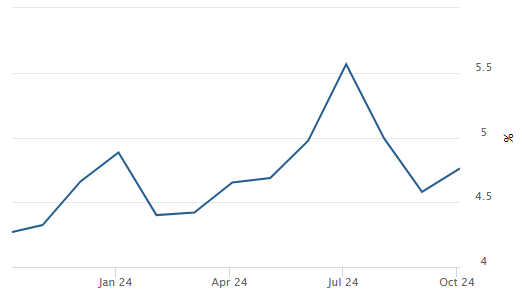
    MEXICO | Headline inflation up while core rate slows. On 7 November Mexico’s national statistics institute (Inegi) released the consumer price index for October, showing monthly inflation of 0.55%, up from 0.05% in September. Annual inflation in October stood at 4.76%, up from 4.58% in September. The core inflation rate, which excludes volatile items, was 0.28% in monthly terms, remaining the same as in September. In annual terms, the core rate was 3.80%, down from 3.91% in September.

    MEXICO | GFCF drops. On 4 November Mexico’s national statistics institute (Inegi) reported that gross fixed capital formation (GFCF) dropped by 0.9% in August 2024 in annual terms and 1.9% in monthly terms. The monthly drop in August was driven by a 4.0% decrease in investment in construction, while investment in machinery and equipment grew by 0.6%. In yearly terms, investment in construction decreased by 6.0%, however investment in machinery and equipment was up by 5.0%.

    MEXICO | Remittances up. Mexico’s central bank (Banxico) released new figures on 1 November showing that remittances to the country totalled US$5.36bn in September, up 4.6% year-on-year but down 7.5% compared with August. The cumulative total of remittances from January to September this year reached US$48.39bn, a 2.8% rise from the same period in 2023.

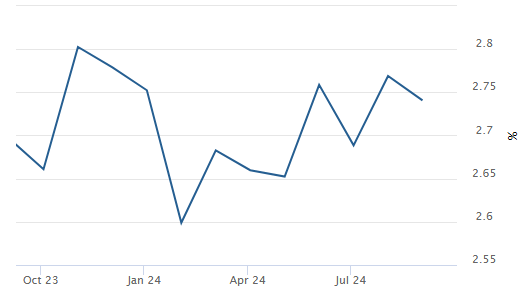
    MEXICO | Unemployment rate remains stable. Mexico’s national statistics institute (Inegi) published figures on 1 November showing that the unemployment rate of the economically active population was 2.9% in September, equating to 1.8m people, up 38,000 compared to September 2023. In seasonally adjusted monthly terms, the unemployment rate remained the same as compared with August.

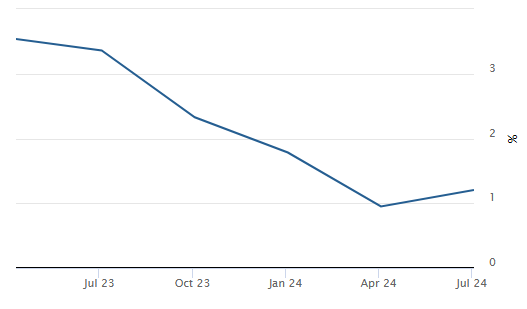
    Mexico: GDP growth
    Percentage variation (year-on-year)

    Mexico: unemployment rate
    Economically active population

    Mexico: inflation rate
    Percentage variation (year-on-year)

    Source (all graphs): National Statistics Institute (Inegi)

  • TRACKING TRENDS

    Abbi Dicker 15 May 2025 Hits: 2109

    BRAZIL | Coffee exports down. The national council of coffee exporters (Cecafé) released its latest monthly report on 12 May, which showed that national exports totalled 3.09m sacks of coffee (one sack = 60kg) in April. This marks a 27.7% decrease from the 4.28m sacks exported in April last year. Arabica coffee exports in April stood at 2.68m sacks, down 17.4% year-on-year, while robusta exports came to 103,577 sacks, down 84.9% compared with the same month last year.

    The Cecafé report also included export figures for January-April 2025, showing a total of 13.8m sacks exported, which is down 15.5% from the first four months of 2024. However, Cecafé still expects the 2024-2025 harvest cycle to post strong results. It highlighted that April is the tenth month of the cycle, and exports for July 2024-April 2025 totalled 39.99m sacks, up 1.5% from the first 10 months of the 2023-2024 cycle.


    BRAZIL | JBS posts higher profit. Meatpacking company JBS released its earnings results for the first quarter of 2025 on 13 May, showing a net profit of R$2.92bn (US$519m). This marks a 21.2% increase from the R$2.41bn profit registered for the final quarter of 2024 and a 77.6% rise from the net profit of R$1.65bn in the first quarter of 2024. The company’s earnings before tax, interest, depreciation, and amortisation (Ebitda) in the first quarter showed a decrease of 17.2% to R$8.93bn on the previous quarter but a year-on-year increase of 38.9% from the R$6.43bn registered in the first quarter of 2024.


    BRAZIL | Trade surplus down year-on-year in April. The ministry of development, industry, trade, and services (MDIC) reported on 7 May that the country’s trade surplus for April came to US$8.15bn, down 3.3% from the surplus registered in April 2024. Exports in April this year totalled US$30.4bn, up 0.3% year-on-year, while imports totalled US$22.3bn, up 1.6%. Monthly exports for agricultural products came to US$7.99bn (-0.7%) and extractive industries registered an export value of US$7.19bn (-3.8%). Meanwhile, manufacturing exports posted a year-on-year rise of 2.4%, with a monthly export value of US$15.04bn in April 2025.

  • RASTREANDO TENDENCIAS

    LatinNews 16 January 2012 Hits: 746

    BRASIL | Oro negro. Las vastas reservas de petróleo en aguas profundas de Brasil es la mejor apuesta para el futuro. La compañía petrolera estatal Petrobrás intenta invertir más de US$1,0 trillones  para alcanzar la meta trazada de llegar a un nivel de producción petrolera de 6,0m de barriles por día (bpd) para 2020. De acuerdo con la agencia nacional del petróleo (ANP), la producción total de hidrocarburos de Brasil alcanzó un record equivalente a 2,615m bpd de petróleo en noviembre de 2011. La producción de petróleo en sí misma fue de 2,188m bpd. La producción de petróleo de Venezuela está en alrededor de 2,9m bpd y apunta a producir 4,0m bpd para el año 2016.

    CHILE | Las exportaciones llegan a nivel record. En el 2011, las exportaciones de Chile alcanzaron un nivel record de US$80,59bn, un13,5%  más que el año anterior. Sin embargo, las importaciones treparon con mayor rapidez aún para llegar a US$69,97bn, subiendo 26,8% sobre el año previo, impulsadas por la demanda interna y las inversiones. Como resultado el superávit comercial de Chile descendió de US$15,86bn en 2010, a US$10,62bn el año pasado. El banco central predice que el superávit comercial se contraerá a US$4,8bn en 2012, con una disminución en los  valores de las exportaciones gracias a la caída en el precio del cobre debido al pobre panorama económico global. El superávit comercial en diciembre, por ejemplo, fue de solamente US$393m las exportaciones cayeron un 17,3% a US$6,31bn y las importaciones crecieron en 14,3% a US$5,92bn.

    La inflación en 2011 llegó a 4,4%, más alto de lo pronosticado, aunque el ministro de finanzas, Felipe Larraín, sostuvo que descendería significativamente en los meses próximos. La meta del banco central para los próximos 24 meses es entre 2% y 4%. Larraín dijo que la caída del precio del cobre se debe al hecho que “la mayoría de los países europeos están en recesión”.

    URUGUAY | Aún escurriéndose. La inflación llegó a 8,6% en 2011, informó el instituto nacional de estadísticas de Uruguay, Ine. Esta cifra excede la meta de 6% establecida por el gobierno y sobrepasó la inflación de 6,9% en 2010. El Presidente José Mujica, quien el año pasado describió a la inflación como “una anguila escurridiza”, dijo que lo cifra “no era desastrosa” pero que reducirla era una prioridad de su gobierno. En el lado positivo, el desempleo fue de 5,5% en noviembre, cayendo de 5,7% el mes anterior y cerca del nivel de diciembre de 2010, de 5,4%, el más bajo nivel en décadas. Menos de 100.000 uruguayos en edad de trabajar, principalmente mujeres y jóvenes, están desempleados.

  • REGION: Differing visions for English-speaking Caribbean

    LatinNews 07 March 2012 Hits: 1960

    The signing up of three English-speaking Caribbean nations to the 4 February declaration of the radical Venezuela-led integration bloc Alianza Bolivariana para los Pueblos de Nuestra América (Alba) banning ships flying the Falklands flag from docking in their ports may have caught the headlines, but it was symptomatic of a wider malaise about the orientation of the English-speaking Caribbean that the Caricom (Caribbean Community) 8-9 March heads of government meeting in Suriname is hoping to address.

    There was some shock in the Caribbean that Dominica, Antigua & Barbuda, and St Vincent & the Grenadines signed up to the Alba declaration. The eight-nation grouping includes the three small Caribbean island states plus Venezuela, Bolivia, Ecuador, Nicaragua, and Cuba. The Alba declaration ended by saying that member states “support the decision made by the countries of the region to ban ships with the colonial flag imposed on the Malvinas [Falklands] from entering their ports”.

    The first of the Caribbean trio to back away from the statement was Antigua & Barbuda, which issued a statement on 8 February saying: “Antigua & Barbuda has never supported any call for the banning of flagships from any country in the region and therefore disassociates itself from any statement regarding the banning of ships carrying the flag of the Falklands (Malvinas) from entering our ports.”

    Prime Minister Ralph Gonsalves of St Vincent & the Grenadines was somewhat less straightforward in his denial, saying that his support for the declaration was “largely a symbolic gesture” as “we don’t have ships from the Falklands coming to St Vincent”.

    Dominica’s Prime Minister Roosevelt Skerrit adopted a position somewhere between Antigua and St Vincent. On returning from the Alba summit he simply said that he wasn’t worried about the banning of ships point as there were no Falkland Island ships calling at Dominica. However, the government then hardened its denial, saying that it “has not granted its support to any call for the region to ban ships with the colonial flag imposed on the Malvinas from entering its ports, as stated in the said declaration”.

    In another indication of distancing by the Caribbean trio from Alba, Skerrit has also said that they will not deposit reserves in Alba’s development bank, despite an Alba agreement for members to deposit 1% of their international reserves into a development bank. According to Skerrit: “What we have indicated to our friends in Alba is that countries like Dominica, St Vincent, and Antigua cannot participate in the arrangement because our monetary policy is governed by the monetary council of the Eastern Caribbean Central Bank.” He also said that the three would not participate in the sucre, the currency Alba members have said that they will use for trade amongst themselves.

    Just after these signs of backtracking, on 17 February, Grenada’s Prime Minister Tillman Thomas indicated that his country’s associate status of Alba is unlikely to lead to much more. He told a press conference in Toronto that Caribbean leaders should concentrate more on the Caricom than Alba, and (in a clear dig at those taking Venezuelan money) he said that a nation with strong values is more important than money.

    The Caricom point is an important one. There is talk of a “crisis” within Caricom, and signs that Alba’s pull on member states might be diminishing, or at least not increasing, will be welcome. Three Caricom members signing up to the Alba declaration on the Falklands, for instance, goes against the treaty obligation under which Caricom member states are obliged to co-ordinate their foreign-policy positions. And when the foreign ministers of the 15 Caricom member nations gathered at the United Kingdom-Caribbean Forum in Grenada in January they agreed to “support the principle and the right to self-determination of all peoples, including the Falkland Islanders, recognizing the historical importance of self-determination in the political development of the Caribbean”.

    The upcoming Caricom meeting will review an internal report on the group entitled: “Turning around Caricom: Proposals to restructure the Secretariat.” According to some sources, the crisis within Caricom is sufficiently severe to bring the organization’s existence into question. Organizational problems, slow progress on its objectives, and a lack of funding seem to be the main problems. The study on Caricom’s future warns that “Caricom could expire slowly over the next few years as stakeholders begin to vote with their feet.”

    One of the most outspoken critics of Caricom’s performance has been Prime Minister Ralph Gonsalves of St Vincent. He has written to Caricom’s Secretary-General Irwin LaRocque warning about the “inbuilt lethargy in our collective political leadership”. He called on Caricom’s heads of government “to move resolutely beyond minimalism in integration, which inexorably leads to regression”, and he warned that talk of “pausing” is “a euphemism for standing still, which, in a dynamic world, is sliding backwards”.